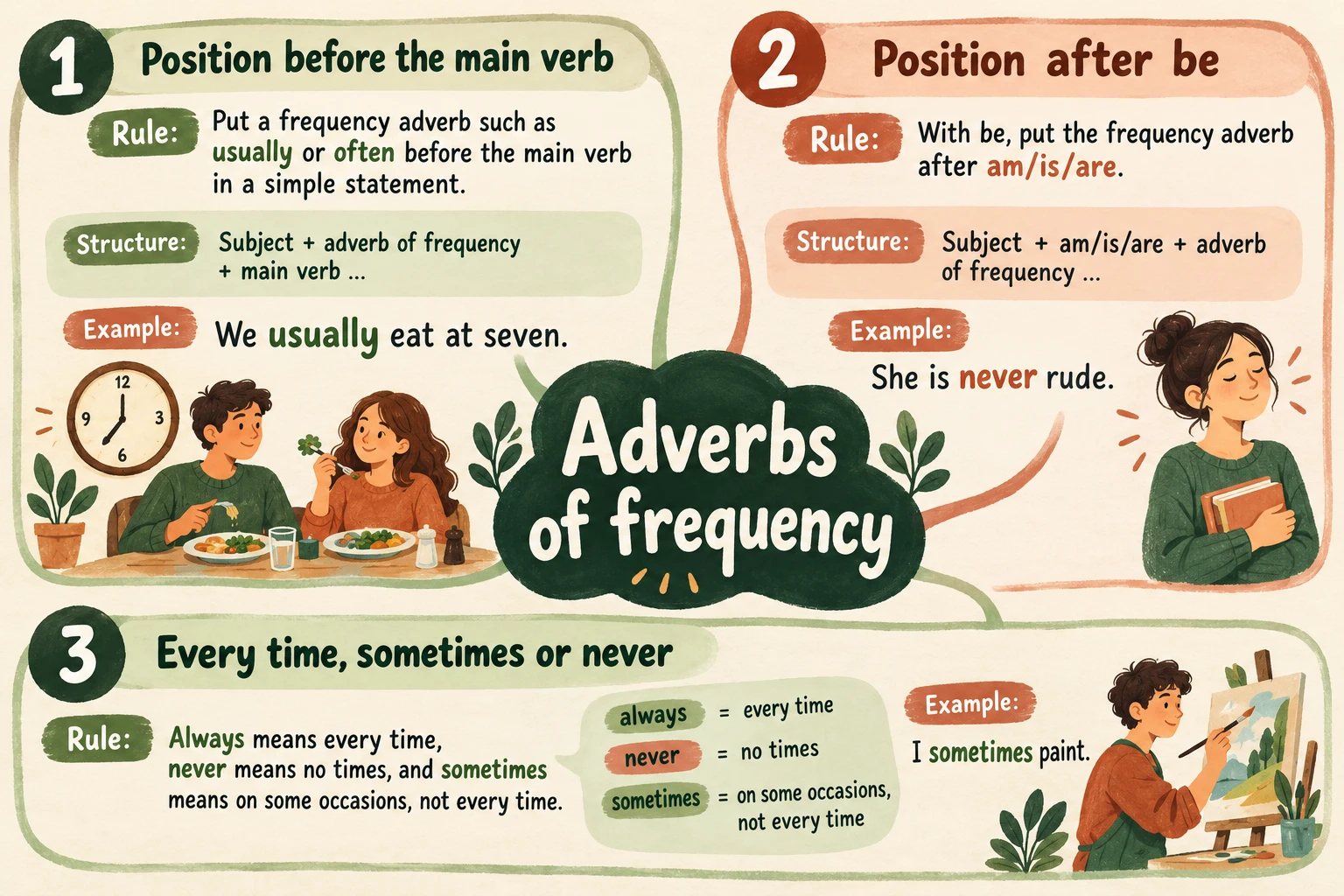
01Position vor dem Vollverb
Usually oder often steht im Aussagesatz vor dem Vollverb.
We usually eat at seven.
Häufigkeitsadverbien · A1. Usually oder often steht im Aussagesatz vor dem Vollverb.
Übe Häufigkeitsadverbien in kurzen Situationen. Lies den Hinweis, wähle oder schreibe eine Form und prüfe die Begründung. Die Stufe dient der redaktionellen Orientierung.
Usually oder often steht im Aussagesatz vor dem Vollverb.
We usually eat at seven.Bei be steht das Häufigkeitsadverb nach am/is/are.
She is never rude.Always heißt jedes Mal, never kein einziges Mal und sometimes gelegentlich.
I sometimes paint.
Choose the normal word order: I ___ before breakfast.
Usually oder often steht im Aussagesatz vor dem Vollverb.
We usually eat at seven.Bei be steht das Häufigkeitsadverb nach am/is/are.
She is never rude.Always heißt jedes Mal, never kein einziges Mal und sometimes gelegentlich.
I sometimes paint.Bewahre den ersten Versuch. Verstehe die Änderung. Prüfe sie in einer neuen Situation.
Noch keine Lernnotizen. Starte mit einem kurzen Einstieg.
Usually oder often steht im Aussagesatz vor dem Vollverb.
We usually eat at seven.Bei be steht das Häufigkeitsadverb nach am/is/are.
She is never rude.Always heißt jedes Mal, never kein einziges Mal und sometimes gelegentlich.
I sometimes paint.Das Öffnen einer Antwort wird für diese Aufgabe als Hilfe erfasst.
Choose the normal word order: I ___ before breakfast.
Achte auf „Choose the normal word order: I ___ before breakfast.“. Usually oder often steht im Aussagesatz vor dem Vollverb. Vollständiger Satz: „Choose the normal word order: I usually shower before breakfast.“.
Complete the sentence: Sam ___ often early for class.
Achte auf „Complete the sentence: Sam ___ often early for class.“. Bei be steht das Häufigkeitsadverb nach am/is/are. Vollständiger Satz: „Complete the sentence: Sam is often early for class.“.
Ted takes the bus every single day. He ___ takes the bus.
Achte auf „Ted takes the bus every single day. He ___ takes the bus.“. Always heißt jedes Mal, never kein einziges Mal und sometimes gelegentlich. Vollständiger Satz: „Ted takes the bus every single day. He always takes the bus.“.
Complete the normal order: We ___ cook together on Fridays. (usually)
Vollständiger Beispielsatz: „Complete the normal order: We usually cook together on Fridays. (usually)“. Usually oder often steht im Aussagesatz vor dem Vollverb.
Complete the normal order: My keys are ___ in this drawer. (usually)
Achte auf „Complete the normal order: My keys are ___ in this drawer. (usually)“. Bei be steht das Häufigkeitsadverb nach am/is/are. Vollständiger Satz: „Complete the normal order: My keys are usually in this drawer. (usually)“.
I have not eaten meat at any time in my life. I ___ eat meat.
Achte auf „I have not eaten meat at any time in my life. I ___ eat meat.“. Always heißt jedes Mal, never kein einziges Mal und sometimes gelegentlich. Vollständiger Satz: „I have not eaten meat at any time in my life. I never eat meat.“.
Complete the normal order: Ana ___ walks to school. (often)
Vollständiger Beispielsatz: „Complete the normal order: Ana often walks to school. (often)“. Usually oder often steht im Aussagesatz vor dem Vollverb.
Choose the normal word order: Our neighbours ___ after lunch.
Achte auf „Choose the normal word order: Our neighbours ___ after lunch.“. Usually oder often steht im Aussagesatz vor dem Vollverb. Vollständiger Satz: „Choose the normal word order: Our neighbours often walk after lunch.“.
Choose the normal word order: The train ___ on Mondays.
Achte auf „Choose the normal word order: The train ___ on Mondays.“. Bei be steht das Häufigkeitsadverb nach am/is/are. Vollständiger Satz: „Choose the normal word order: The train is usually crowded on Mondays.“.
Only on some evenings, not every evening, we watch a film. We ___ watch films.
Vollständiger Beispielsatz: „Only on some evenings, not every evening, we watch a film. We sometimes watch films.“. Always heißt jedes Mal, never kein einziges Mal und sometimes gelegentlich.
Complete the normal order: I am ___ tired after swimming. (often)
Achte auf „Complete the normal order: I am ___ tired after swimming. (often)“. Bei be steht das Häufigkeitsadverb nach am/is/are. Vollständiger Satz: „Complete the normal order: I am often tired after swimming. (often)“.
Our team has won every match this season. So far, it has ___ won.
Vollständiger Beispielsatz: „Our team has won every match this season. So far, it has always won.“. Always heißt jedes Mal, never kein einziges Mal und sometimes gelegentlich. In dieser Aufgabe sind auch diese Formen geprüft: consistently / invariably. Die Liste ist nicht vollständig.