01A devant un son consonne
Emploie a devant un son consonne avec un nom dénombrable singulier. Le son compte : a university commence par /j/.
A doctor lives here.
A, an et the · A1. Emploie a devant un son consonne avec un nom dénombrable singulier. Le son compte : a university commence par /j/.
Travaille A, an et the dans de courtes situations. Lis l’indice, choisis ou écris une forme, puis vérifie l’explication. Le niveau est une indication éditoriale.
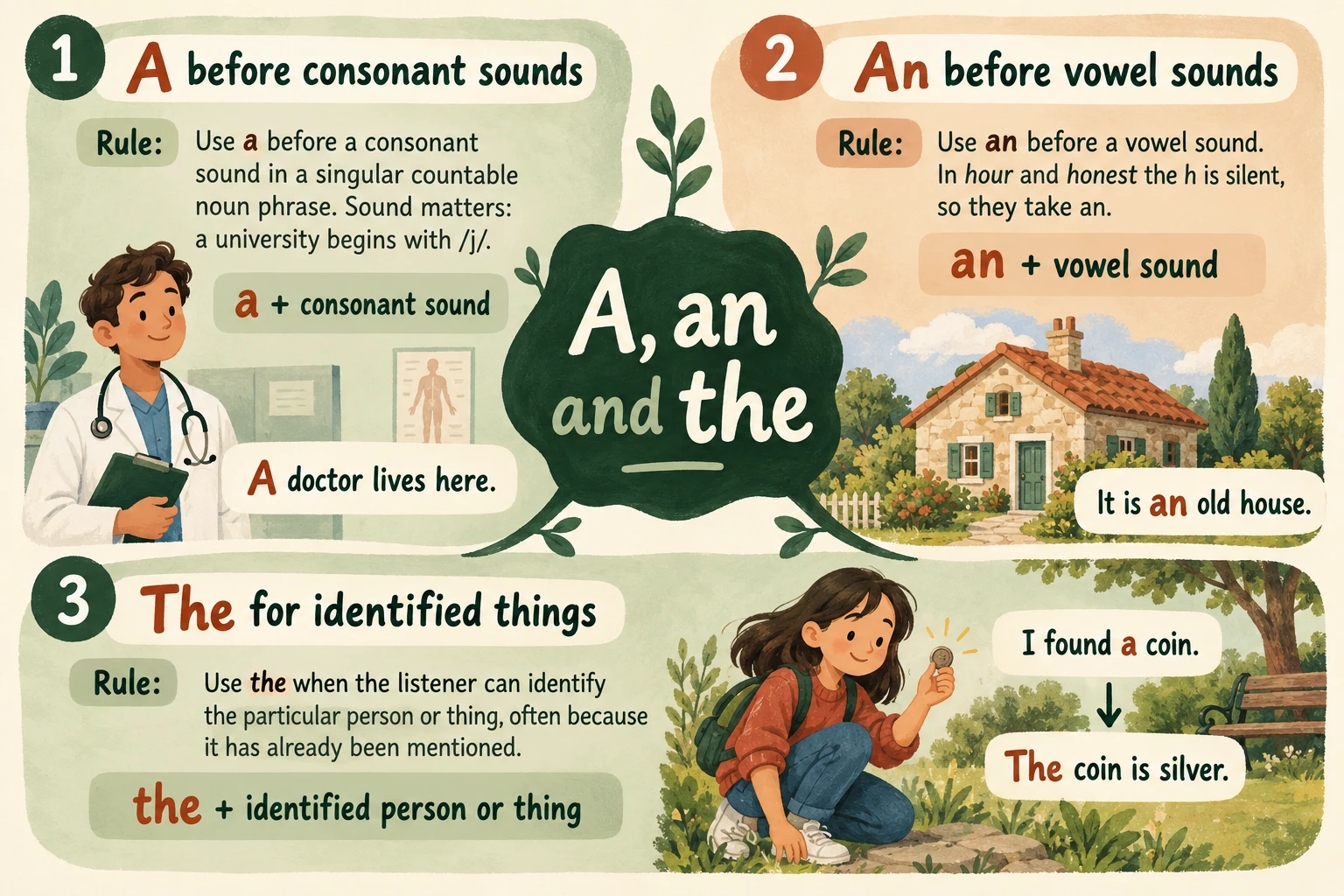
Emploie a devant un son consonne avec un nom dénombrable singulier. Le son compte : a university commence par /j/.
A doctor lives here.Utilise an devant un son voyelle. Le h de hour et honest est muet, d’où an.
It is an old house.Utilise the quand la personne ou la chose est identifiable, souvent après une première mention.
I found a coin. The coin is silver.
Use an indefinite article for a non-specific singular reference: Rina is ___ dentist at a clinic near here.
Emploie a devant un son consonne avec un nom dénombrable singulier. Le son compte : a university commence par /j/.
A doctor lives here.Utilise an devant un son voyelle. Le h de hour et honest est muet, d’où an.
It is an old house.Utilise the quand la personne ou la chose est identifiable, souvent après une première mention.
I found a coin. The coin is silver.Gardez la première tentative, comprenez le changement et essayez dans une nouvelle situation.
Pas encore de notes. Essayez un court échauffement.
Emploie a devant un son consonne avec un nom dénombrable singulier. Le son compte : a university commence par /j/.
A doctor lives here.Utilise an devant un son voyelle. Le h de hour et honest est muet, d’où an.
It is an old house.Utilise the quand la personne ou la chose est identifiable, souvent après une première mention.
I found a coin. The coin is silver.Ouvrir une réponse enregistre une aide pour cette question.
Use an indefinite article for a non-specific singular reference: Rina is ___ dentist at a clinic near here.
Observe « Use an indefinite article for a non-specific singular reference: Rina is ___ dentist at a clinic near here. ». Emploie a devant un son consonne avec un nom dénombrable singulier. Le son compte : a university commence par /j/. Phrase complète : « Use an indefinite article for a non-specific singular reference: Rina is a dentist at a clinic near here. ».
Use an indefinite article for a non-specific singular reference: We waited for ___ hour outside the cinema.
Observe « Use an indefinite article for a non-specific singular reference: We waited for ___ hour outside the cinema. ». Utilise an devant un son voyelle. Le h de hour et honest est muet, d’où an. Phrase complète : « Use an indefinite article for a non-specific singular reference: We waited for an hour outside the cinema. ».
I bought a lamp yesterday. ___ lamp is now on my desk.
Observe « I bought a lamp yesterday. ___ lamp is now on my desk. ». Utilise the quand la personne ou la chose est identifiable, souvent après une première mention. Phrase complète : « I bought a lamp yesterday. The lamp is now on my desk. ».
Use an indefinite article for a non-specific singular reference: There is ___ university beside the river.
Phrase de référence : « Use an indefinite article for a non-specific singular reference: There is a university beside the river. ». Emploie a devant un son consonne avec un nom dénombrable singulier. Le son compte : a university commence par /j/.
Use an indefinite article for a first, non-specific mention: Please bring ___ umbrella; any one will do.
Observe « Use an indefinite article for a first, non-specific mention: Please bring ___ umbrella; any one will do. ». Utilise an devant un son voyelle. Le h de hour et honest est muet, d’où an. Phrase complète : « Use an indefinite article for a first, non-specific mention: Please bring an umbrella; any one will do. ».
I saw a cat under our car. ___ cat had a red collar.
Observe « I saw a cat under our car. ___ cat had a red collar. ». Utilise the quand la personne ou la chose est identifiable, souvent après une première mention. Phrase complète : « I saw a cat under our car. The cat had a red collar. ».
Use an indefinite article for a non-specific singular reference: My cousin wants to be ___ pilot.
Phrase de référence : « Use an indefinite article for a non-specific singular reference: My cousin wants to be a pilot. ». Emploie a devant un son consonne avec un nom dénombrable singulier. Le son compte : a university commence par /j/.
Use an indefinite article for a non-specific singular reference: We need ___ useful map for the walk.
Observe « Use an indefinite article for a non-specific singular reference: We need ___ useful map for the walk. ». Emploie a devant un son consonne avec un nom dénombrable singulier. Le son compte : a university commence par /j/. Phrase complète : « Use an indefinite article for a non-specific singular reference: We need a useful map for the walk. ».
Use an indefinite article for a non-specific singular reference: He gave us ___ honest answer.
Observe « Use an indefinite article for a non-specific singular reference: He gave us ___ honest answer. ». Utilise an devant un son voyelle. Le h de hour et honest est muet, d’où an. Phrase complète : « Use an indefinite article for a non-specific singular reference: He gave us an honest answer. ».
I put a key in your bag. Please find ___ key.
Phrase de référence : « I put a key in your bag. Please find the key. ». Utilise the quand la personne ou la chose est identifiable, souvent après une première mention.
Use an indefinite article for a non-specific singular reference: There is ___ egg in the small bowl. Any egg will do.
Observe « Use an indefinite article for a non-specific singular reference: There is ___ egg in the small bowl. Any egg will do. ». Utilise an devant un son voyelle. Le h de hour et honest est muet, d’où an. Phrase complète : « Use an indefinite article for a non-specific singular reference: There is an egg in the small bowl. Any egg will do. ».
I opened a book on the train. ___ book was about bees.
Phrase de référence : « I opened a book on the train. The book was about bees. ». Utilise the quand la personne ou la chose est identifiable, souvent après une première mention.