01My, your, his y her
My, your, his y her van delante del nombre e indican al poseedor, no el género de la cosa.
This is my desk.
Adjetivos posesivos · A1. My, your, his y her van delante del nombre e indican al poseedor, no el género de la cosa.
Practica Adjetivos posesivos en situaciones breves. Lee la pista, elige o escribe una forma y revisa la explicación. El nivel es una orientación editorial.
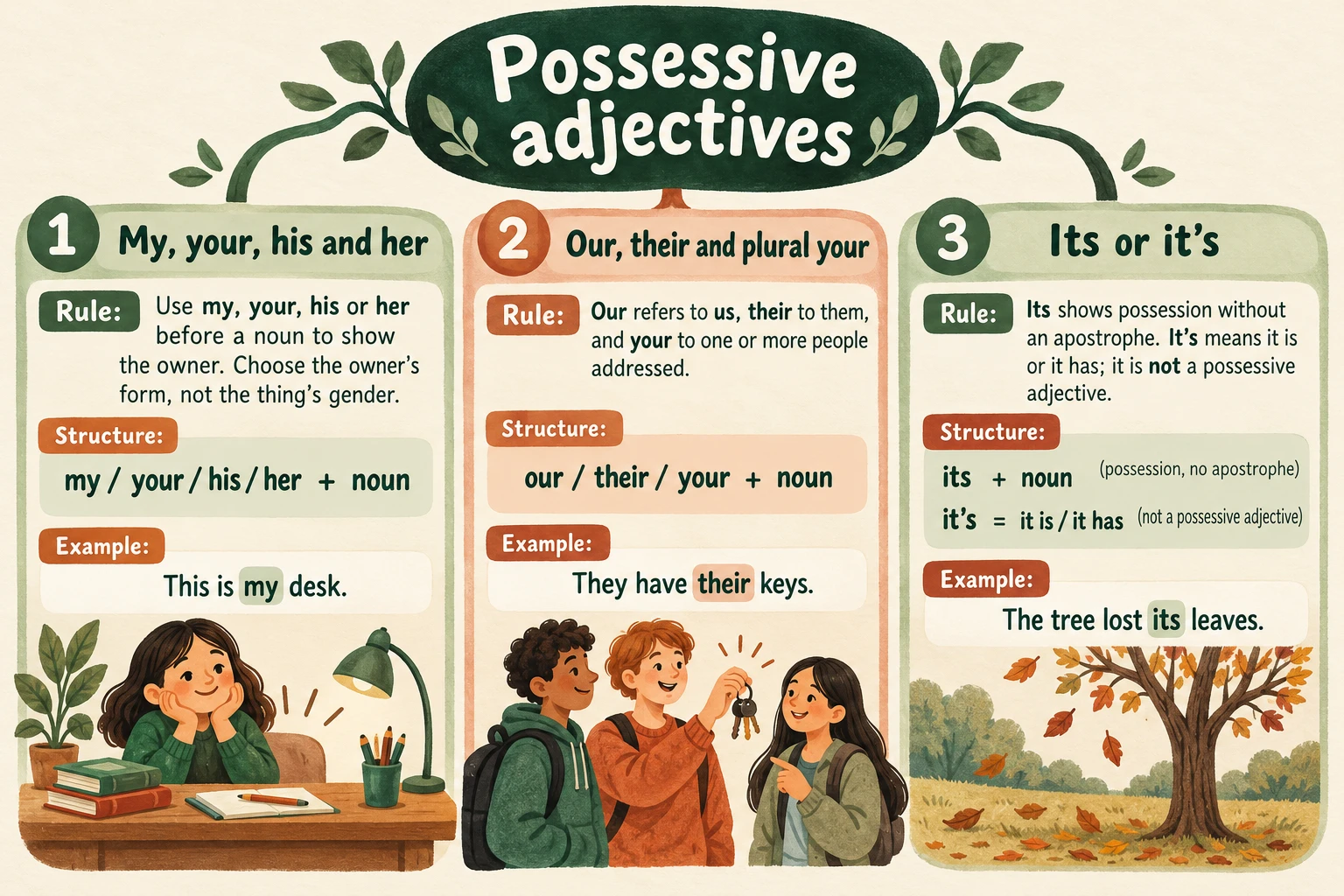
My, your, his y her van delante del nombre e indican al poseedor, no el género de la cosa.
This is my desk.Our se refiere a nosotros; their, a ellos; your, a una o varias personas a quienes hablamos.
They have their keys.Its indica posesión sin apóstrofo. It’s significa it is o it has, no es posesivo.
The tree lost its leaves.
I am looking for ___ phone. It belongs to me.
My, your, his y her van delante del nombre e indican al poseedor, no el género de la cosa.
This is my desk.Our se refiere a nosotros; their, a ellos; your, a una o varias personas a quienes hablamos.
They have their keys.Its indica posesión sin apóstrofo. It’s significa it is o it has, no es posesivo.
The tree lost its leaves.Conserva el primer intento, entiende el cambio y compruébalo en otra situación.
Aún no hay repasos. Prueba un calentamiento corto.
My, your, his y her van delante del nombre e indican al poseedor, no el género de la cosa.
This is my desk.Our se refiere a nosotros; their, a ellos; your, a una o varias personas a quienes hablamos.
They have their keys.Its indica posesión sin apóstrofo. It’s significa it is o it has, no es posesivo.
The tree lost its leaves.Abrir una respuesta registra ayuda para esa pregunta.
I am looking for ___ phone. It belongs to me.
Mira «I am looking for ___ phone. It belongs to me.». My, your, his y her van delante del nombre e indican al poseedor, no el género de la cosa. Oración completa: «I am looking for my phone. It belongs to me.».
We live here. This is ___ flat.
Mira «We live here. This is ___ flat.». Our se refiere a nosotros; their, a ellos; your, a una o varias personas a quienes hablamos. Oración completa: «We live here. This is our flat.».
The dog is eating ___ food.
Mira «The dog is eating ___ food.». Its indica posesión sin apóstrofo. It’s significa it is o it has, no es posesivo. Oración completa: «The dog is eating its food.».
Maria is a teacher. ___ classroom is upstairs.
Oración de referencia: «Maria is a teacher. Her classroom is upstairs.». My, your, his y her van delante del nombre e indican al poseedor, no el género de la cosa.
The boys have a tent. ___ tent is blue.
Mira «The boys have a tent. ___ tent is blue.». Our se refiere a nosotros; their, a ellos; your, a una o varias personas a quienes hablamos. Oración completa: «The boys have a tent. Their tent is blue.».
This robot can move ___ arms.
Mira «This robot can move ___ arms.». Its indica posesión sin apóstrofo. It’s significa it is o it has, no es posesivo. Oración completa: «This robot can move its arms.».
You own this bike. Is this ___ helmet too?
Oración de referencia: «You own this bike. Is this your helmet too?». My, your, his y her van delante del nombre e indican al poseedor, no el género de la cosa.
Leo left ___ coat on the bus. It is Leo’s own coat, and he needs it tonight.
Mira «Leo left ___ coat on the bus. It is Leo’s own coat, and he needs it tonight.». My, your, his y her van delante del nombre e indican al poseedor, no el género de la cosa. Oración completa: «Leo left his coat on the bus. He needs it tonight.».
You and Eva are invited. Bring ___ tickets: the tickets belonging to you and Eva.
Mira «You and Eva are invited. Bring ___ tickets: the tickets belonging to you and Eva.». Our se refiere a nosotros; their, a ellos; your, a una o varias personas a quienes hablamos. Oración completa: «You and Eva are invited. Bring your tickets.».
The hotel has changed ___ name.
Oración de referencia: «The hotel has changed its name.». Its indica posesión sin apóstrofo. It’s significa it is o it has, no es posesivo.
The children are in class. ___ bags are by the door.
Mira «The children are in class. ___ bags are by the door.». Our se refiere a nosotros; their, a ellos; your, a una o varias personas a quienes hablamos. Oración completa: «The children are in class. Their bags are by the door.».
The bird hurt ___ wing.
Oración de referencia: «The bird hurt its wing.». Its indica posesión sin apóstrofo. It’s significa it is o it has, no es posesivo. También se admiten estas variantes revisadas: his / her. No es una lista de todas las expresiones posibles.