
A1-A2

Pasado simple: ejercicios

Sobre esta lección

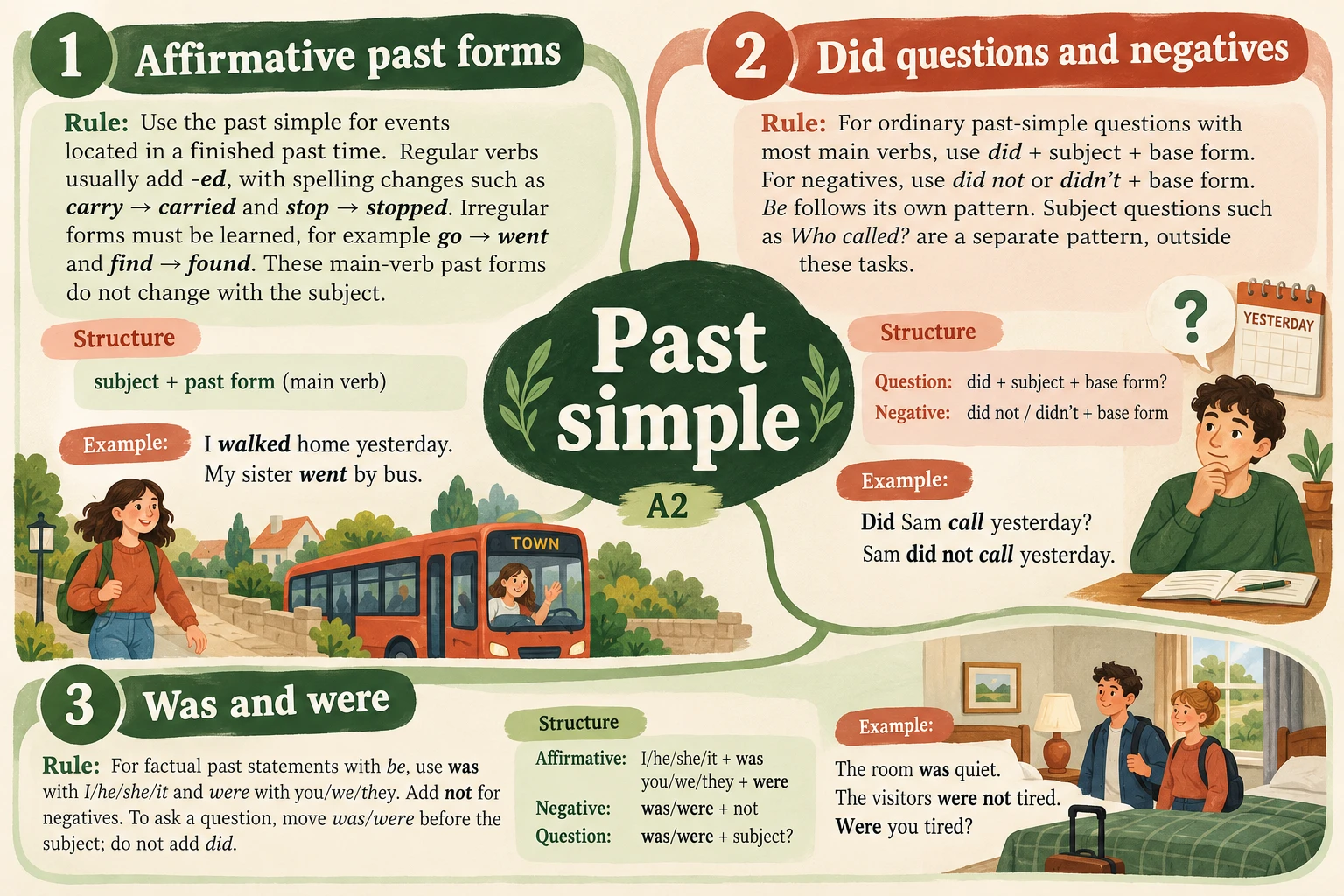
Pasado simple · A2. Usa el pasado simple para hechos situados en un tiempo pasado terminado. Los verbos regulares suelen añadir -ed, con cambios como carry → carried y stop → stopped. Hay que aprender las formas irregulares, como go → went y find → found. Estas formas del verbo principal no cambian según el sujeto.

Practica hechos pasados, verbos regulares e irregulares, preguntas con did y was/were.

12 preguntas
Guárdalo para encontrarlo en Mi colección.
Mapa de conceptos

Past simple

Empezar a practicar
Past simple — Mapa de conceptos

01Formas afirmativas del pasado

Usa el pasado simple para hechos situados en un tiempo pasado terminado. Los verbos regulares suelen añadir -ed, con cambios como carry → carried y stop → stopped. Hay que aprender las formas irregulares, como go → went y find → found. Estas formas del verbo principal no cambian según el sujeto.

walk → walked · go → went
02Preguntas y negaciones con did

Para preguntas ordinarias de pasado con la mayoría de los verbos, usa did + sujeto + forma base. Para negar, usa did not o didn’t + forma base. Be tiene su propio patrón. Las preguntas por el sujeto, como Who called?, siguen otro patrón y quedan fuera de estas tareas.

did / didn’t + base verb

03Was y were

En afirmaciones sobre hechos pasados con be, usa was con I/he/she/it y were con you/we/they. Añade not para negar. Para preguntar, coloca was/were antes del sujeto, sin añadir did.

I/he/she/it was · you/we/they were

Afirmación

I worked yesterday.She went home.

Negación

I didn’t work yesterday.She didn’t go home.

Pregunta

Did you work yesterday?Did she go home?

Respuesta breve

Yes, I did.No, she didn’t.

Guía ilustrada

0/12
Preguntas
01 / 12D01Guárdalo para encontrarlo en Mi colección.

Mia finished cleaning her room yesterday.

Choose the correct past-simple sentence.

Tu respuesta
1 / 12

Tu ruta de aprendizaje

01
Paso 1 · Calentamiento

Calentamiento

0/3
02
Paso 2 · Practicar la habilidad

Formas afirmativas del pasado

0/1

Usa el pasado simple para hechos situados en un tiempo pasado terminado. Los verbos regulares suelen añadir -ed, con cambios como carry → carried y stop → stopped. Hay que aprender las formas irregulares, como go → went y find → found. Estas formas del verbo principal no cambian según el sujeto.

I walked home yesterday. My sister went by bus.
03
Paso 3 · Practicar la habilidad

Was y were

0/2

En afirmaciones sobre hechos pasados con be, usa was con I/he/she/it y were con you/we/they. Añade not para negar. Para preguntar, coloca was/were antes del sujeto, sin añadir did.

The room was quiet. The visitors were not tired. Were you tired?
04
Paso 4 · Practicar la habilidad

Preguntas y negaciones con did

0/1

Para preguntas ordinarias de pasado con la mayoría de los verbos, usa did + sujeto + forma base. Para negar, usa did not o didn’t + forma base. Be tiene su propio patrón. Las preguntas por el sujeto, como Who called?, siguen otro patrón y quedan fuera de estas tareas.

Did Sam call yesterday? Sam did not call yesterday.
05
Paso 5 · Nuevos contextos

Nuevos contextos

0/3
06
Paso 6 · Un nuevo reto

Un nuevo reto

0/2
Repasos de esta unidad

Haz que los errores sirvan.

Conserva el primer intento, entiende el cambio y compruébalo en otra situación.

0

Aún no hay repasos. Prueba un calentamiento corto.

Mapa de la lección

Pasado simple

A2
Past simple

Puntos de la lección

01

Formas afirmativas del pasado

Usa el pasado simple para hechos situados en un tiempo pasado terminado. Los verbos regulares suelen añadir -ed, con cambios como carry → carried y stop → stopped. Hay que aprender las formas irregulares, como go → went y find → found. Estas formas del verbo principal no cambian según el sujeto.

I walked home yesterday. My sister went by bus.
02

Preguntas y negaciones con did

Para preguntas ordinarias de pasado con la mayoría de los verbos, usa did + sujeto + forma base. Para negar, usa did not o didn’t + forma base. Be tiene su propio patrón. Las preguntas por el sujeto, como Who called?, siguen otro patrón y quedan fuera de estas tareas.

Did Sam call yesterday? Sam did not call yesterday.
03

Was y were

En afirmaciones sobre hechos pasados con be, usa was con I/he/she/it y were con you/we/they. Añade not para negar. Para preguntar, coloca was/were antes del sujeto, sin añadir did.

The room was quiet. The visitors were not tired. Were you tired?

Preguntas y respuestas

Abrir una respuesta registra ayuda para esa pregunta.

D01 · Calentamiento

Mia finished cleaning her room yesterday.

Choose the correct past-simple sentence.

  1. Mia cleaned her room yesterday.
  2. Mia cleaning her room yesterday.
  3. Mia cleans her room yesterday.
Respuesta y explicación
Mia cleaned her room yesterday.

Mira «Mia finished cleaning her room yesterday.». Usa el pasado simple para hechos situados en un tiempo pasado terminado. Los verbos regulares suelen añadir -ed, con cambios como carry → carried y stop → stopped. Hay que aprender las formas irregulares, como go → went y find → found. Estas formas del verbo principal no cambian según el sujeto. Oración completa: «Mia cleaned her room yesterday.».

D02 · Calentamiento

You want to know whether Omar bought a notebook yesterday.

Choose the correct question.

  1. Did Omar bought a notebook yesterday?
  2. Does Omar buy a notebook yesterday?
  3. Did Omar buy a notebook yesterday?
Respuesta y explicación
Did Omar buy a notebook yesterday?

Mira «You want to know whether Omar bought a notebook yesterday.». Para preguntas ordinarias de pasado con la mayoría de los verbos, usa did + sujeto + forma base. Para negar, usa did not o didn’t + forma base. Be tiene su propio patrón. Las preguntas por el sujeto, como Who called?, siguen otro patrón y quedan fuera de estas tareas. Oración completa: «Did Omar buy a notebook yesterday?».

D03 · Calentamiento

You want to know if someone left the windows open last night.

Choose the correct question.

  1. Were the windows open last night?
  2. Was the windows open last night?
  3. Did the windows be open last night?
Respuesta y explicación
Were the windows open last night?

Mira «You want to know if someone left the windows open last night.». En afirmaciones sobre hechos pasados con be, usa was con I/he/she/it y were con you/we/they. Añade not para negar. Para preguntar, coloca was/were antes del sujeto, sin añadir did. Oración completa: «Were the windows open last night?».

P01 · Practicar la habilidad

The boxes are upstairs now. The work finished yesterday.

Complete the sentence with the past-simple form of carry. Write only the missing verb: We ___ the boxes upstairs yesterday.

Respuesta y explicación
carried

La acción terminó ayer. Carry termina en consonante + y: cambia y por i y añade -ed para formar carried.

P02 · Practicar la habilidad

Nina stayed at home last Friday because of a fever.

Choose the correct sentence about last Friday.

  1. Nina was ill last Friday.
  2. Nina did be ill last Friday.
  3. Nina were ill last Friday.
Respuesta y explicación
Nina was ill last Friday.

Mira «Nina stayed at home last Friday because of a fever.». En afirmaciones sobre hechos pasados con be, usa was con I/he/she/it y were con you/we/they. Añade not para negar. Para preguntar, coloca was/were antes del sujeto, sin añadir did. Oración completa: «Nina was ill last Friday.».

P03 · Practicar la habilidad

They planned to play chess last night, but the game did not happen.

Choose the correct negative sentence.

  1. They did not play chess last night.
  2. They do not play chess last night.
  3. They did not played chess last night.
Respuesta y explicación
They did not play chess last night.

Mira «They planned to play chess last night, but the game did not happen.». Para preguntas ordinarias de pasado con la mayoría de los verbos, usa did + sujeto + forma base. Para negar, usa did not o didn’t + forma base. Be tiene su propio patrón. Las preguntas por el sujeto, como Who called?, siguen otro patrón y quedan fuera de estas tareas. Oración completa: «They did not play chess last night.».

P04 · Practicar la habilidad

The cafe was closed yesterday. Correct this claim by making it negative: The cafe was open yesterday.

Write the full negative sentence. Keep all other words in the same order.

Respuesta y explicación
The cafe was not open yesterday.

Con be en pasado, coloca not después de was. Tanto was not como wasn’t son correctos; conserva el resto de la oración.

Otras respuestas aceptadas
  • The cafe wasn't open yesterday.
R01 · Nuevos contextos

This sentence has one spelling error: Ava stoped near the bridge yesterday.

Correct only the misspelled past verb and write the full sentence.

Respuesta y explicación
Ava stopped near the bridge yesterday.

En el verbo corto stop, se duplica la p final antes de añadir -ed: stopped. La frase describe una parada terminada ayer.

R02 · Nuevos contextos

Yesterday you left your bag somewhere. Your friend asks about the place.

Choose the correctly formed question.

  1. Where did you left your bag yesterday?
  2. Where you leave your bag yesterday?
  3. Where did you leave your bag yesterday?
Respuesta y explicación
Where did you leave your bag yesterday?

Mira «Yesterday you left your bag somewhere. Your friend asks about the place.». Para preguntas ordinarias de pasado con la mayoría de los verbos, usa did + sujeto + forma base. Para negar, usa did not o didn’t + forma base. Be tiene su propio patrón. Las preguntas por el sujeto, como Who called?, siguen otro patrón y quedan fuera de estas tareas. Oración completa: «Where did you leave your bag yesterday?».

R03 · Nuevos contextos

We arrived before the lesson started yesterday. Describe our arrival using a negative with late.

Choose the correct negative sentence.

  1. We was not late yesterday.
  2. We were not late yesterday.
  3. We did not be late yesterday.
Respuesta y explicación
We were not late yesterday.

Mira «We arrived before the lesson started yesterday. Describe our arrival using a negative with late.». En afirmaciones sobre hechos pasados con be, usa was con I/he/she/it y were con you/we/they. Añade not para negar. Para preguntar, coloca was/were antes del sujeto, sin añadir did. Oración completa: «We were not late yesterday.».

X01 · Un nuevo reto

My wallet was missing. The search ended yesterday evening: it was under a chair.

Choose the correct past-simple sentence.

  1. I found my wallet under a chair yesterday evening.
  2. I find my wallet under a chair yesterday evening.
  3. I finded my wallet under a chair yesterday evening.
Respuesta y explicación
I found my wallet under a chair yesterday evening.

Mira «My wallet was missing. The search ended yesterday evening: it was under a chair.». Usa el pasado simple para hechos situados en un tiempo pasado terminado. Los verbos regulares suelen añadir -ed, con cambios como carry → carried y stop → stopped. Hay que aprender las formas irregulares, como go → went y find → found. Estas formas del verbo principal no cambian según el sujeto. Oración completa: «I found my wallet under a chair yesterday evening.».

X02 · Un nuevo reto

You do not know whether your friend sent the email yesterday.

Write one full yes/no question beginning with Did. Use these words in order after Did: you / send / the email / yesterday.

Respuesta y explicación
Did you send the email yesterday?

Una pregunta de sí o no sobre ayer usa Did + you + send. Send se mantiene en forma base después de did.