01Vorhersagen, Versprechen und Entscheidungen
Will + Grundform dient Vorhersagen, Versprechen oder spontanen Entscheidungen. Will bleibt bei allen Subjekten gleich.
I will call you tonight.
Zukunft mit will · A2. Will + Grundform dient Vorhersagen, Versprechen oder spontanen Entscheidungen. Will bleibt bei allen Subjekten gleich.
Übe Zukunft mit will in kurzen Situationen. Lies den Hinweis, wähle oder schreibe eine Form und prüfe die Begründung. Die Stufe dient der redaktionellen Orientierung.
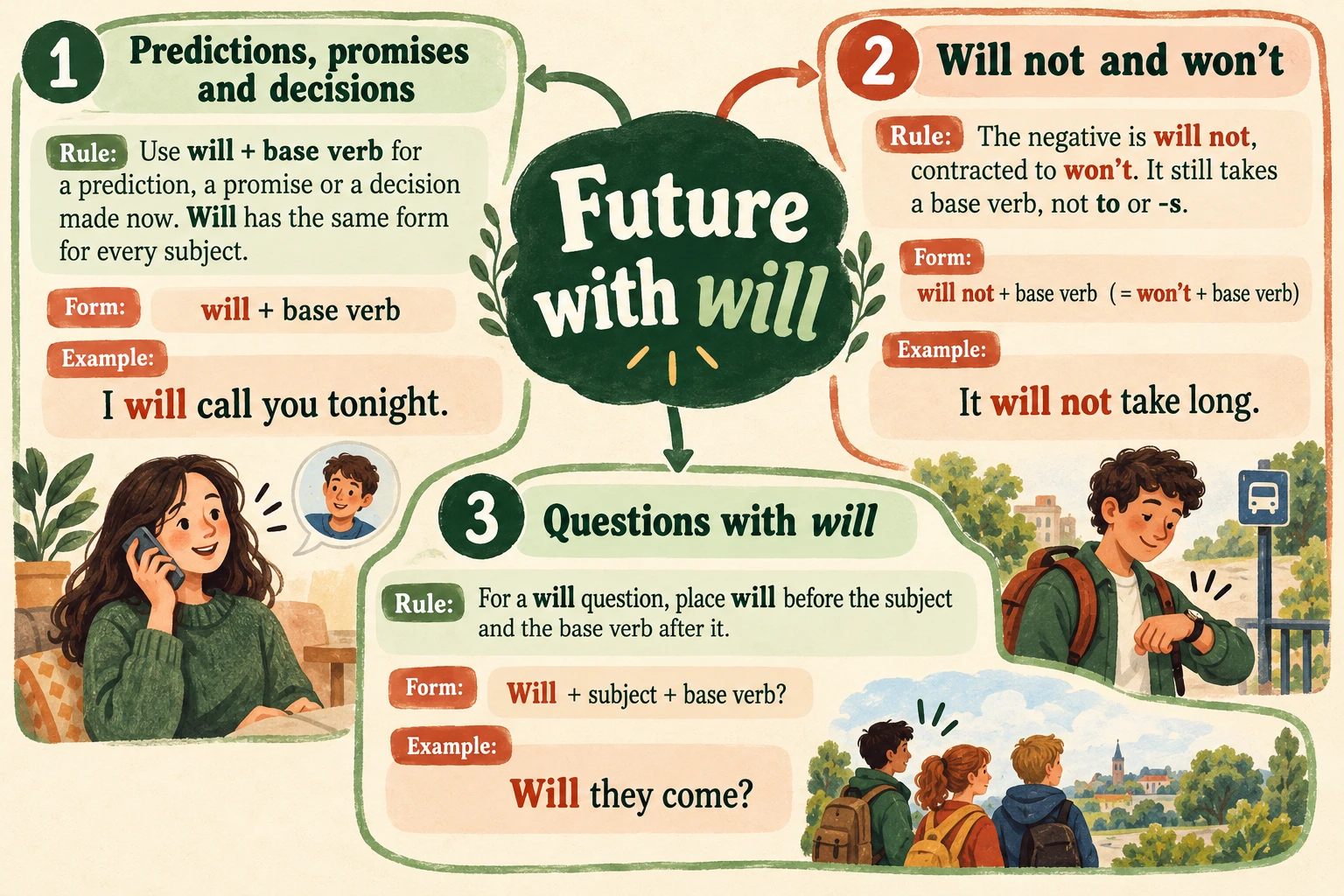
Will + Grundform dient Vorhersagen, Versprechen oder spontanen Entscheidungen. Will bleibt bei allen Subjekten gleich.
I will call you tonight.Die Verneinung ist will not, kurz won’t. Danach steht die Grundform ohne to oder -s.
It will not take long.Bei will-Fragen steht will vor dem Subjekt und die Grundform danach.
Will they come?
The phone is ringing. I ___ it now. (answer; use will)
Will + Grundform dient Vorhersagen, Versprechen oder spontanen Entscheidungen. Will bleibt bei allen Subjekten gleich.
I will call you tonight.Die Verneinung ist will not, kurz won’t. Danach steht die Grundform ohne to oder -s.
It will not take long.Bei will-Fragen steht will vor dem Subjekt und die Grundform danach.
Will they come?Bewahre den ersten Versuch. Verstehe die Änderung. Prüfe sie in einer neuen Situation.
Noch keine Lernnotizen. Starte mit einem kurzen Einstieg.
Will + Grundform dient Vorhersagen, Versprechen oder spontanen Entscheidungen. Will bleibt bei allen Subjekten gleich.
I will call you tonight.Die Verneinung ist will not, kurz won’t. Danach steht die Grundform ohne to oder -s.
It will not take long.Bei will-Fragen steht will vor dem Subjekt und die Grundform danach.
Will they come?Das Öffnen einer Antwort wird für diese Aufgabe als Hilfe erfasst.
The phone is ringing. I ___ it now. (answer; use will)
Achte auf „The phone is ringing. I ___ it now. (answer; use will)“. Will + Grundform dient Vorhersagen, Versprechen oder spontanen Entscheidungen. Will bleibt bei allen Subjekten gleich. Vollständiger Satz: „The phone is ringing. I will answer it now. (answer; use will)“.
I promise I ___ forget your birthday. (negative will)
Achte auf „I promise I ___ forget your birthday. (negative will)“. Die Verneinung ist will not, kurz won’t. Danach steht die Grundform ohne to oder -s. Vollständiger Satz: „I promise I will not forget your birthday. (negative will)“.
___ you help me with this box? (use will)
Achte auf „___ you help me with this box? (use will)“. Bei will-Fragen steht will vor dem Subjekt und die Grundform danach. Vollständiger Satz: „Will you help me with this box? (use will)“.
I think the new café ___ popular. (be; use will)
Vollständiger Beispielsatz: „I think the new café will be popular. (be; use will)“. Will + Grundform dient Vorhersagen, Versprechen oder spontanen Entscheidungen. Will bleibt bei allen Subjekten gleich.
The shop is closed tomorrow, so it ___ open. (negative will)
Achte auf „The shop is closed tomorrow, so it ___ open. (negative will)“. Die Verneinung ist will not, kurz won’t. Danach steht die Grundform ohne to oder -s. Vollständiger Satz: „The shop is closed tomorrow, so it will not open. (negative will)“.
Will the parcel ___ tomorrow? (arrive)
Achte auf „Will the parcel ___ tomorrow? (arrive)“. Bei will-Fragen steht will vor dem Subjekt und die Grundform danach. Vollständiger Satz: „Will the parcel arrive tomorrow? (arrive)“.
I promise I ___ the door. (lock; use will)
Vollständiger Beispielsatz: „I promise I will lock the door. (lock; use will)“. Will + Grundform dient Vorhersagen, Versprechen oder spontanen Entscheidungen. Will bleibt bei allen Subjekten gleich. In dieser Aufgabe sind auch diese Formen geprüft: 'll lock. Die Liste ist nicht vollständig.
That bag looks heavy. I ___ it for you. (carry; use will)
Achte auf „That bag looks heavy. I ___ it for you. (carry; use will)“. Will + Grundform dient Vorhersagen, Versprechen oder spontanen Entscheidungen. Will bleibt bei allen Subjekten gleich. Vollständiger Satz: „That bag looks heavy. I will carry it for you. (carry; use will)“.
We have decided to refuse. We ___ accept the offer. (negative will)
Achte auf „We have decided to refuse. We ___ accept the offer. (negative will)“. Die Verneinung ist will not, kurz won’t. Danach steht die Grundform ohne to oder -s. Vollständiger Satz: „We have decided to refuse. We will not accept the offer. (negative will)“.
Where ___ they wait for us? (use will)
Vollständiger Beispielsatz: „Where will they wait for us? (use will)“. Bei will-Fragen steht will vor dem Subjekt und die Grundform danach.
He promises he ___ tell anyone the secret. (negative will)
Achte auf „He promises he ___ tell anyone the secret. (negative will)“. Die Verneinung ist will not, kurz won’t. Danach steht die Grundform ohne to oder -s. Vollständiger Satz: „He promises he will not tell anyone the secret. (negative will)“.
Will your sister ___ us at the station? (meet)
Vollständiger Beispielsatz: „Will your sister meet us at the station? (meet)“. Bei will-Fragen steht will vor dem Subjekt und die Grundform danach.