01Ações acontecendo agora
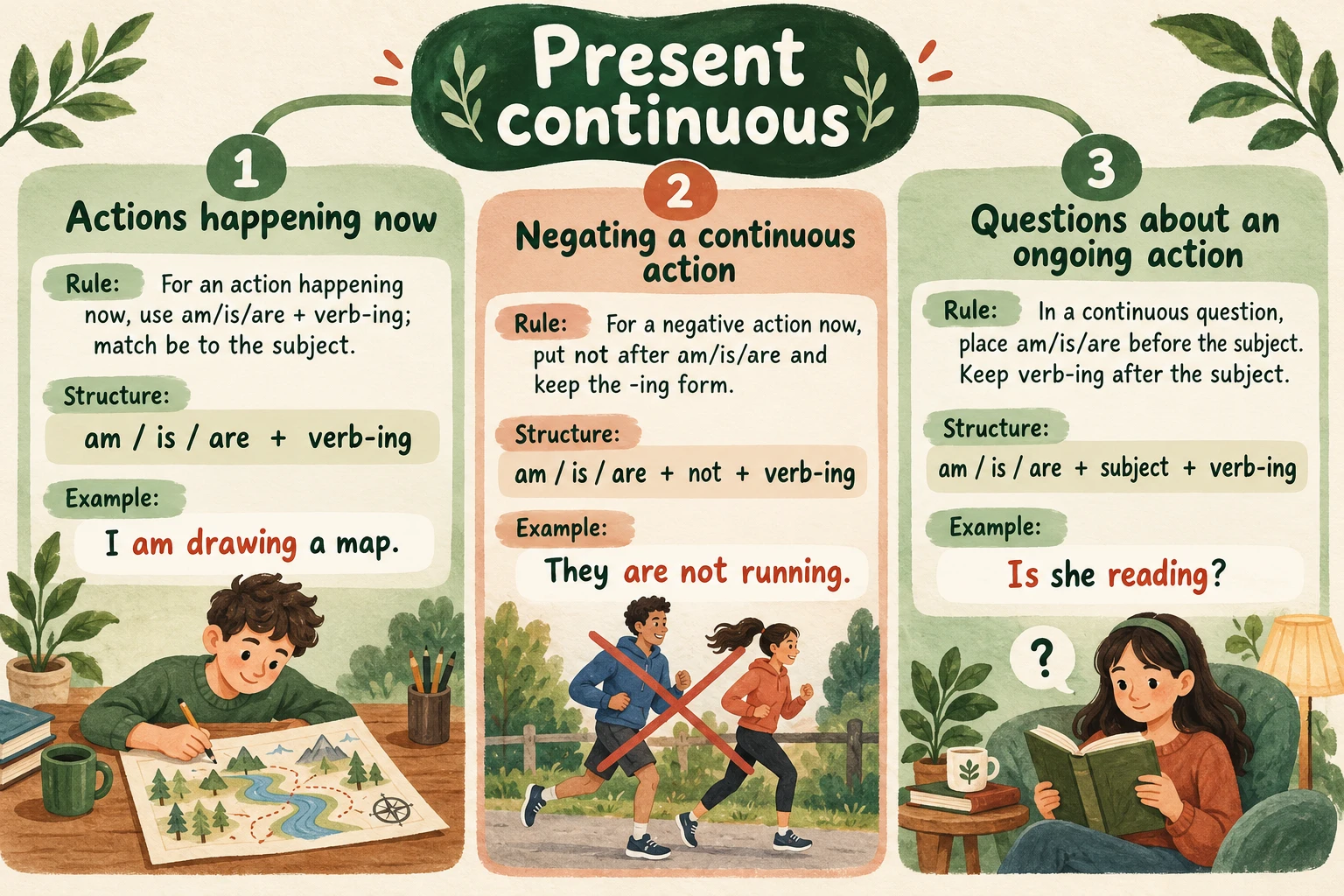
Para ações acontecendo agora, use am/is/are + verbo-ing, concordando be com o sujeito.
I am drawing a map.
Presente contínuo · A1. Para ações acontecendo agora, use am/is/are + verbo-ing, concordando be com o sujeito.
Pratique Presente contínuo em situações curtas. Leia a pista, escolha ou escreva uma forma e confira a explicação. O nível é uma orientação editorial.
Para ações acontecendo agora, use am/is/are + verbo-ing, concordando be com o sujeito.
I am drawing a map.Para negar uma ação em curso, ponha not após am/is/are e mantenha -ing.
They are not running.Nas perguntas do contínuo, am/is/are vem antes do sujeito e o verbo-ing depois.
Is she reading?I am working.She is working.
I am not working.She isn’t working.
Are you working?Is she working?
Yes, I am.No, she isn’t.
Look! The children ___ football in the park. (play)
Para ações acontecendo agora, use am/is/are + verbo-ing, concordando be com o sujeito.
I am drawing a map.Para negar uma ação em curso, ponha not após am/is/are e mantenha -ing.
They are not running.Nas perguntas do contínuo, am/is/are vem antes do sujeito e o verbo-ing depois.
Is she reading?Guarde a primeira tentativa, entenda a mudança e confira em outra situação.
Ainda não há revisões. Faça um aquecimento curto.
Para ações acontecendo agora, use am/is/are + verbo-ing, concordando be com o sujeito.
I am drawing a map.Para negar uma ação em curso, ponha not após am/is/are e mantenha -ing.
They are not running.Nas perguntas do contínuo, am/is/are vem antes do sujeito e o verbo-ing depois.
Is she reading?Abrir uma resposta registra ajuda para essa questão.
Look! The children ___ football in the park. (play)
Observe “Look! The children ___ football in the park. (play)”. Para ações acontecendo agora, use am/is/are + verbo-ing, concordando be com o sujeito. Frase completa: “Look! The children are playing football in the park. (play)”.
Sara is on the sofa with a book. She ___ television now. (not watch)
Observe “Sara is on the sofa with a book. She ___ television now. (not watch)”. Para negar uma ação em curso, ponha not após am/is/are e mantenha -ing. Frase completa: “Sara is on the sofa with a book. She is not watching television now. (not watch)”.
___ you waiting for bus 9?
Observe “___ you waiting for bus 9?”. Nas perguntas do contínuo, am/is/are vem antes do sujeito e o verbo-ing depois. Frase completa: “Are you waiting for bus 9?”.
I ___ dinner right now. (cook)
Frase de referência: “I am cooking dinner right now. (cook)”. Para ações acontecendo agora, use am/is/are + verbo-ing, concordando be com o sujeito.
The workers have stopped for lunch. They ___ at the moment. (not work)
Observe “The workers have stopped for lunch. They ___ at the moment. (not work)”. Para negar uma ação em curso, ponha not após am/is/are e mantenha -ing. Frase completa: “The workers have stopped for lunch. They are not working at the moment. (not work)”.
___ your brother sleeping? Please be quiet.
Observe “___ your brother sleeping? Please be quiet.”. Nas perguntas do contínuo, am/is/are vem antes do sujeito e o verbo-ing depois. Frase completa: “Is your brother sleeping? Please be quiet.”.
Please hold on. The computer ___ the file now. (save)
Frase de referência: “Please hold on. The computer is saving the file now. (save)”. Para ações acontecendo agora, use am/is/are + verbo-ing, concordando be com o sujeito. Também são aceitas estas variantes revisadas: 's saving. A lista não cobre todas as expressões possíveis.
The baby ___ at this moment. (cry)
Observe “The baby ___ at this moment. (cry)”. Para ações acontecendo agora, use am/is/are + verbo-ing, concordando be com o sujeito. Frase completa: “The baby is crying at this moment. (cry)”.
My phone is off. I ___ any calls now. (not make)
Observe “My phone is off. I ___ any calls now. (not make)”. Para negar uma ação em curso, ponha not após am/is/are e mantenha -ing. Frase completa: “My phone is off. I am not making any calls now. (not make)”.
What ___ the students writing on the board?
Frase de referência: “What are the students writing on the board?”. Nas perguntas do contínuo, am/is/are vem antes do sujeito e o verbo-ing depois.
Dad is in the garden, so he ___ the kitchen now. (not clean)
Observe “Dad is in the garden, so he ___ the kitchen now. (not clean)”. Para negar uma ação em curso, ponha not após am/is/are e mantenha -ing. Frase completa: “Dad is in the garden, so he is not cleaning the kitchen now. (not clean)”.
Where ___ Nina going with that suitcase?
Frase de referência: “Where is Nina going with that suitcase?”. Nas perguntas do contínuo, am/is/are vem antes do sujeito e o verbo-ing depois.