01Acciones en curso ahora
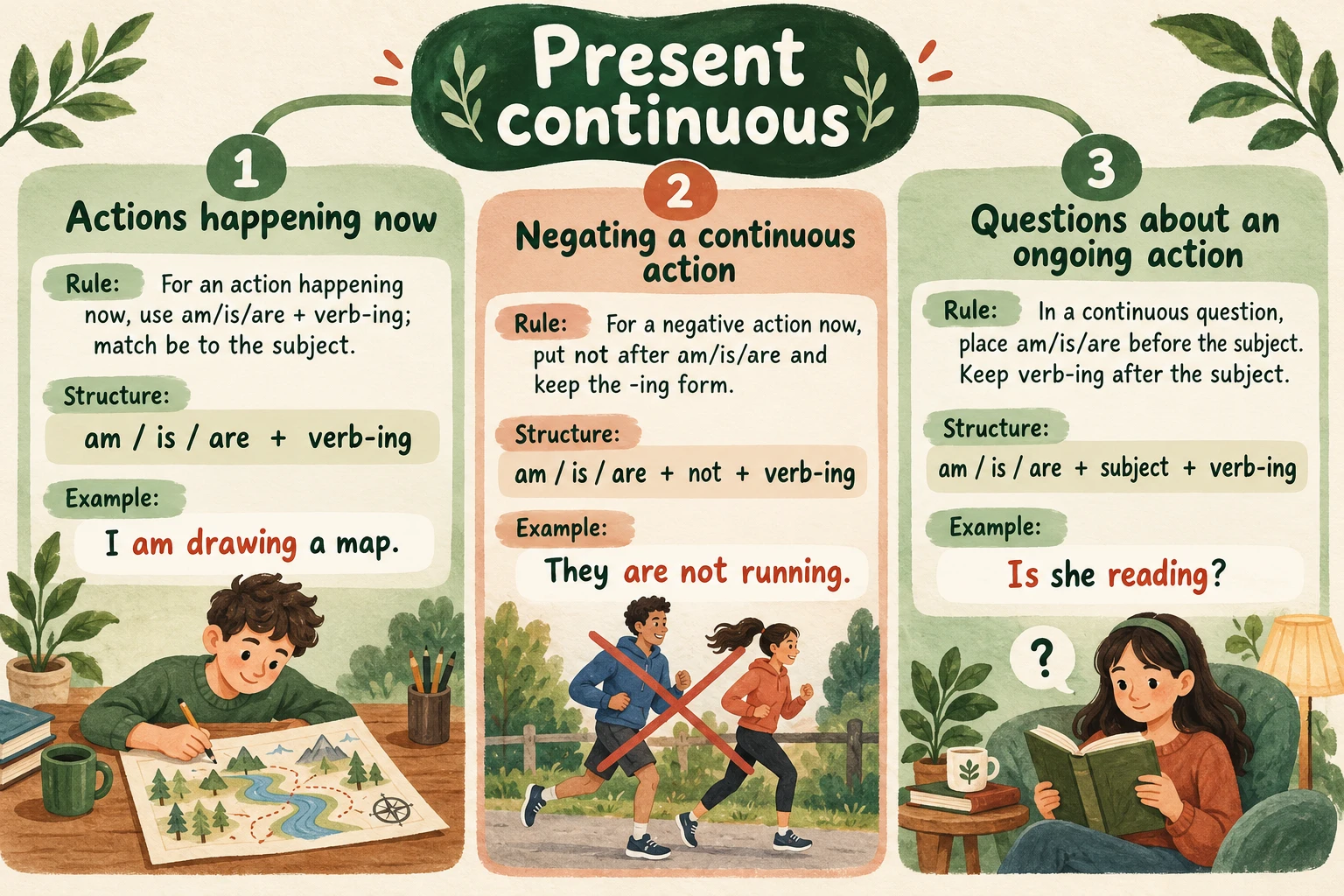
Para acciones que ocurren ahora usa am/is/are + verbo-ing, concordando be con el sujeto.
I am drawing a map.
Presente continuo · A1. Para acciones que ocurren ahora usa am/is/are + verbo-ing, concordando be con el sujeto.
Practica Presente continuo en situaciones breves. Lee la pista, elige o escribe una forma y revisa la explicación. El nivel es una orientación editorial.
Para acciones que ocurren ahora usa am/is/are + verbo-ing, concordando be con el sujeto.
I am drawing a map.Para negar una acción actual coloca not tras am/is/are y mantén -ing.
They are not running.En preguntas continuas, am/is/are va antes del sujeto y el verbo-ing después.
Is she reading?I am working.She is working.
I am not working.She isn’t working.
Are you working?Is she working?
Yes, I am.No, she isn’t.

Look! The children ___ football in the park. (play)
Para acciones que ocurren ahora usa am/is/are + verbo-ing, concordando be con el sujeto.
I am drawing a map.Para negar una acción actual coloca not tras am/is/are y mantén -ing.
They are not running.En preguntas continuas, am/is/are va antes del sujeto y el verbo-ing después.
Is she reading?Conserva el primer intento, entiende el cambio y compruébalo en otra situación.
Aún no hay repasos. Prueba un calentamiento corto.
Para acciones que ocurren ahora usa am/is/are + verbo-ing, concordando be con el sujeto.
I am drawing a map.Para negar una acción actual coloca not tras am/is/are y mantén -ing.
They are not running.En preguntas continuas, am/is/are va antes del sujeto y el verbo-ing después.
Is she reading?Abrir una respuesta registra ayuda para esa pregunta.
Look! The children ___ football in the park. (play)
Mira «Look! The children ___ football in the park. (play)». Para acciones que ocurren ahora usa am/is/are + verbo-ing, concordando be con el sujeto. Oración completa: «Look! The children are playing football in the park. (play)».
Sara is on the sofa with a book. She ___ television now. (not watch)
Mira «Sara is on the sofa with a book. She ___ television now. (not watch)». Para negar una acción actual coloca not tras am/is/are y mantén -ing. Oración completa: «Sara is on the sofa with a book. She is not watching television now. (not watch)».
___ you waiting for bus 9?
Mira «___ you waiting for bus 9?». En preguntas continuas, am/is/are va antes del sujeto y el verbo-ing después. Oración completa: «Are you waiting for bus 9?».
I ___ dinner right now. (cook)
Oración de referencia: «I am cooking dinner right now. (cook)». Para acciones que ocurren ahora usa am/is/are + verbo-ing, concordando be con el sujeto.
The workers have stopped for lunch. They ___ at the moment. (not work)
Mira «The workers have stopped for lunch. They ___ at the moment. (not work)». Para negar una acción actual coloca not tras am/is/are y mantén -ing. Oración completa: «The workers have stopped for lunch. They are not working at the moment. (not work)».
___ your brother sleeping? Please be quiet.
Mira «___ your brother sleeping? Please be quiet.». En preguntas continuas, am/is/are va antes del sujeto y el verbo-ing después. Oración completa: «Is your brother sleeping? Please be quiet.».
Please hold on. The computer ___ the file now. (save)
Oración de referencia: «Please hold on. The computer is saving the file now. (save)». Para acciones que ocurren ahora usa am/is/are + verbo-ing, concordando be con el sujeto. También se admiten estas variantes revisadas: 's saving. No es una lista de todas las expresiones posibles.
The baby ___ at this moment. (cry)
Mira «The baby ___ at this moment. (cry)». Para acciones que ocurren ahora usa am/is/are + verbo-ing, concordando be con el sujeto. Oración completa: «The baby is crying at this moment. (cry)».
My phone is off. I ___ any calls now. (not make)
Mira «My phone is off. I ___ any calls now. (not make)». Para negar una acción actual coloca not tras am/is/are y mantén -ing. Oración completa: «My phone is off. I am not making any calls now. (not make)».
What ___ the students writing on the board?
Oración de referencia: «What are the students writing on the board?». En preguntas continuas, am/is/are va antes del sujeto y el verbo-ing después.
Dad is in the garden, so he ___ the kitchen now. (not clean)
Mira «Dad is in the garden, so he ___ the kitchen now. (not clean)». Para negar una acción actual coloca not tras am/is/are y mantén -ing. Oración completa: «Dad is in the garden, so he is not cleaning the kitchen now. (not clean)».
Where ___ Nina going with that suitcase?
Oración de referencia: «Where is Nina going with that suitcase?». En preguntas continuas, am/is/are va antes del sujeto y el verbo-ing después.