01if의 일반 조건
일반적인 규칙의 if절은 현재시제이며 미래의 약속이 아닙니다.
If you drop a stone, it falls.
영조건문 · A2. 일반적인 규칙의 if절은 현재시제이며 미래의 약속이 아닙니다.
짧은 상황에서 ‘영조건문’을 연습합니다. 단서를 읽고 형태를 고르거나 쓴 뒤 이유를 확인하세요. 수준은 편집상 안내입니다.
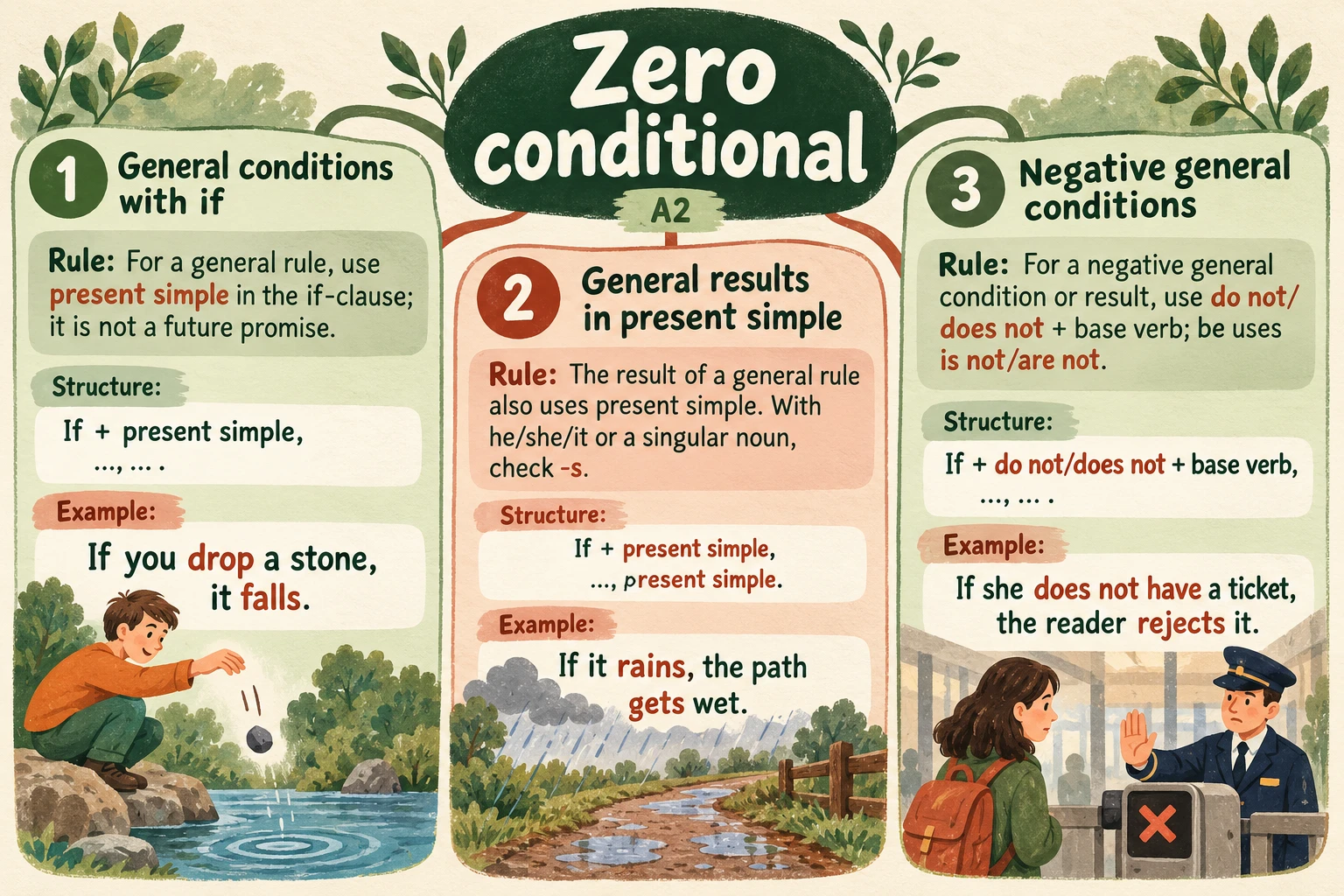
일반적인 규칙의 if절은 현재시제이며 미래의 약속이 아닙니다.
If you drop a stone, it falls.일반 규칙의 결과절도 현재시제이며 단수 주어에서는 -s를 확인합니다.
If it rains, the path gets wet.일반 조건·결과의 부정은 do not/does not+원형이며 be는 is not/are not입니다.
If she does not have a ticket, the reader rejects it.
General fact: if you ___ ice above its melting point, it melts. (heat)
일반적인 규칙의 if절은 현재시제이며 미래의 약속이 아닙니다.
If you drop a stone, it falls.일반 규칙의 결과절도 현재시제이며 단수 주어에서는 -s를 확인합니다.
If it rains, the path gets wet.일반 조건·결과의 부정은 do not/does not+원형이며 be는 is not/are not입니다.
If she does not have a ticket, the reader rejects it.첫 시도를 남기고 변화의 이유를 이해한 뒤 새로운 상황에서 확인해 보세요.
아직 복습 노트가 없어요. 짧은 워밍업부터 해보세요.
일반적인 규칙의 if절은 현재시제이며 미래의 약속이 아닙니다.
If you drop a stone, it falls.일반 규칙의 결과절도 현재시제이며 단수 주어에서는 -s를 확인합니다.
If it rains, the path gets wet.일반 조건·결과의 부정은 do not/does not+원형이며 be는 is not/are not입니다.
If she does not have a ticket, the reader rejects it.정답을 열면 해당 문제에 도움 사용이 기록돼요.
General fact: if you ___ ice above its melting point, it melts. (heat)
“General fact: if you ___ ice above its melting point, it melts. (heat)”를 보세요. 일반적인 규칙의 if절은 현재시제이며 미래의 약속이 아닙니다. 완성 문장: “General fact: if you heat ice above its melting point, it melts. (heat)”.
This machine always works like this: if you press START, the light ___ on. (come)
“This machine always works like this: if you press START, the light ___ on. (come)”를 보세요. 일반 규칙의 결과절도 현재시제이며 단수 주어에서는 -s를 확인합니다. 완성 문장: “This machine always works like this: if you press START, the light comes on. (come)”.
Plants die if they ___ get water for too long. (negative do)
“Plants die if they ___ get water for too long. (negative do)”를 보세요. 일반 조건·결과의 부정은 do not/does not+원형이며 be는 is not/are not입니다. 완성 문장: “Plants die if they do not get water for too long. (negative do)”.
General rule: if water ___ below zero Celsius under normal conditions, it freezes. (cool)
완성 예문: “General rule: if water cools below zero Celsius under normal conditions, it freezes. (cool)”. 일반적인 규칙의 if절은 현재시제이며 미래의 약속이 아닙니다.
The shop’s usual rule is: if an item is damaged, we ___ it. (replace)
“The shop’s usual rule is: if an item is damaged, we ___ it. (replace)”를 보세요. 일반 규칙의 결과절도 현재시제이며 단수 주어에서는 -s를 확인합니다. 완성 문장: “The shop’s usual rule is: if an item is damaged, we replace it. (replace)”.
This alarm sounds if the door ___ closed. (negative be)
“This alarm sounds if the door ___ closed. (negative be)”를 보세요. 일반 조건·결과의 부정은 do not/does not+원형이며 be는 is not/are not입니다. 완성 문장: “This alarm sounds if the door is not closed. (negative be)”.
General fact: if a person ___ no air, they cannot breathe. (have)
완성 예문: “General fact: if a person has no air, they cannot breathe. (have)”. 일반적인 규칙의 if절은 현재시제이며 미래의 약속이 아닙니다.
General rule: if you ___ red and white paint, you get pink. (mix)
“General rule: if you ___ red and white paint, you get pink. (mix)”를 보세요. 일반적인 규칙의 if절은 현재시제이며 미래의 약속이 아닙니다. 완성 문장: “General rule: if you mix red and white paint, you get pink. (mix)”.
The printer’s usual behaviour: if the paper runs out, it ___. (stop)
“The printer’s usual behaviour: if the paper runs out, it ___. (stop)”를 보세요. 일반 규칙의 결과절도 현재시제이며 단수 주어에서는 -s를 확인합니다. 완성 문장: “The printer’s usual behaviour: if the paper runs out, it stops. (stop)”.
The scanner rejects a card if it ___ have a valid code. (negative do)
완성 예문: “The scanner rejects a card if it does not have a valid code. (negative do)”. 일반 조건·결과의 부정은 do not/does not+원형이며 be는 is not/are not입니다.
General fact: if a metal bar gets hotter, it usually ___. (expand)
“General fact: if a metal bar gets hotter, it usually ___. (expand)”를 보세요. 일반 규칙의 결과절도 현재시제이며 단수 주어에서는 -s를 확인합니다. 완성 문장: “General fact: if a metal bar gets hotter, it usually expands. (expand)”.
This automatic gate stays shut if the sensor ___ detect a car. (negative do)
완성 예문: “This automatic gate stays shut if the sensor does not detect a car. (negative do)”. 일반 조건·결과의 부정은 do not/does not+원형이며 be는 is not/are not입니다.