01Allgemeine Bedingungen mit if
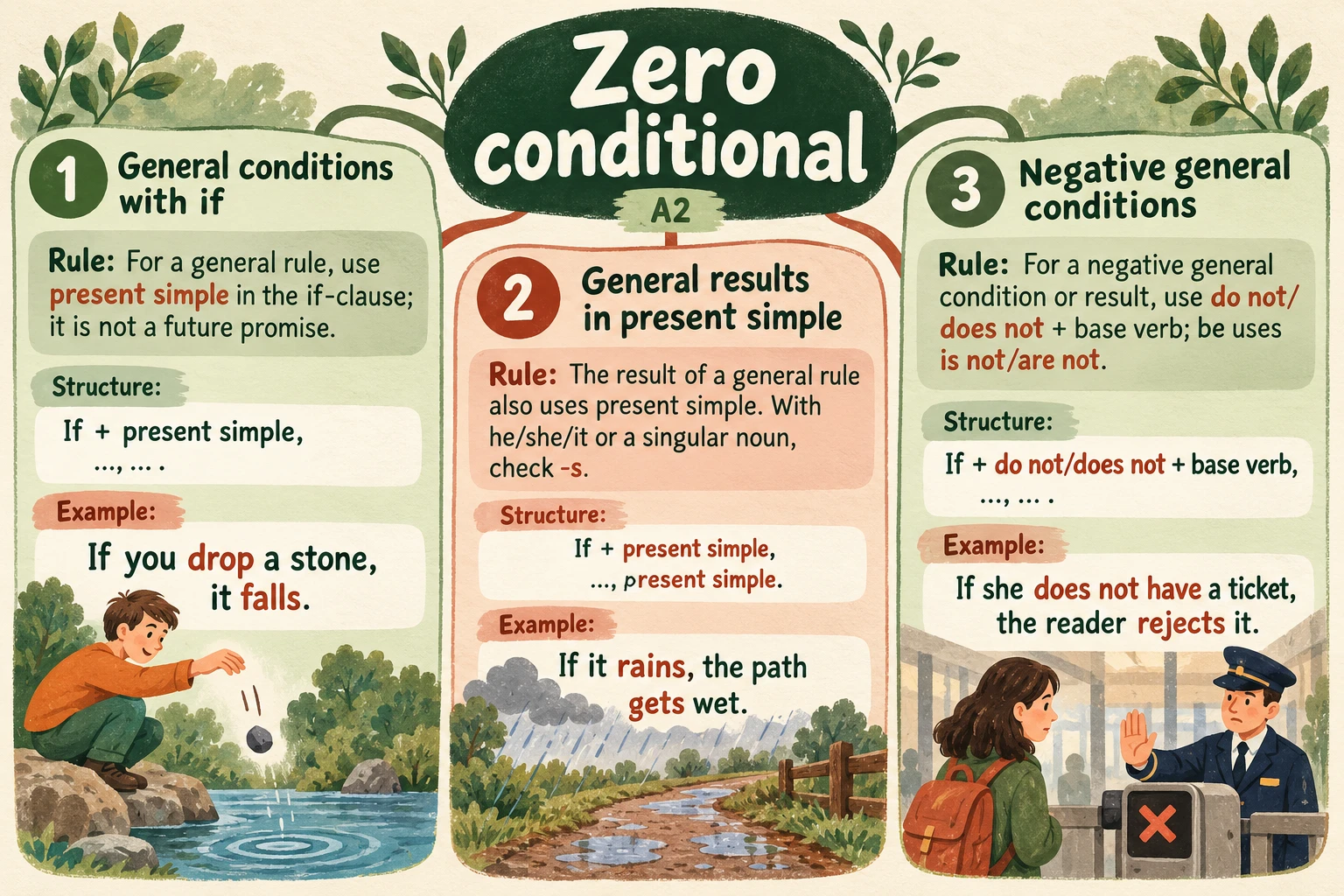
Bei allgemeinen Regeln steht im if-Satz das einfache Präsens; es ist kein Zukunftsversprechen.
If you drop a stone, it falls.
Nullkonditional · A2. Bei allgemeinen Regeln steht im if-Satz das einfache Präsens; es ist kein Zukunftsversprechen.
Übe Nullkonditional in kurzen Situationen. Lies den Hinweis, wähle oder schreibe eine Form und prüfe die Begründung. Die Stufe dient der redaktionellen Orientierung.
Bei allgemeinen Regeln steht im if-Satz das einfache Präsens; es ist kein Zukunftsversprechen.
If you drop a stone, it falls.Auch das Ergebnis einer allgemeinen Regel steht im Präsens; bei Singular ist -s zu beachten.
If it rains, the path gets wet.Verneinte allgemeine Bedingungen verwenden do not/does not + Grundform; bei be steht is not/are not.
If she does not have a ticket, the reader rejects it.
General fact: if you ___ ice above its melting point, it melts. (heat)
Bei allgemeinen Regeln steht im if-Satz das einfache Präsens; es ist kein Zukunftsversprechen.
If you drop a stone, it falls.Auch das Ergebnis einer allgemeinen Regel steht im Präsens; bei Singular ist -s zu beachten.
If it rains, the path gets wet.Verneinte allgemeine Bedingungen verwenden do not/does not + Grundform; bei be steht is not/are not.
If she does not have a ticket, the reader rejects it.Bewahre den ersten Versuch. Verstehe die Änderung. Prüfe sie in einer neuen Situation.
Noch keine Lernnotizen. Starte mit einem kurzen Einstieg.
Bei allgemeinen Regeln steht im if-Satz das einfache Präsens; es ist kein Zukunftsversprechen.
If you drop a stone, it falls.Auch das Ergebnis einer allgemeinen Regel steht im Präsens; bei Singular ist -s zu beachten.
If it rains, the path gets wet.Verneinte allgemeine Bedingungen verwenden do not/does not + Grundform; bei be steht is not/are not.
If she does not have a ticket, the reader rejects it.Das Öffnen einer Antwort wird für diese Aufgabe als Hilfe erfasst.
General fact: if you ___ ice above its melting point, it melts. (heat)
Achte auf „General fact: if you ___ ice above its melting point, it melts. (heat)“. Bei allgemeinen Regeln steht im if-Satz das einfache Präsens; es ist kein Zukunftsversprechen. Vollständiger Satz: „General fact: if you heat ice above its melting point, it melts. (heat)“.
This machine always works like this: if you press START, the light ___ on. (come)
Achte auf „This machine always works like this: if you press START, the light ___ on. (come)“. Auch das Ergebnis einer allgemeinen Regel steht im Präsens; bei Singular ist -s zu beachten. Vollständiger Satz: „This machine always works like this: if you press START, the light comes on. (come)“.
Plants die if they ___ get water for too long. (negative do)
Achte auf „Plants die if they ___ get water for too long. (negative do)“. Verneinte allgemeine Bedingungen verwenden do not/does not + Grundform; bei be steht is not/are not. Vollständiger Satz: „Plants die if they do not get water for too long. (negative do)“.
General rule: if water ___ below zero Celsius under normal conditions, it freezes. (cool)
Vollständiger Beispielsatz: „General rule: if water cools below zero Celsius under normal conditions, it freezes. (cool)“. Bei allgemeinen Regeln steht im if-Satz das einfache Präsens; es ist kein Zukunftsversprechen.
The shop’s usual rule is: if an item is damaged, we ___ it. (replace)
Achte auf „The shop’s usual rule is: if an item is damaged, we ___ it. (replace)“. Auch das Ergebnis einer allgemeinen Regel steht im Präsens; bei Singular ist -s zu beachten. Vollständiger Satz: „The shop’s usual rule is: if an item is damaged, we replace it. (replace)“.
This alarm sounds if the door ___ closed. (negative be)
Achte auf „This alarm sounds if the door ___ closed. (negative be)“. Verneinte allgemeine Bedingungen verwenden do not/does not + Grundform; bei be steht is not/are not. Vollständiger Satz: „This alarm sounds if the door is not closed. (negative be)“.
General fact: if a person ___ no air, they cannot breathe. (have)
Vollständiger Beispielsatz: „General fact: if a person has no air, they cannot breathe. (have)“. Bei allgemeinen Regeln steht im if-Satz das einfache Präsens; es ist kein Zukunftsversprechen.
General rule: if you ___ red and white paint, you get pink. (mix)
Achte auf „General rule: if you ___ red and white paint, you get pink. (mix)“. Bei allgemeinen Regeln steht im if-Satz das einfache Präsens; es ist kein Zukunftsversprechen. Vollständiger Satz: „General rule: if you mix red and white paint, you get pink. (mix)“.
The printer’s usual behaviour: if the paper runs out, it ___. (stop)
Achte auf „The printer’s usual behaviour: if the paper runs out, it ___. (stop)“. Auch das Ergebnis einer allgemeinen Regel steht im Präsens; bei Singular ist -s zu beachten. Vollständiger Satz: „The printer’s usual behaviour: if the paper runs out, it stops. (stop)“.
The scanner rejects a card if it ___ have a valid code. (negative do)
Vollständiger Beispielsatz: „The scanner rejects a card if it does not have a valid code. (negative do)“. Verneinte allgemeine Bedingungen verwenden do not/does not + Grundform; bei be steht is not/are not.
General fact: if a metal bar gets hotter, it usually ___. (expand)
Achte auf „General fact: if a metal bar gets hotter, it usually ___. (expand)“. Auch das Ergebnis einer allgemeinen Regel steht im Präsens; bei Singular ist -s zu beachten. Vollständiger Satz: „General fact: if a metal bar gets hotter, it usually expands. (expand)“.
This automatic gate stays shut if the sensor ___ detect a car. (negative do)
Vollständiger Beispielsatz: „This automatic gate stays shut if the sensor does not detect a car. (negative do)“. Verneinte allgemeine Bedingungen verwenden do not/does not + Grundform; bei be steht is not/are not.