01Condiciones generales con if
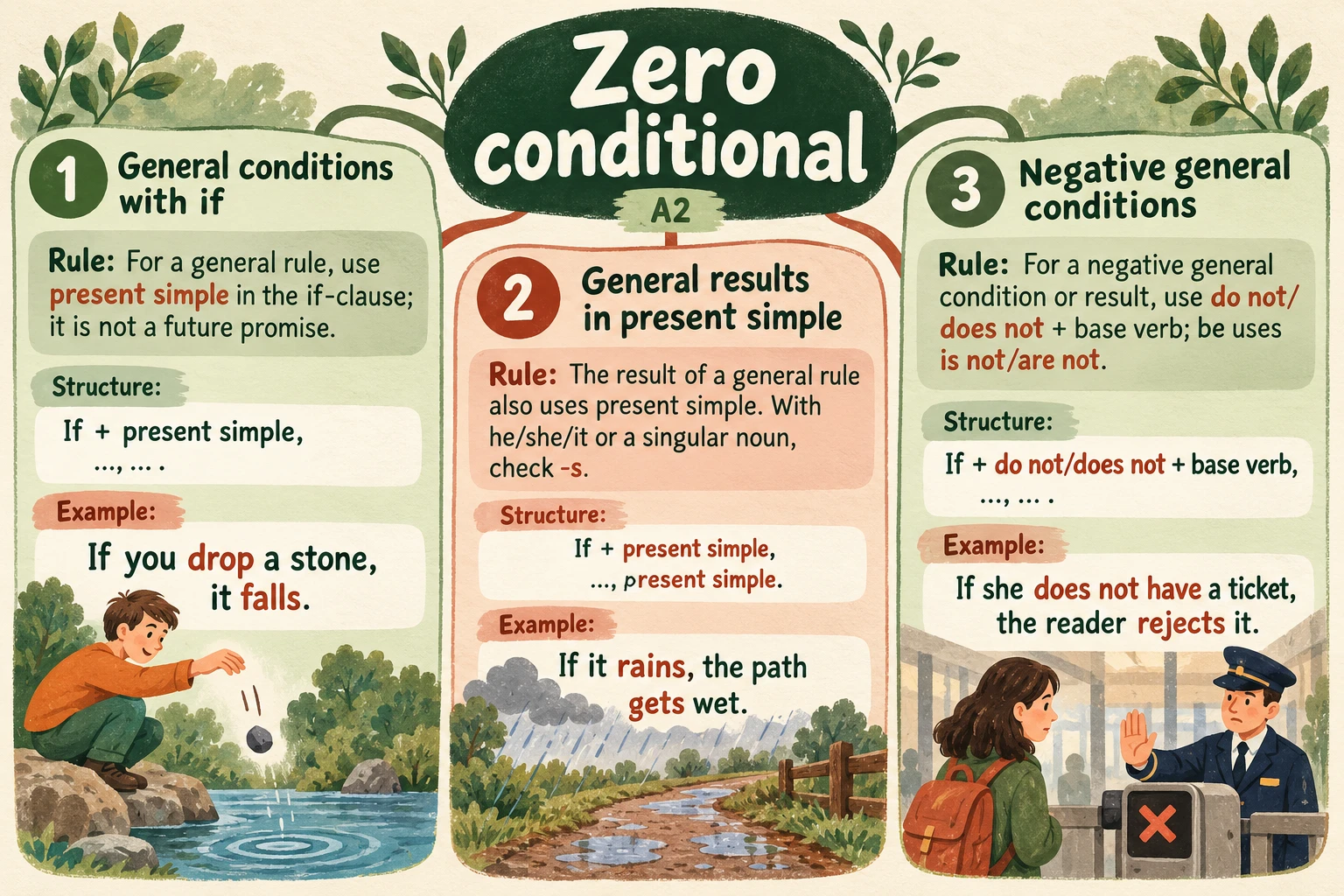
Para reglas generales usa presente simple en la cláusula con if; no es una promesa futura.
If you drop a stone, it falls.
Condicional cero · A2. Para reglas generales usa presente simple en la cláusula con if; no es una promesa futura.
Practica Condicional cero en situaciones breves. Lee la pista, elige o escribe una forma y revisa la explicación. El nivel es una orientación editorial.
Para reglas generales usa presente simple en la cláusula con if; no es una promesa futura.
If you drop a stone, it falls.El resultado de una regla general también usa presente simple; revisa -s con sujeto singular.
If it rains, the path gets wet.Para condiciones o resultados negativos usa do not/does not + verbo base; con be usa is not/are not.
If she does not have a ticket, the reader rejects it.
General fact: if you ___ ice above its melting point, it melts. (heat)
Para reglas generales usa presente simple en la cláusula con if; no es una promesa futura.
If you drop a stone, it falls.El resultado de una regla general también usa presente simple; revisa -s con sujeto singular.
If it rains, the path gets wet.Para condiciones o resultados negativos usa do not/does not + verbo base; con be usa is not/are not.
If she does not have a ticket, the reader rejects it.Conserva el primer intento, entiende el cambio y compruébalo en otra situación.
Aún no hay repasos. Prueba un calentamiento corto.
Para reglas generales usa presente simple en la cláusula con if; no es una promesa futura.
If you drop a stone, it falls.El resultado de una regla general también usa presente simple; revisa -s con sujeto singular.
If it rains, the path gets wet.Para condiciones o resultados negativos usa do not/does not + verbo base; con be usa is not/are not.
If she does not have a ticket, the reader rejects it.Abrir una respuesta registra ayuda para esa pregunta.
General fact: if you ___ ice above its melting point, it melts. (heat)
Mira «General fact: if you ___ ice above its melting point, it melts. (heat)». Para reglas generales usa presente simple en la cláusula con if; no es una promesa futura. Oración completa: «General fact: if you heat ice above its melting point, it melts. (heat)».
This machine always works like this: if you press START, the light ___ on. (come)
Mira «This machine always works like this: if you press START, the light ___ on. (come)». El resultado de una regla general también usa presente simple; revisa -s con sujeto singular. Oración completa: «This machine always works like this: if you press START, the light comes on. (come)».
Plants die if they ___ get water for too long. (negative do)
Mira «Plants die if they ___ get water for too long. (negative do)». Para condiciones o resultados negativos usa do not/does not + verbo base; con be usa is not/are not. Oración completa: «Plants die if they do not get water for too long. (negative do)».
General rule: if water ___ below zero Celsius under normal conditions, it freezes. (cool)
Oración de referencia: «General rule: if water cools below zero Celsius under normal conditions, it freezes. (cool)». Para reglas generales usa presente simple en la cláusula con if; no es una promesa futura.
The shop’s usual rule is: if an item is damaged, we ___ it. (replace)
Mira «The shop’s usual rule is: if an item is damaged, we ___ it. (replace)». El resultado de una regla general también usa presente simple; revisa -s con sujeto singular. Oración completa: «The shop’s usual rule is: if an item is damaged, we replace it. (replace)».
This alarm sounds if the door ___ closed. (negative be)
Mira «This alarm sounds if the door ___ closed. (negative be)». Para condiciones o resultados negativos usa do not/does not + verbo base; con be usa is not/are not. Oración completa: «This alarm sounds if the door is not closed. (negative be)».
General fact: if a person ___ no air, they cannot breathe. (have)
Oración de referencia: «General fact: if a person has no air, they cannot breathe. (have)». Para reglas generales usa presente simple en la cláusula con if; no es una promesa futura.
General rule: if you ___ red and white paint, you get pink. (mix)
Mira «General rule: if you ___ red and white paint, you get pink. (mix)». Para reglas generales usa presente simple en la cláusula con if; no es una promesa futura. Oración completa: «General rule: if you mix red and white paint, you get pink. (mix)».
The printer’s usual behaviour: if the paper runs out, it ___. (stop)
Mira «The printer’s usual behaviour: if the paper runs out, it ___. (stop)». El resultado de una regla general también usa presente simple; revisa -s con sujeto singular. Oración completa: «The printer’s usual behaviour: if the paper runs out, it stops. (stop)».
The scanner rejects a card if it ___ have a valid code. (negative do)
Oración de referencia: «The scanner rejects a card if it does not have a valid code. (negative do)». Para condiciones o resultados negativos usa do not/does not + verbo base; con be usa is not/are not.
General fact: if a metal bar gets hotter, it usually ___. (expand)
Mira «General fact: if a metal bar gets hotter, it usually ___. (expand)». El resultado de una regla general también usa presente simple; revisa -s con sujeto singular. Oración completa: «General fact: if a metal bar gets hotter, it usually expands. (expand)».
This automatic gate stays shut if the sensor ___ detect a car. (negative do)
Oración de referencia: «This automatic gate stays shut if the sensor does not detect a car. (negative do)». Para condiciones o resultados negativos usa do not/does not + verbo base; con be usa is not/are not.