01정해진 미래 일정
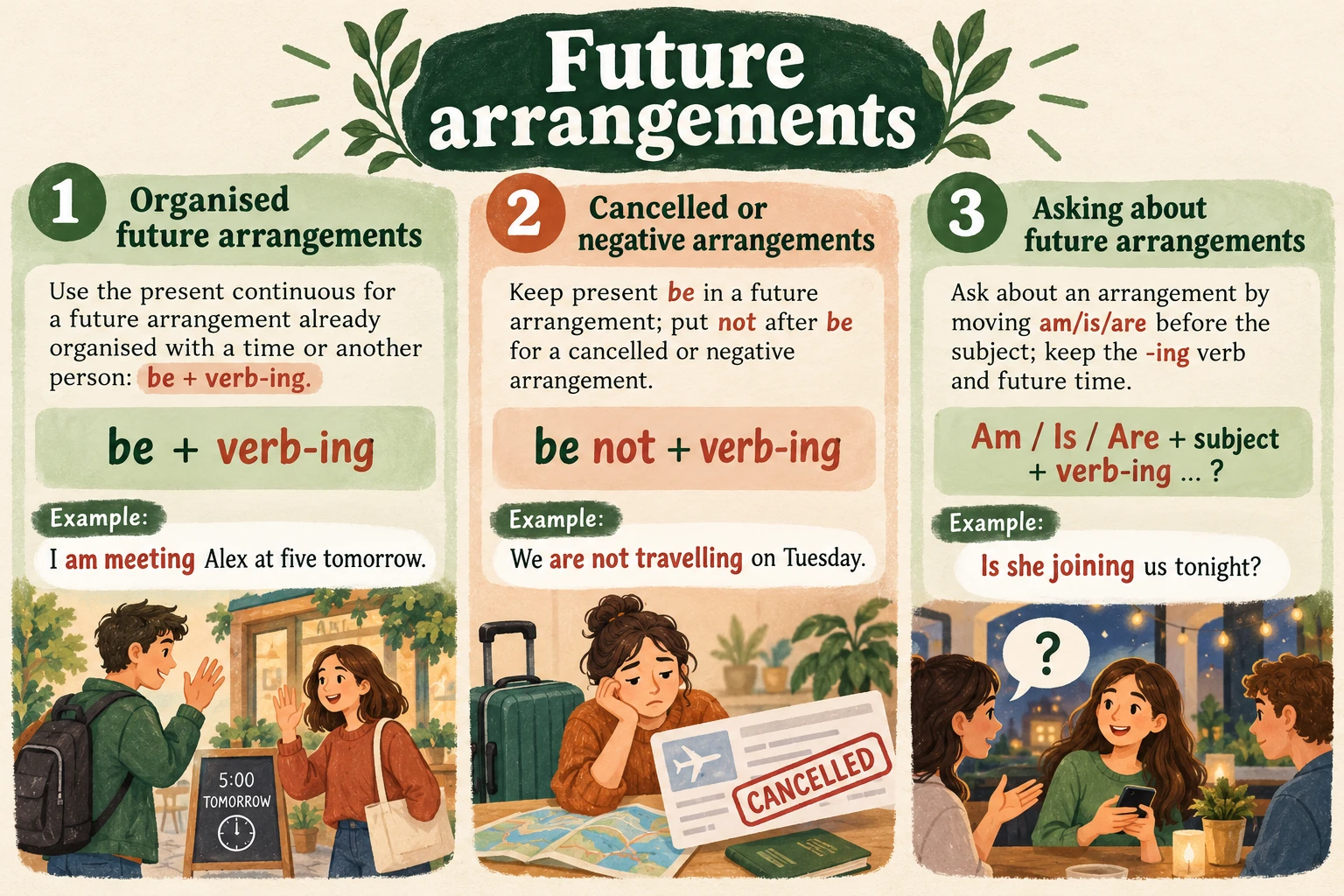
시간이나 상대가 정해진 미래 일정은 be+동사-ing의 현재진행형으로 나타냅니다.
I am meeting Alex at five tomorrow.
확정된 미래 일정 · A2. 시간이나 상대가 정해진 미래 일정은 be+동사-ing의 현재진행형으로 나타냅니다.
짧은 상황에서 ‘확정된 미래 일정’을 연습합니다. 단서를 읽고 형태를 고르거나 쓴 뒤 이유를 확인하세요. 수준은 편집상 안내입니다.
시간이나 상대가 정해진 미래 일정은 be+동사-ing의 현재진행형으로 나타냅니다.
I am meeting Alex at five tomorrow.미래 일정이라도 be는 현재형이며 부정은 be 뒤에 not을 둡니다.
We are not travelling on Tuesday.일정을 물을 때 am/is/are를 주어 앞에 두고 -ing와 미래 시간 표현을 유지합니다.
Is she joining us tonight?
We have tickets for tomorrow. We ___ to Rome in the morning. (fly; present continuous)
시간이나 상대가 정해진 미래 일정은 be+동사-ing의 현재진행형으로 나타냅니다.
I am meeting Alex at five tomorrow.미래 일정이라도 be는 현재형이며 부정은 be 뒤에 not을 둡니다.
We are not travelling on Tuesday.일정을 물을 때 am/is/are를 주어 앞에 두고 -ing와 미래 시간 표현을 유지합니다.
Is she joining us tonight?첫 시도를 남기고 변화의 이유를 이해한 뒤 새로운 상황에서 확인해 보세요.
아직 복습 노트가 없어요. 짧은 워밍업부터 해보세요.
시간이나 상대가 정해진 미래 일정은 be+동사-ing의 현재진행형으로 나타냅니다.
I am meeting Alex at five tomorrow.미래 일정이라도 be는 현재형이며 부정은 be 뒤에 not을 둡니다.
We are not travelling on Tuesday.일정을 물을 때 am/is/are를 주어 앞에 두고 -ing와 미래 시간 표현을 유지합니다.
Is she joining us tonight?정답을 열면 해당 문제에 도움 사용이 기록돼요.
We have tickets for tomorrow. We ___ to Rome in the morning. (fly; present continuous)
“We have tickets for tomorrow. We ___ to Rome in the morning. (fly; present continuous)”를 보세요. 시간이나 상대가 정해진 미래 일정은 be+동사-ing의 현재진행형으로 나타냅니다. 완성 문장: “We have tickets for tomorrow. We are flying to Rome in the morning. (fly; present continuous)”.
The meeting is cancelled. She ___ us on Friday. (not meet; present continuous)
“The meeting is cancelled. She ___ us on Friday. (not meet; present continuous)”를 보세요. 미래 일정이라도 be는 현재형이며 부정은 be 뒤에 not을 둡니다. 완성 문장: “The meeting is cancelled. She is not meeting us on Friday. (not meet; present continuous)”.
___ you having dinner with Jo tomorrow?
“___ you having dinner with Jo tomorrow?”를 보세요. 일정을 물을 때 am/is/are를 주어 앞에 두고 -ing와 미래 시간 표현을 유지합니다. 완성 문장: “Are you having dinner with Jo tomorrow?”.
My appointment is booked. I ___ the dentist at two tomorrow. (see; present continuous)
완성 예문: “My appointment is booked. I am seeing the dentist at two tomorrow. (see; present continuous)”. 시간이나 상대가 정해진 미래 일정은 be+동사-ing의 현재진행형으로 나타냅니다. 이 문제에서는 다음 표현도 확인된 답으로 인정합니다: 'm seeing. 가능한 모든 영어 표현의 목록은 아닙니다.
Our booking has changed. We ___ on Monday. (not leave; present continuous)
“Our booking has changed. We ___ on Monday. (not leave; present continuous)”를 보세요. 미래 일정이라도 be는 현재형이며 부정은 be 뒤에 not을 둡니다. 완성 문장: “Our booking has changed. We are not leaving on Monday. (not leave; present continuous)”.
What time ___ Leo catching the train tomorrow?
“What time ___ Leo catching the train tomorrow?”를 보세요. 일정을 물을 때 am/is/are를 주어 앞에 두고 -ing와 미래 시간 표현을 유지합니다. 완성 문장: “What time is Leo catching the train tomorrow?”.
The venue is reserved. Nina ___ a party on Saturday. (have; present continuous)
완성 예문: “The venue is reserved. Nina is having a party on Saturday. (have; present continuous)”. 시간이나 상대가 정해진 미래 일정은 be+동사-ing의 현재진행형으로 나타냅니다. 이 문제에서는 다음 표현도 확인된 답으로 인정합니다: 's having. 가능한 모든 영어 표현의 목록은 아닙니다.
The restaurant has our booking. We ___ there at eight tonight. (eat; present continuous)
“The restaurant has our booking. We ___ there at eight tonight. (eat; present continuous)”를 보세요. 시간이나 상대가 정해진 미래 일정은 be+동사-ing의 현재진행형으로 나타냅니다. 완성 문장: “The restaurant has our booking. We are eating there at eight tonight. (eat; present continuous)”.
His flight was changed. He ___ tonight. (not arrive; present continuous)
“His flight was changed. He ___ tonight. (not arrive; present continuous)”를 보세요. 미래 일정이라도 be는 현재형이며 부정은 be 뒤에 not을 둡니다. 완성 문장: “His flight was changed. He is not arriving tonight. (not arrive; present continuous)”.
Who ___ you meeting after class tomorrow?
완성 예문: “Who are you meeting after class tomorrow?”. 일정을 물을 때 am/is/are를 주어 앞에 두고 -ing와 미래 시간 표현을 유지합니다.
I cancelled my ticket. I ___ the concert on Sunday. (not attend; present continuous)
“I cancelled my ticket. I ___ the concert on Sunday. (not attend; present continuous)”를 보세요. 미래 일정이라도 be는 현재형이며 부정은 be 뒤에 not을 둡니다. 완성 문장: “I cancelled my ticket. I am not attending the concert on Sunday. (not attend; present continuous)”.
Where ___ your parents staying next weekend?
완성 예문: “Where are your parents staying next weekend?”. 일정을 물을 때 am/is/are를 주어 앞에 두고 -ing와 미래 시간 표현을 유지합니다.