01Organisierte Zukunftspläne
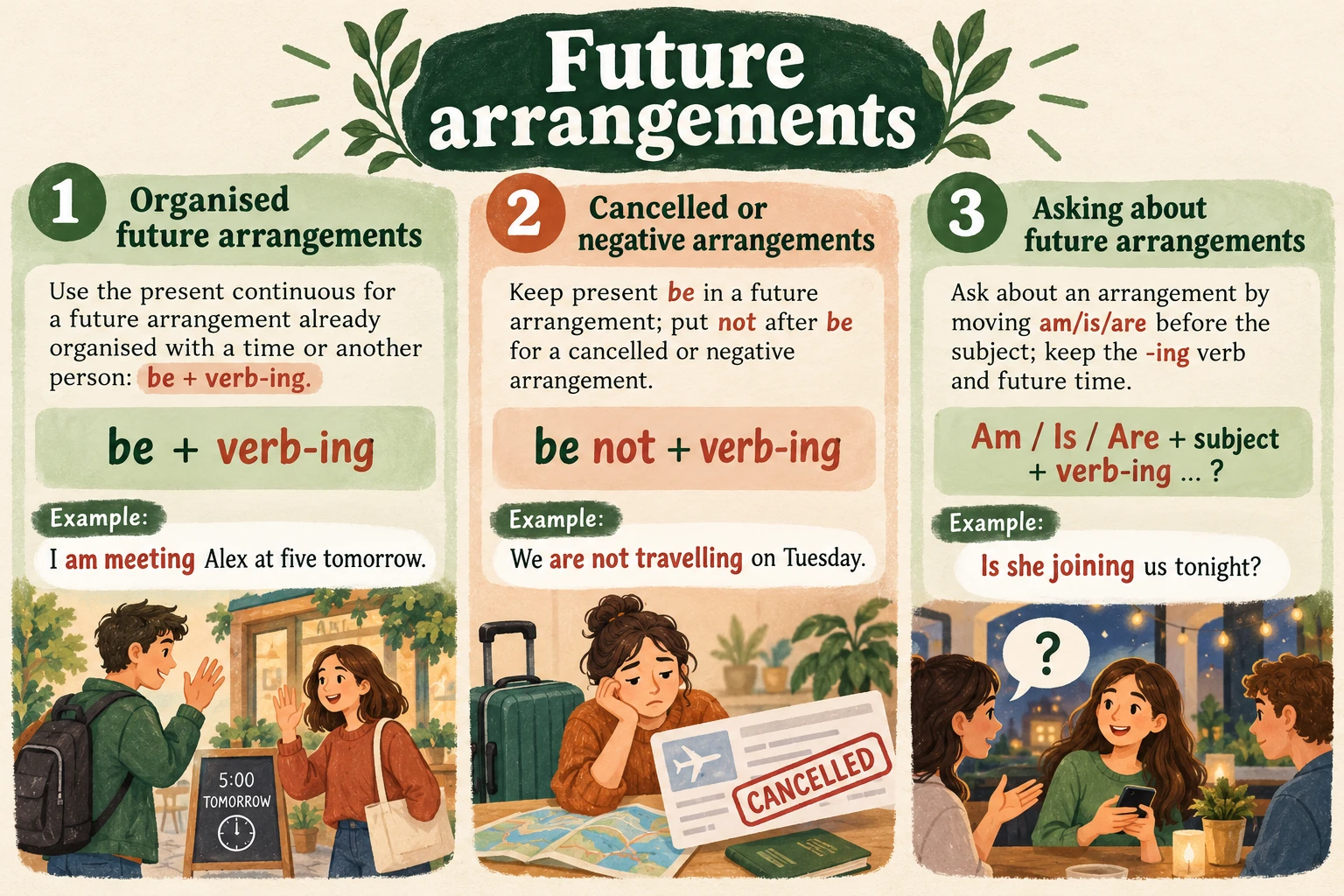
Die Verlaufsform be + Verb-ing beschreibt eine organisierte Zukunftsverabredung mit Zeit oder anderer Person.
I am meeting Alex at five tomorrow.
Feste Zukunftspläne · A2. Die Verlaufsform be + Verb-ing beschreibt eine organisierte Zukunftsverabredung mit Zeit oder anderer Person.
Übe Feste Zukunftspläne in kurzen Situationen. Lies den Hinweis, wähle oder schreibe eine Form und prüfe die Begründung. Die Stufe dient der redaktionellen Orientierung.
Die Verlaufsform be + Verb-ing beschreibt eine organisierte Zukunftsverabredung mit Zeit oder anderer Person.
I am meeting Alex at five tomorrow.Bei Zukunftsplänen bleibt be im Präsens; bei Verneinung folgt not auf be.
We are not travelling on Tuesday.Frage nach einer Verabredung mit am/is/are vor dem Subjekt; -ing-Verb und Zukunftszeit bleiben.
Is she joining us tonight?
We have tickets for tomorrow. We ___ to Rome in the morning. (fly; present continuous)
Die Verlaufsform be + Verb-ing beschreibt eine organisierte Zukunftsverabredung mit Zeit oder anderer Person.
I am meeting Alex at five tomorrow.Bei Zukunftsplänen bleibt be im Präsens; bei Verneinung folgt not auf be.
We are not travelling on Tuesday.Frage nach einer Verabredung mit am/is/are vor dem Subjekt; -ing-Verb und Zukunftszeit bleiben.
Is she joining us tonight?Bewahre den ersten Versuch. Verstehe die Änderung. Prüfe sie in einer neuen Situation.
Noch keine Lernnotizen. Starte mit einem kurzen Einstieg.
Die Verlaufsform be + Verb-ing beschreibt eine organisierte Zukunftsverabredung mit Zeit oder anderer Person.
I am meeting Alex at five tomorrow.Bei Zukunftsplänen bleibt be im Präsens; bei Verneinung folgt not auf be.
We are not travelling on Tuesday.Frage nach einer Verabredung mit am/is/are vor dem Subjekt; -ing-Verb und Zukunftszeit bleiben.
Is she joining us tonight?Das Öffnen einer Antwort wird für diese Aufgabe als Hilfe erfasst.
We have tickets for tomorrow. We ___ to Rome in the morning. (fly; present continuous)
Achte auf „We have tickets for tomorrow. We ___ to Rome in the morning. (fly; present continuous)“. Die Verlaufsform be + Verb-ing beschreibt eine organisierte Zukunftsverabredung mit Zeit oder anderer Person. Vollständiger Satz: „We have tickets for tomorrow. We are flying to Rome in the morning. (fly; present continuous)“.
The meeting is cancelled. She ___ us on Friday. (not meet; present continuous)
Achte auf „The meeting is cancelled. She ___ us on Friday. (not meet; present continuous)“. Bei Zukunftsplänen bleibt be im Präsens; bei Verneinung folgt not auf be. Vollständiger Satz: „The meeting is cancelled. She is not meeting us on Friday. (not meet; present continuous)“.
___ you having dinner with Jo tomorrow?
Achte auf „___ you having dinner with Jo tomorrow?“. Frage nach einer Verabredung mit am/is/are vor dem Subjekt; -ing-Verb und Zukunftszeit bleiben. Vollständiger Satz: „Are you having dinner with Jo tomorrow?“.
My appointment is booked. I ___ the dentist at two tomorrow. (see; present continuous)
Vollständiger Beispielsatz: „My appointment is booked. I am seeing the dentist at two tomorrow. (see; present continuous)“. Die Verlaufsform be + Verb-ing beschreibt eine organisierte Zukunftsverabredung mit Zeit oder anderer Person. In dieser Aufgabe sind auch diese Formen geprüft: 'm seeing. Die Liste ist nicht vollständig.
Our booking has changed. We ___ on Monday. (not leave; present continuous)
Achte auf „Our booking has changed. We ___ on Monday. (not leave; present continuous)“. Bei Zukunftsplänen bleibt be im Präsens; bei Verneinung folgt not auf be. Vollständiger Satz: „Our booking has changed. We are not leaving on Monday. (not leave; present continuous)“.
What time ___ Leo catching the train tomorrow?
Achte auf „What time ___ Leo catching the train tomorrow?“. Frage nach einer Verabredung mit am/is/are vor dem Subjekt; -ing-Verb und Zukunftszeit bleiben. Vollständiger Satz: „What time is Leo catching the train tomorrow?“.
The venue is reserved. Nina ___ a party on Saturday. (have; present continuous)
Vollständiger Beispielsatz: „The venue is reserved. Nina is having a party on Saturday. (have; present continuous)“. Die Verlaufsform be + Verb-ing beschreibt eine organisierte Zukunftsverabredung mit Zeit oder anderer Person. In dieser Aufgabe sind auch diese Formen geprüft: 's having. Die Liste ist nicht vollständig.
The restaurant has our booking. We ___ there at eight tonight. (eat; present continuous)
Achte auf „The restaurant has our booking. We ___ there at eight tonight. (eat; present continuous)“. Die Verlaufsform be + Verb-ing beschreibt eine organisierte Zukunftsverabredung mit Zeit oder anderer Person. Vollständiger Satz: „The restaurant has our booking. We are eating there at eight tonight. (eat; present continuous)“.
His flight was changed. He ___ tonight. (not arrive; present continuous)
Achte auf „His flight was changed. He ___ tonight. (not arrive; present continuous)“. Bei Zukunftsplänen bleibt be im Präsens; bei Verneinung folgt not auf be. Vollständiger Satz: „His flight was changed. He is not arriving tonight. (not arrive; present continuous)“.
Who ___ you meeting after class tomorrow?
Vollständiger Beispielsatz: „Who are you meeting after class tomorrow?“. Frage nach einer Verabredung mit am/is/are vor dem Subjekt; -ing-Verb und Zukunftszeit bleiben.
I cancelled my ticket. I ___ the concert on Sunday. (not attend; present continuous)
Achte auf „I cancelled my ticket. I ___ the concert on Sunday. (not attend; present continuous)“. Bei Zukunftsplänen bleibt be im Präsens; bei Verneinung folgt not auf be. Vollständiger Satz: „I cancelled my ticket. I am not attending the concert on Sunday. (not attend; present continuous)“.
Where ___ your parents staying next weekend?
Vollständiger Beispielsatz: „Where are your parents staying next weekend?“. Frage nach einer Verabredung mit am/is/are vor dem Subjekt; -ing-Verb und Zukunftszeit bleiben.