01Compromissos futuros organizados
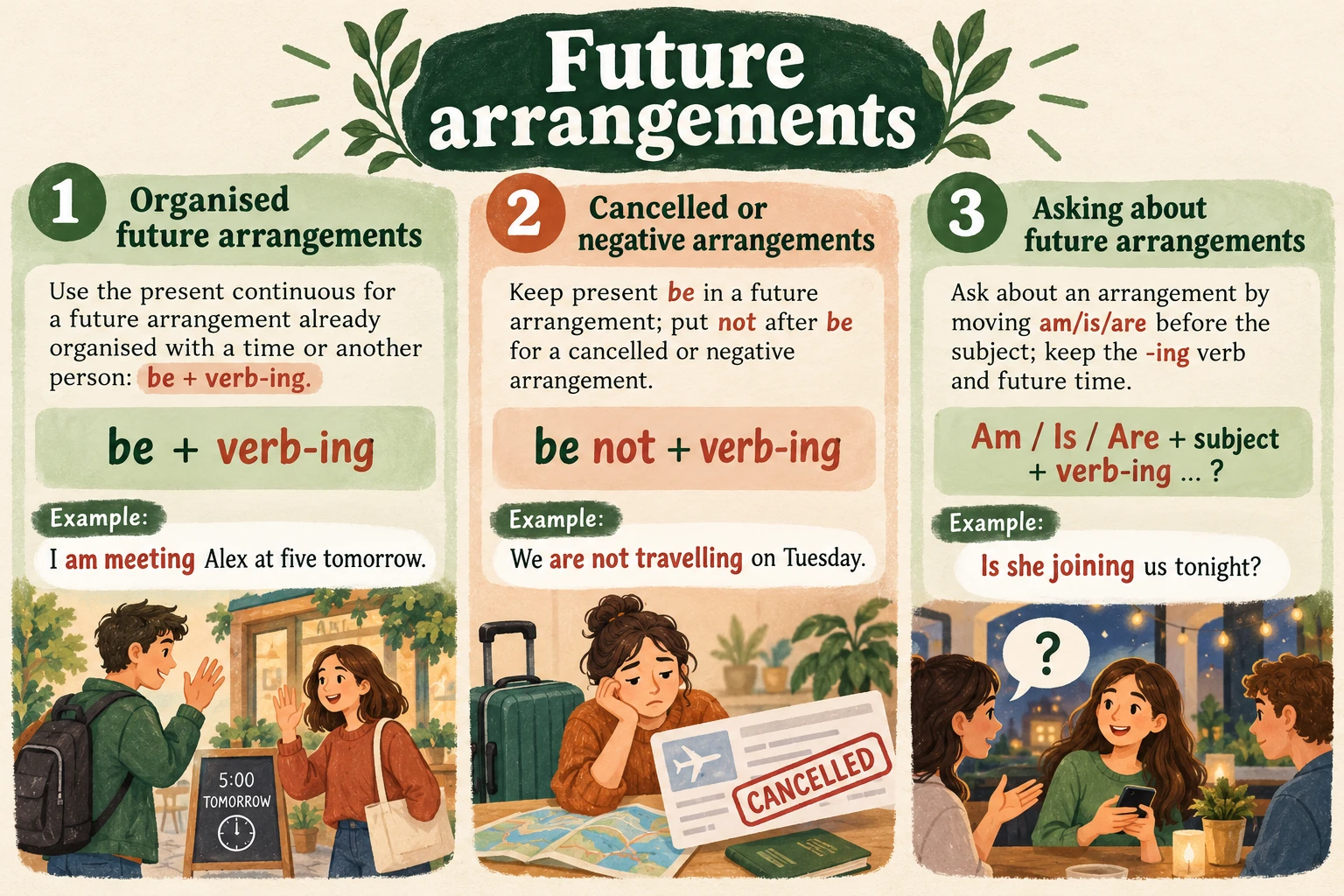
Use be + verbo-ing para compromisso futuro já organizado com horário ou outra pessoa.
I am meeting Alex at five tomorrow.
Compromissos futuros · A2. Use be + verbo-ing para compromisso futuro já organizado com horário ou outra pessoa.
Pratique Compromissos futuros em situações curtas. Leia a pista, escolha ou escreva uma forma e confira a explicação. O nível é uma orientação editorial.
Use be + verbo-ing para compromisso futuro já organizado com horário ou outra pessoa.
I am meeting Alex at five tomorrow.Mantenha be no presente em compromissos futuros; ponha not depois para negar.
We are not travelling on Tuesday.Pergunte sobre o compromisso movendo am/is/are antes do sujeito e mantendo -ing e o tempo futuro.
Is she joining us tonight?
We have tickets for tomorrow. We ___ to Rome in the morning. (fly; present continuous)
Use be + verbo-ing para compromisso futuro já organizado com horário ou outra pessoa.
I am meeting Alex at five tomorrow.Mantenha be no presente em compromissos futuros; ponha not depois para negar.
We are not travelling on Tuesday.Pergunte sobre o compromisso movendo am/is/are antes do sujeito e mantendo -ing e o tempo futuro.
Is she joining us tonight?Guarde a primeira tentativa, entenda a mudança e confira em outra situação.
Ainda não há revisões. Faça um aquecimento curto.
Use be + verbo-ing para compromisso futuro já organizado com horário ou outra pessoa.
I am meeting Alex at five tomorrow.Mantenha be no presente em compromissos futuros; ponha not depois para negar.
We are not travelling on Tuesday.Pergunte sobre o compromisso movendo am/is/are antes do sujeito e mantendo -ing e o tempo futuro.
Is she joining us tonight?Abrir uma resposta registra ajuda para essa questão.
We have tickets for tomorrow. We ___ to Rome in the morning. (fly; present continuous)
Observe “We have tickets for tomorrow. We ___ to Rome in the morning. (fly; present continuous)”. Use be + verbo-ing para compromisso futuro já organizado com horário ou outra pessoa. Frase completa: “We have tickets for tomorrow. We are flying to Rome in the morning. (fly; present continuous)”.
The meeting is cancelled. She ___ us on Friday. (not meet; present continuous)
Observe “The meeting is cancelled. She ___ us on Friday. (not meet; present continuous)”. Mantenha be no presente em compromissos futuros; ponha not depois para negar. Frase completa: “The meeting is cancelled. She is not meeting us on Friday. (not meet; present continuous)”.
___ you having dinner with Jo tomorrow?
Observe “___ you having dinner with Jo tomorrow?”. Pergunte sobre o compromisso movendo am/is/are antes do sujeito e mantendo -ing e o tempo futuro. Frase completa: “Are you having dinner with Jo tomorrow?”.
My appointment is booked. I ___ the dentist at two tomorrow. (see; present continuous)
Frase de referência: “My appointment is booked. I am seeing the dentist at two tomorrow. (see; present continuous)”. Use be + verbo-ing para compromisso futuro já organizado com horário ou outra pessoa. Também são aceitas estas variantes revisadas: 'm seeing. A lista não cobre todas as expressões possíveis.
Our booking has changed. We ___ on Monday. (not leave; present continuous)
Observe “Our booking has changed. We ___ on Monday. (not leave; present continuous)”. Mantenha be no presente em compromissos futuros; ponha not depois para negar. Frase completa: “Our booking has changed. We are not leaving on Monday. (not leave; present continuous)”.
What time ___ Leo catching the train tomorrow?
Observe “What time ___ Leo catching the train tomorrow?”. Pergunte sobre o compromisso movendo am/is/are antes do sujeito e mantendo -ing e o tempo futuro. Frase completa: “What time is Leo catching the train tomorrow?”.
The venue is reserved. Nina ___ a party on Saturday. (have; present continuous)
Frase de referência: “The venue is reserved. Nina is having a party on Saturday. (have; present continuous)”. Use be + verbo-ing para compromisso futuro já organizado com horário ou outra pessoa. Também são aceitas estas variantes revisadas: 's having. A lista não cobre todas as expressões possíveis.
The restaurant has our booking. We ___ there at eight tonight. (eat; present continuous)
Observe “The restaurant has our booking. We ___ there at eight tonight. (eat; present continuous)”. Use be + verbo-ing para compromisso futuro já organizado com horário ou outra pessoa. Frase completa: “The restaurant has our booking. We are eating there at eight tonight. (eat; present continuous)”.
His flight was changed. He ___ tonight. (not arrive; present continuous)
Observe “His flight was changed. He ___ tonight. (not arrive; present continuous)”. Mantenha be no presente em compromissos futuros; ponha not depois para negar. Frase completa: “His flight was changed. He is not arriving tonight. (not arrive; present continuous)”.
Who ___ you meeting after class tomorrow?
Frase de referência: “Who are you meeting after class tomorrow?”. Pergunte sobre o compromisso movendo am/is/are antes do sujeito e mantendo -ing e o tempo futuro.
I cancelled my ticket. I ___ the concert on Sunday. (not attend; present continuous)
Observe “I cancelled my ticket. I ___ the concert on Sunday. (not attend; present continuous)”. Mantenha be no presente em compromissos futuros; ponha not depois para negar. Frase completa: “I cancelled my ticket. I am not attending the concert on Sunday. (not attend; present continuous)”.
Where ___ your parents staying next weekend?
Frase de referência: “Where are your parents staying next weekend?”. Pergunte sobre o compromisso movendo am/is/are antes do sujeito e mantendo -ing e o tempo futuro.