01a reduced active relative clause: the noun performs the ongoing action
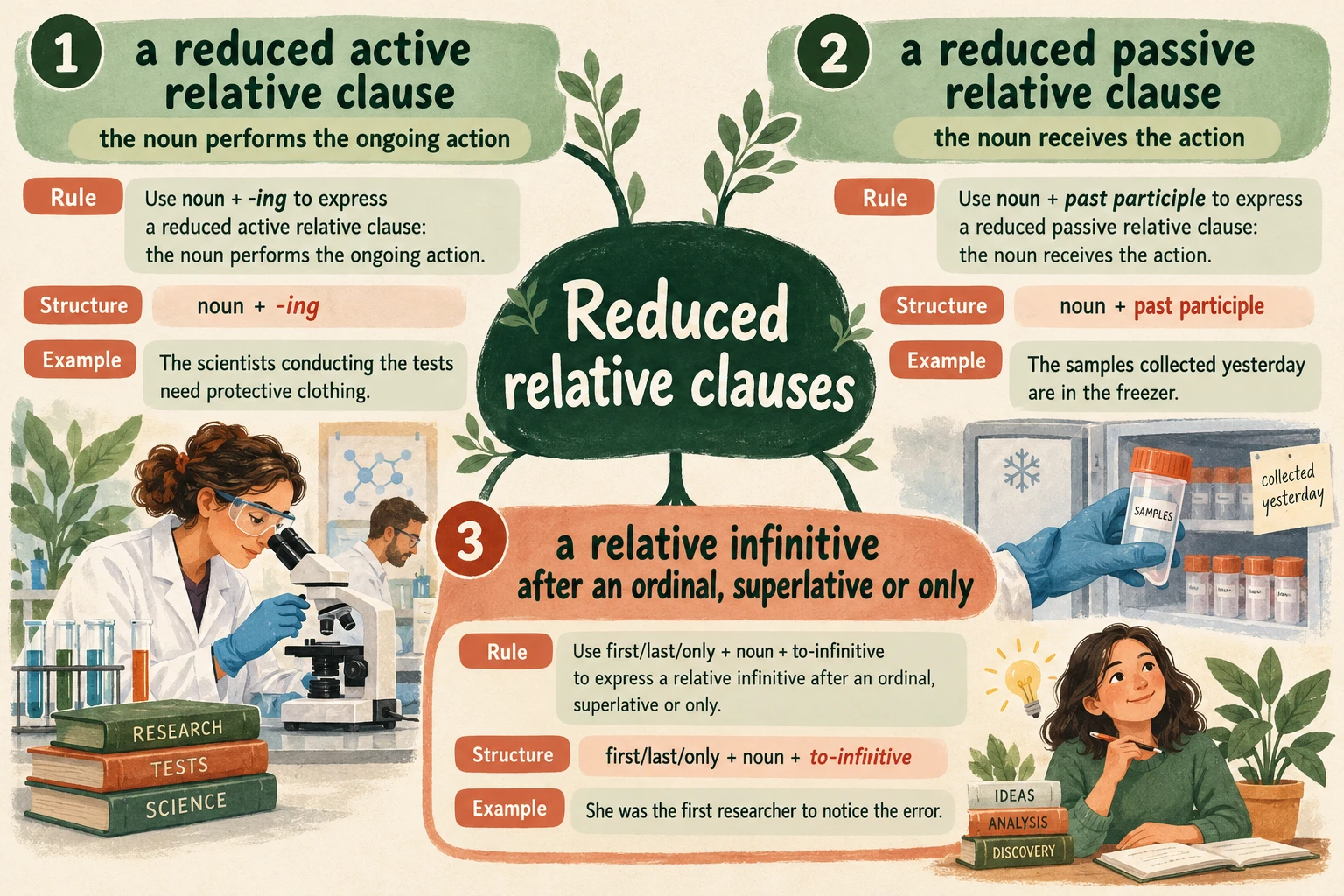
Use noun + -ing to express a reduced active relative clause: the noun performs the ongoing action.
The scientists conducting the tests need protective clothing.
Reduced relative clauses · B2. Use noun + -ing to express a reduced active relative clause: the noun performs the ongoing action.
Complete 12 original tasks. Use the situation to choose the intended meaning, practise the form, then apply it in a fresh context.
Use noun + -ing to express a reduced active relative clause: the noun performs the ongoing action.
The scientists conducting the tests need protective clothing.Use noun + past participle to express a reduced passive relative clause: the noun receives the action.
The samples collected yesterday are in the freezer.Use first/last/only + noun + to-infinitive to express a relative infinitive after an ordinal, superlative or only.
She was the first researcher to notice the error.
The scientists are carrying out the tests themselves.
Use noun + -ing to express a reduced active relative clause: the noun performs the ongoing action.
The scientists conducting the tests need protective clothing.Use noun + past participle to express a reduced passive relative clause: the noun receives the action.
The samples collected yesterday are in the freezer.Use first/last/only + noun + to-infinitive to express a relative infinitive after an ordinal, superlative or only.
She was the first researcher to notice the error.Keep the first try. Understand the change. Check it in a fresh situation.
No practice notes yet. Try a short warm-up.
Use noun + -ing to express a reduced active relative clause: the noun performs the ongoing action.
The scientists conducting the tests need protective clothing.Use noun + past participle to express a reduced passive relative clause: the noun receives the action.
The samples collected yesterday are in the freezer.Use first/last/only + noun + to-infinitive to express a relative infinitive after an ordinal, superlative or only.
She was the first researcher to notice the error.Opening an answer records help for that question.
The scientists are carrying out the tests themselves.
The deciding clue is “The scientists are carrying out the tests themselves.”. Use noun + -ing to express a reduced active relative clause: the noun performs the ongoing action. In this task, the completed sentence is “The scientists conducting the tests need protective clothing.”.
The samples receive the action, performed yesterday.
The deciding clue is “The samples receive the action, performed yesterday.”. Use noun + past participle to express a reduced passive relative clause: the noun receives the action. In this task, the completed sentence is “The samples collected yesterday are in the freezer.”.
An ordinal identifies the first person who acted.
The deciding clue is “An ordinal identifies the first person who acted.”. Use first/last/only + noun + to-infinitive to express a relative infinitive after an ordinal, superlative or only. In this task, the completed sentence is “She was the first researcher to notice the error.”.
People are currently queuing outside.
The deciding clue is “People are currently queuing outside.”. Use noun + -ing to express a reduced active relative clause: the noun performs the ongoing action. In this task, the completed sentence is “Anyone waiting outside should move under the shelter.”.
Use a reduced passive relative clause with approve; the plan receives the board’s approval.
Complete sentence: “The plan approved by the board includes a new laboratory.” Use noun + past participle to express a reduced passive relative clause: the noun receives the action. The subject, time and meaning in the task determine this form. Only reviewed responses are matched automatically; other wording is not automatically wrong.
Only plus a noun takes a relative infinitive.
The deciding clue is “Only plus a noun takes a relative infinitive.”. Use first/last/only + noun + to-infinitive to express a relative infinitive after an ordinal, superlative or only. In this task, the completed sentence is “The only person to respond was the caretaker.”.
Use a reduced active relative clause with carry; the passengers perform the action.
Complete sentence: “Passengers carrying large bags must use the lift.” Use noun + -ing to express a reduced active relative clause: the noun performs the ongoing action. The subject, time and meaning in the task determine this form. Only reviewed responses are matched automatically; other wording is not automatically wrong.
The engineers themselves work on the bridge.
The deciding clue is “The engineers themselves work on the bridge.”. Use noun + -ing to express a reduced active relative clause: the noun performs the ongoing action. In this task, the completed sentence is “The engineers working on the bridge need permits.”.
Use a reduced passive relative clause with damage.
Complete sentence: “The houses damaged in the storm will be inspected.” Use noun + past participle to express a reduced passive relative clause: the noun receives the action. The subject, time and meaning in the task determine this form. Only reviewed responses are matched automatically; other wording is not automatically wrong.
The final person who leaves should switch off the lights.
The deciding clue is “The final person who leaves should switch off the lights.”. Use first/last/only + noun + to-infinitive to express a relative infinitive after an ordinal, superlative or only. In this task, the completed sentence is “The last person to leave must switch off the lights.”.
The emails receive automated generation.
The deciding clue is “The emails receive automated generation.”. Use noun + past participle to express a reduced passive relative clause: the noun receives the action. In this task, the completed sentence is “Emails generated by this system cannot be replied to.”.
Use a to-infinitive of reach after the first team, rather than a full finite relative clause.
Complete sentence: “They were the first team to reach the remote camp.” Use first/last/only + noun + to-infinitive to express a relative infinitive after an ordinal, superlative or only. The subject, time and meaning in the task determine this form. Only reviewed responses are matched automatically; other wording is not automatically wrong.