01une relative active réduite : le nom accomplit l’action en cours
Utilisez noun + -ing pour exprimer une relative active réduite : le nom accomplit l’action en cours.
The scientists conducting the tests need protective clothing.
Relatives réduites · B2. Utilisez noun + -ing pour exprimer une relative active réduite : le nom accomplit l’action en cours.
Réalisez 12 exercices originaux. Appuyez-vous sur la situation pour interpréter le sens, pratiquer la forme et la réutiliser dans un nouveau contexte.
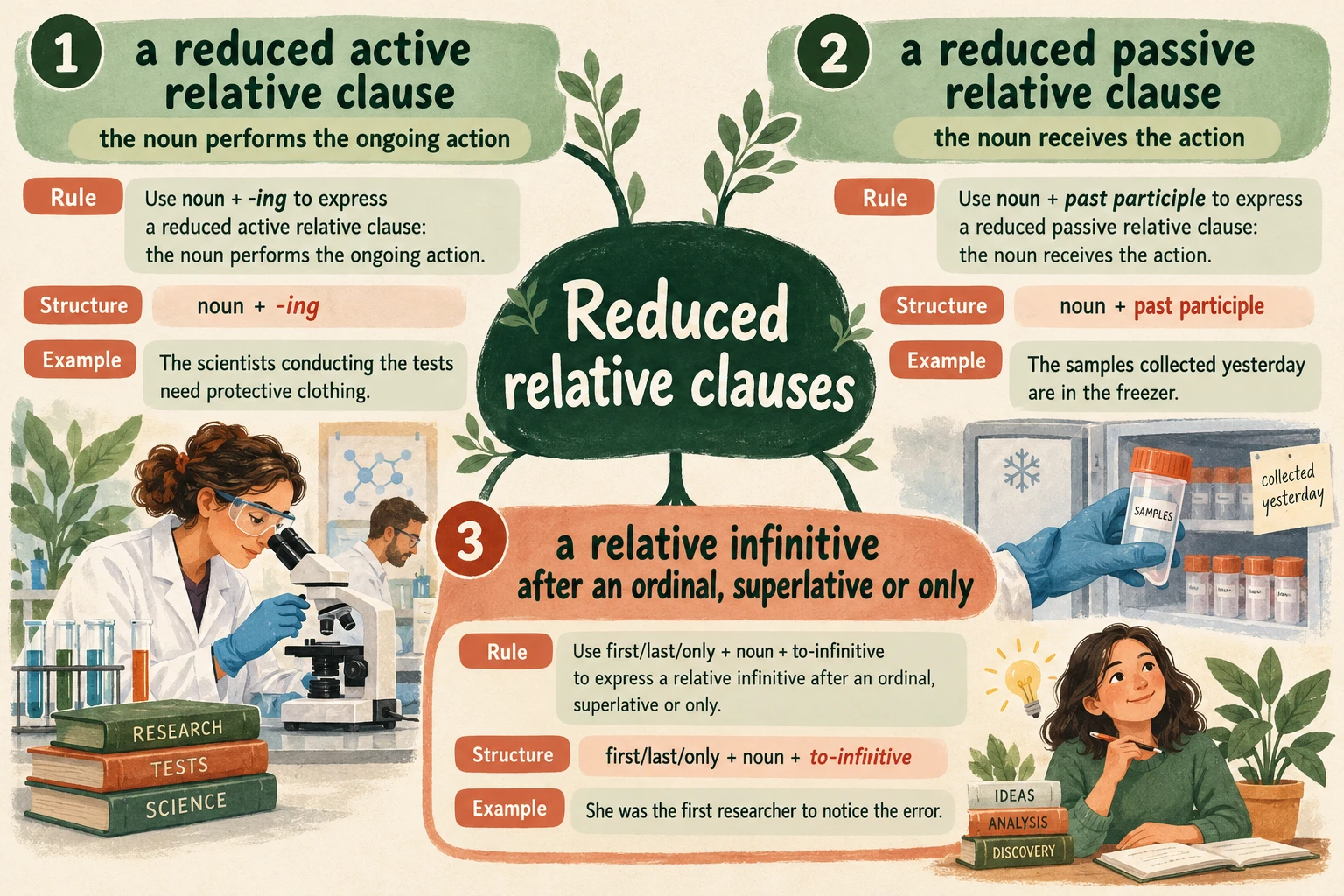
Utilisez noun + -ing pour exprimer une relative active réduite : le nom accomplit l’action en cours.
The scientists conducting the tests need protective clothing.Utilisez noun + past participle pour exprimer une relative passive réduite : le nom subit l’action.
The samples collected yesterday are in the freezer.Utilisez first/last/only + noun + to-infinitive pour exprimer un infinitif relatif après un ordinal, superlatif ou only.
She was the first researcher to notice the error.
The scientists are carrying out the tests themselves.
Utilisez noun + -ing pour exprimer une relative active réduite : le nom accomplit l’action en cours.
The scientists conducting the tests need protective clothing.Utilisez noun + past participle pour exprimer une relative passive réduite : le nom subit l’action.
The samples collected yesterday are in the freezer.Utilisez first/last/only + noun + to-infinitive pour exprimer un infinitif relatif après un ordinal, superlatif ou only.
She was the first researcher to notice the error.Gardez la première tentative, comprenez le changement et essayez dans une nouvelle situation.
Pas encore de notes. Essayez un court échauffement.
Utilisez noun + -ing pour exprimer une relative active réduite : le nom accomplit l’action en cours.
The scientists conducting the tests need protective clothing.Utilisez noun + past participle pour exprimer une relative passive réduite : le nom subit l’action.
The samples collected yesterday are in the freezer.Utilisez first/last/only + noun + to-infinitive pour exprimer un infinitif relatif après un ordinal, superlatif ou only.
She was the first researcher to notice the error.Ouvrir une réponse enregistre une aide pour cette question.
The scientists are carrying out the tests themselves.
L’indice décisif est « The scientists are carrying out the tests themselves. ». Utilisez noun + -ing pour exprimer une relative active réduite : le nom accomplit l’action en cours. Dans cette tâche, la phrase complète est « The scientists conducting the tests need protective clothing. ».
The samples receive the action, performed yesterday.
L’indice décisif est « The samples receive the action, performed yesterday. ». Utilisez noun + past participle pour exprimer une relative passive réduite : le nom subit l’action. Dans cette tâche, la phrase complète est « The samples collected yesterday are in the freezer. ».
An ordinal identifies the first person who acted.
L’indice décisif est « An ordinal identifies the first person who acted. ». Utilisez first/last/only + noun + to-infinitive pour exprimer un infinitif relatif après un ordinal, superlatif ou only. Dans cette tâche, la phrase complète est « She was the first researcher to notice the error. ».
People are currently queuing outside.
L’indice décisif est « People are currently queuing outside. ». Utilisez noun + -ing pour exprimer une relative active réduite : le nom accomplit l’action en cours. Dans cette tâche, la phrase complète est « Anyone waiting outside should move under the shelter. ».
Use a reduced passive relative clause with approve; the plan receives the board’s approval.
Phrase complète : « The plan approved by the board includes a new laboratory. » Utilisez noun + past participle pour exprimer une relative passive réduite : le nom subit l’action. Le sujet, le temps et le sens de la consigne déterminent cette forme. Seules les réponses vérifiées sont comparées automatiquement ; toute autre formulation n’est pas automatiquement fausse.
Only plus a noun takes a relative infinitive.
L’indice décisif est « Only plus a noun takes a relative infinitive. ». Utilisez first/last/only + noun + to-infinitive pour exprimer un infinitif relatif après un ordinal, superlatif ou only. Dans cette tâche, la phrase complète est « The only person to respond was the caretaker. ».
Use a reduced active relative clause with carry; the passengers perform the action.
Phrase complète : « Passengers carrying large bags must use the lift. » Utilisez noun + -ing pour exprimer une relative active réduite : le nom accomplit l’action en cours. Le sujet, le temps et le sens de la consigne déterminent cette forme. Seules les réponses vérifiées sont comparées automatiquement ; toute autre formulation n’est pas automatiquement fausse.
The engineers themselves work on the bridge.
L’indice décisif est « The engineers themselves work on the bridge. ». Utilisez noun + -ing pour exprimer une relative active réduite : le nom accomplit l’action en cours. Dans cette tâche, la phrase complète est « The engineers working on the bridge need permits. ».
Use a reduced passive relative clause with damage.
Phrase complète : « The houses damaged in the storm will be inspected. » Utilisez noun + past participle pour exprimer une relative passive réduite : le nom subit l’action. Le sujet, le temps et le sens de la consigne déterminent cette forme. Seules les réponses vérifiées sont comparées automatiquement ; toute autre formulation n’est pas automatiquement fausse.
The final person who leaves should switch off the lights.
L’indice décisif est « The final person who leaves should switch off the lights. ». Utilisez first/last/only + noun + to-infinitive pour exprimer un infinitif relatif après un ordinal, superlatif ou only. Dans cette tâche, la phrase complète est « The last person to leave must switch off the lights. ».
The emails receive automated generation.
L’indice décisif est « The emails receive automated generation. ». Utilisez noun + past participle pour exprimer une relative passive réduite : le nom subit l’action. Dans cette tâche, la phrase complète est « Emails generated by this system cannot be replied to. ».
Use a to-infinitive of reach after the first team, rather than a full finite relative clause.
Phrase complète : « They were the first team to reach the remote camp. » Utilisez first/last/only + noun + to-infinitive pour exprimer un infinitif relatif après un ordinal, superlatif ou only. Le sujet, le temps et le sens de la consigne déterminent cette forme. Seules les réponses vérifiées sont comparées automatiquement ; toute autre formulation n’est pas automatiquement fausse.