01uma relativa ativa reduzida: o nome executa a ação em andamento
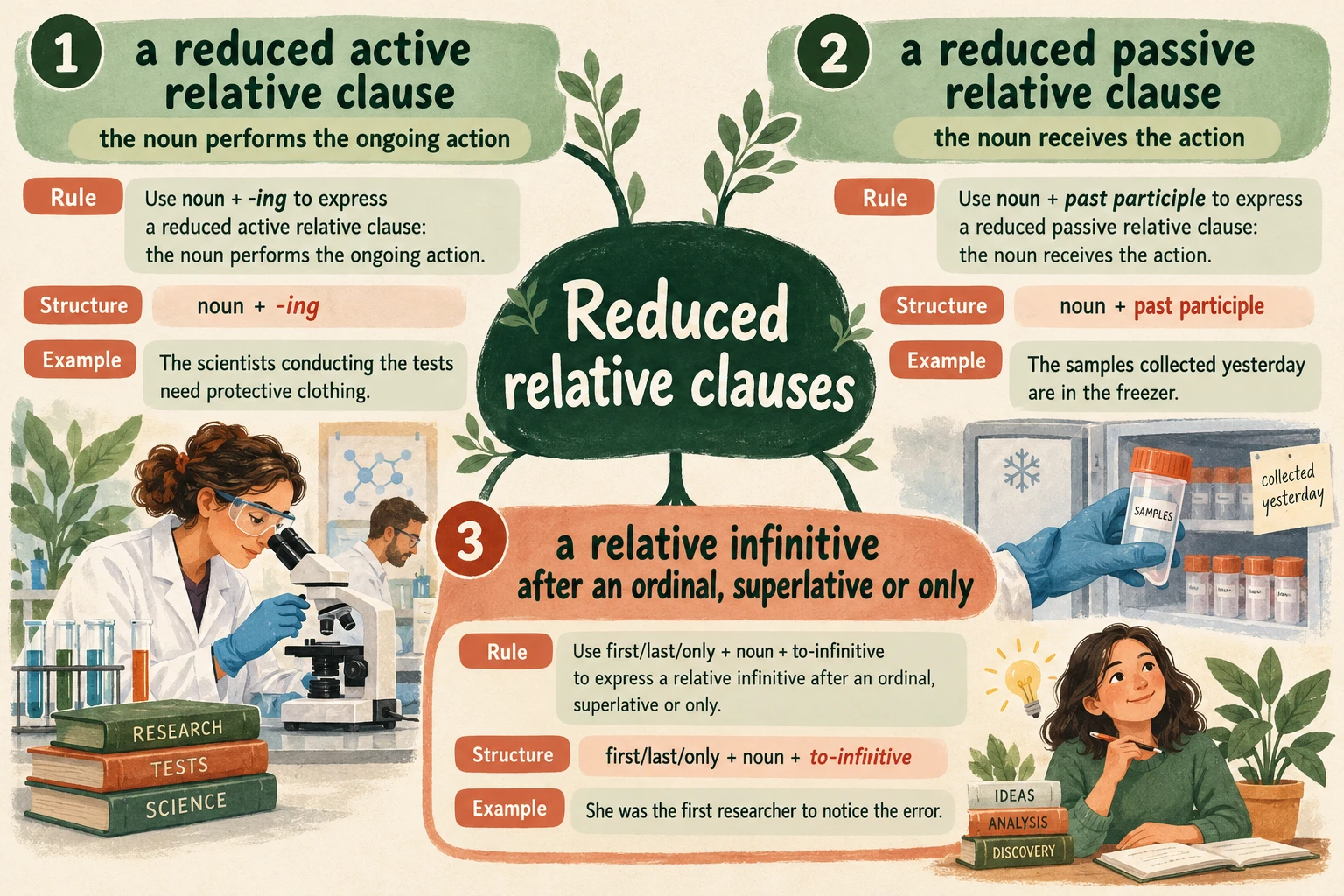
Use noun + -ing para expressar uma relativa ativa reduzida: o nome executa a ação em andamento.
The scientists conducting the tests need protective clothing.
Orações relativas reduzidas · B2. Use noun + -ing para expressar uma relativa ativa reduzida: o nome executa a ação em andamento.
Resolva 12 tarefas originais. Use a situação para interpretar o sentido, praticar a estrutura e aplicá-la em um novo contexto.
Use noun + -ing para expressar uma relativa ativa reduzida: o nome executa a ação em andamento.
The scientists conducting the tests need protective clothing.Use noun + past participle para expressar uma relativa passiva reduzida: o nome recebe a ação.
The samples collected yesterday are in the freezer.Use first/last/only + noun + to-infinitive para expressar um infinitivo relativo após ordinal, superlativo ou only.
She was the first researcher to notice the error.
The scientists are carrying out the tests themselves.
Use noun + -ing para expressar uma relativa ativa reduzida: o nome executa a ação em andamento.
The scientists conducting the tests need protective clothing.Use noun + past participle para expressar uma relativa passiva reduzida: o nome recebe a ação.
The samples collected yesterday are in the freezer.Use first/last/only + noun + to-infinitive para expressar um infinitivo relativo após ordinal, superlativo ou only.
She was the first researcher to notice the error.Guarde a primeira tentativa, entenda a mudança e confira em outra situação.
Ainda não há revisões. Faça um aquecimento curto.
Use noun + -ing para expressar uma relativa ativa reduzida: o nome executa a ação em andamento.
The scientists conducting the tests need protective clothing.Use noun + past participle para expressar uma relativa passiva reduzida: o nome recebe a ação.
The samples collected yesterday are in the freezer.Use first/last/only + noun + to-infinitive para expressar um infinitivo relativo após ordinal, superlativo ou only.
She was the first researcher to notice the error.Abrir uma resposta registra ajuda para essa questão.
The scientists are carrying out the tests themselves.
A pista decisiva é “The scientists are carrying out the tests themselves.”. Use noun + -ing para expressar uma relativa ativa reduzida: o nome executa a ação em andamento. Nesta tarefa, a frase completa é “The scientists conducting the tests need protective clothing.”.
The samples receive the action, performed yesterday.
A pista decisiva é “The samples receive the action, performed yesterday.”. Use noun + past participle para expressar uma relativa passiva reduzida: o nome recebe a ação. Nesta tarefa, a frase completa é “The samples collected yesterday are in the freezer.”.
An ordinal identifies the first person who acted.
A pista decisiva é “An ordinal identifies the first person who acted.”. Use first/last/only + noun + to-infinitive para expressar um infinitivo relativo após ordinal, superlativo ou only. Nesta tarefa, a frase completa é “She was the first researcher to notice the error.”.
People are currently queuing outside.
A pista decisiva é “People are currently queuing outside.”. Use noun + -ing para expressar uma relativa ativa reduzida: o nome executa a ação em andamento. Nesta tarefa, a frase completa é “Anyone waiting outside should move under the shelter.”.
Use a reduced passive relative clause with approve; the plan receives the board’s approval.
Frase completa: “The plan approved by the board includes a new laboratory.” Use noun + past participle para expressar uma relativa passiva reduzida: o nome recebe a ação. O sujeito, o tempo e o sentido da tarefa determinam esta forma. Só as respostas revisadas são comparadas automaticamente; outras formulações não estão automaticamente erradas.
Only plus a noun takes a relative infinitive.
A pista decisiva é “Only plus a noun takes a relative infinitive.”. Use first/last/only + noun + to-infinitive para expressar um infinitivo relativo após ordinal, superlativo ou only. Nesta tarefa, a frase completa é “The only person to respond was the caretaker.”.
Use a reduced active relative clause with carry; the passengers perform the action.
Frase completa: “Passengers carrying large bags must use the lift.” Use noun + -ing para expressar uma relativa ativa reduzida: o nome executa a ação em andamento. O sujeito, o tempo e o sentido da tarefa determinam esta forma. Só as respostas revisadas são comparadas automaticamente; outras formulações não estão automaticamente erradas.
The engineers themselves work on the bridge.
A pista decisiva é “The engineers themselves work on the bridge.”. Use noun + -ing para expressar uma relativa ativa reduzida: o nome executa a ação em andamento. Nesta tarefa, a frase completa é “The engineers working on the bridge need permits.”.
Use a reduced passive relative clause with damage.
Frase completa: “The houses damaged in the storm will be inspected.” Use noun + past participle para expressar uma relativa passiva reduzida: o nome recebe a ação. O sujeito, o tempo e o sentido da tarefa determinam esta forma. Só as respostas revisadas são comparadas automaticamente; outras formulações não estão automaticamente erradas.
The final person who leaves should switch off the lights.
A pista decisiva é “The final person who leaves should switch off the lights.”. Use first/last/only + noun + to-infinitive para expressar um infinitivo relativo após ordinal, superlativo ou only. Nesta tarefa, a frase completa é “The last person to leave must switch off the lights.”.
The emails receive automated generation.
A pista decisiva é “The emails receive automated generation.”. Use noun + past participle para expressar uma relativa passiva reduzida: o nome recebe a ação. Nesta tarefa, a frase completa é “Emails generated by this system cannot be replied to.”.
Use a to-infinitive of reach after the first team, rather than a full finite relative clause.
Frase completa: “They were the first team to reach the remote camp.” Use first/last/only + noun + to-infinitive para expressar um infinitivo relativo após ordinal, superlativo ou only. O sujeito, o tempo e o sentido da tarefa determinam esta forma. Só as respostas revisadas são comparadas automaticamente; outras formulações não estão automaticamente erradas.