
A1-A2

Present Simple Exercises

About this lesson

Present simple · A1. Use the present simple for routines and general facts. With most main verbs, I/you/we/they take the base form; he/she/it and singular nouns take an -s or -es form. Spelling can change: study → studies; go → goes. This rule is for affirmative main verbs, not every verb in every sentence.

Talk about routines and present states. Practise verb endings, do/does, and am/is/are.

12 items
Save it to find it in My collection.
Knowledge map

Present simple

Start practising
Present simple — Knowledge map

01Routines and affirmative forms

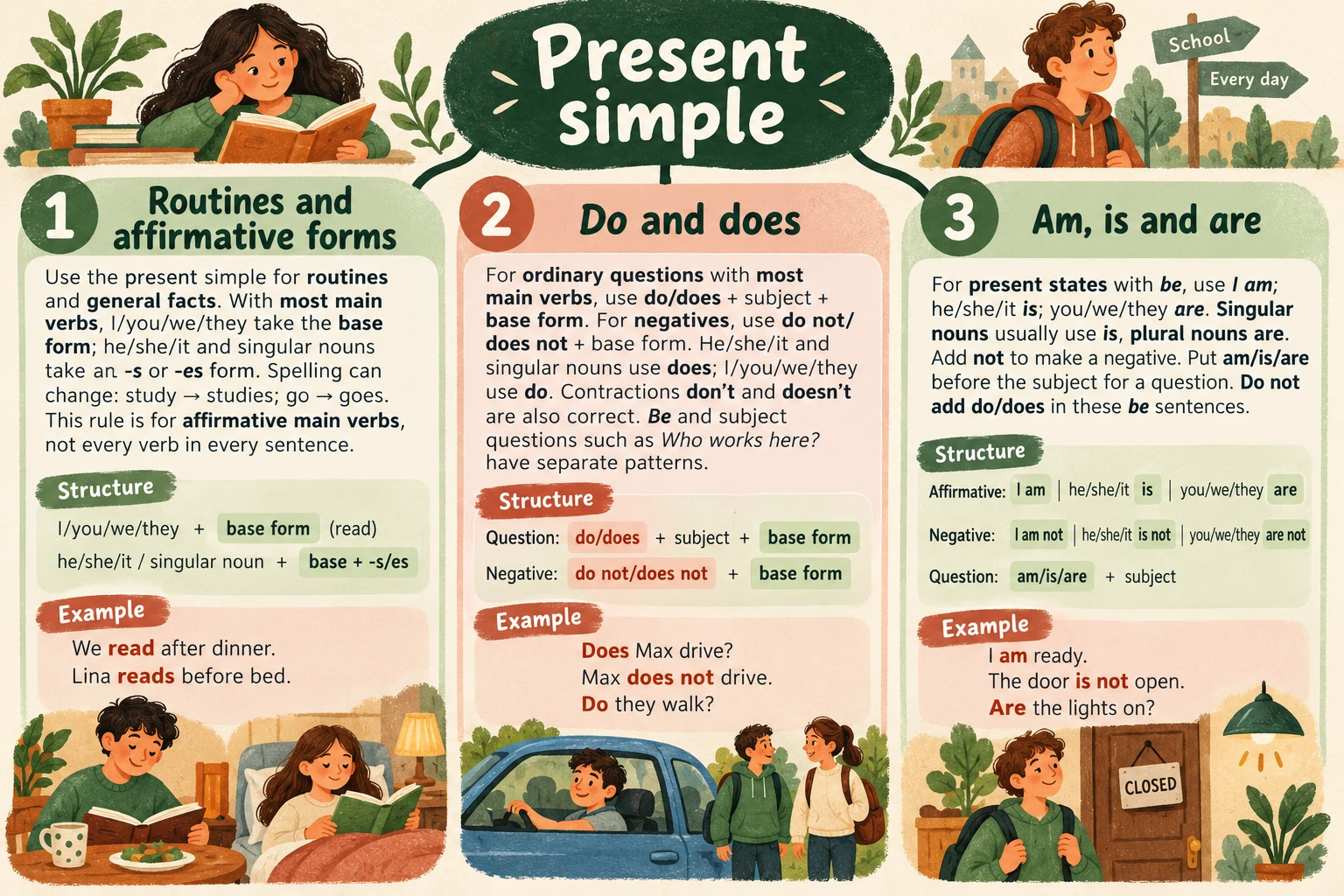
Use the present simple for routines and general facts. With most main verbs, I/you/we/they take the base form; he/she/it and singular nouns take an -s or -es form. Spelling can change: study → studies; go → goes. This rule is for affirmative main verbs, not every verb in every sentence.

I work · she works

02Do and does

For ordinary questions with most main verbs, use do/does + subject + base form. For negatives, use do not/does not + base form. He/she/it and singular nouns use does; I/you/we/they use do. Contractions don’t and doesn’t are also correct. Be and subject questions such as Who works here? have separate patterns.

Do/Does + subject + base verb?

03Am, is and are

For present states with be, use I am; he/she/it is; you/we/they are. Singular nouns usually use is, plural nouns are. Add not to make a negative. Put am/is/are before the subject for a question. Do not add do/does in these be sentences.

I am · she is · they are

Affirmative

I work here.She works here.

Negative

I don’t work here.She doesn’t work here.

Question

Do you work here?Does she work here?

Short answer

Yes, I do.No, she doesn’t.

Illustrated guide

0/12
Questions
01 / 12D01Save it to find it in My collection.

Walking to college is Leila’s daily routine.

Choose the correct present-simple sentence.

Your answer
1 / 12

Your learning route

01
Step 1 · Warm-up

Warm-up

0/3
02
Step 2 · Build the skill

Routines and affirmative forms

0/1

Use the present simple for routines and general facts. With most main verbs, I/you/we/they take the base form; he/she/it and singular nouns take an -s or -es form. Spelling can change: study → studies; go → goes. This rule is for affirmative main verbs, not every verb in every sentence.

We read after dinner. Lina reads before bed.
03
Step 3 · Build the skill

Am, is and are

0/2

For present states with be, use I am; he/she/it is; you/we/they are. Singular nouns usually use is, plural nouns are. Add not to make a negative. Put am/is/are before the subject for a question. Do not add do/does in these be sentences.

I am ready. The door is not open. Are the lights on?
04
Step 4 · Build the skill

Do and does

0/1

For ordinary questions with most main verbs, use do/does + subject + base form. For negatives, use do not/does not + base form. He/she/it and singular nouns use does; I/you/we/they use do. Contractions don’t and doesn’t are also correct. Be and subject questions such as Who works here? have separate patterns.

Does Max drive? Max does not drive. Do they walk?
05
Step 5 · New contexts

New contexts

0/3
06
Step 6 · A fresh challenge

A fresh challenge

0/2
Practice notes in this unit

Make mistakes useful.

Keep the first try. Understand the change. Check it in a fresh situation.

0

No practice notes yet. Try a short warm-up.

Lesson map

Present simple

A1
Present simple

Lesson points

01

Routines and affirmative forms

Use the present simple for routines and general facts. With most main verbs, I/you/we/they take the base form; he/she/it and singular nouns take an -s or -es form. Spelling can change: study → studies; go → goes. This rule is for affirmative main verbs, not every verb in every sentence.

We read after dinner. Lina reads before bed.
02

Do and does

For ordinary questions with most main verbs, use do/does + subject + base form. For negatives, use do not/does not + base form. He/she/it and singular nouns use does; I/you/we/they use do. Contractions don’t and doesn’t are also correct. Be and subject questions such as Who works here? have separate patterns.

Does Max drive? Max does not drive. Do they walk?
03

Am, is and are

For present states with be, use I am; he/she/it is; you/we/they are. Singular nouns usually use is, plural nouns are. Add not to make a negative. Put am/is/are before the subject for a question. Do not add do/does in these be sentences.

I am ready. The door is not open. Are the lights on?

Questions & answers

Opening an answer records help for that question.

D01 · Warm-up

Walking to college is Leila’s daily routine.

Choose the correct present-simple sentence.

  1. Leila walks to college every day.
  2. Leila walk to college every day.
  3. Leila walking to college every day.
Answer & explanation
Leila walks to college every day.

Look at “Walking to college is Leila’s daily routine.”. Use the present simple for routines and general facts. With most main verbs, I/you/we/they take the base form; he/she/it and singular nouns take an -s or -es form. Spelling can change: study → studies; go → goes. This rule is for affirmative main verbs, not every verb in every sentence. Complete sentence: “Leila walks to college every day.”.

D02 · Warm-up

You want to ask about your friend’s brother’s usual Monday routine.

Choose the correct question.

  1. Does your brother cooks on Mondays?
  2. Do your brother cook on Mondays?
  3. Does your brother cook on Mondays?
Answer & explanation
Does your brother cook on Mondays?

Look at “You want to ask about your friend’s brother’s usual Monday routine.”. For ordinary questions with most main verbs, use do/does + subject + base form. For negatives, use do not/does not + base form. He/she/it and singular nouns use does; I/you/we/they use do. Contractions don’t and doesn’t are also correct. Be and subject questions such as Who works here? have separate patterns. Complete sentence: “Does your brother cook on Mondays?”.

D03 · Warm-up

Location note: two keys, inside the drawer, now.

Choose the correct sentence.

  1. The keys is in the drawer.
  2. The keys are in the drawer.
  3. The keys be in the drawer.
Answer & explanation
The keys are in the drawer.

Look at “Location note: two keys, inside the drawer, now.”. For present states with be, use I am; he/she/it is; you/we/they are. Singular nouns usually use is, plural nouns are. Add not to make a negative. Put am/is/are before the subject for a question. Do not add do/does in these be sentences. Complete sentence: “The keys are in the drawer.”.

P01 · Build the skill

Arun has a regular evening study routine.

Complete the sentence with the present-simple form of study. Write only the missing verb: Arun ___ English every evening.

Answer & explanation
studies

Arun is one person, and every evening describes a routine. Study ends in consonant + y, so the affirmative form is studies.

P02 · Build the skill

You have your book and pencil. Tell the teacher that you are ready.

Choose the correct sentence.

  1. I is ready for the lesson.
  2. I am ready for the lesson.
  3. I are ready for the lesson.
Answer & explanation
I am ready for the lesson.

Look at “You have your book and pencil. Tell the teacher that you are ready.”. For present states with be, use I am; he/she/it is; you/we/they are. Singular nouns usually use is, plural nouns are. Add not to make a negative. Put am/is/are before the subject for a question. Do not add do/does in these be sentences. Complete sentence: “I am ready for the lesson.”.

P03 · Build the skill

Coffee is not part of your sister’s usual diet.

Choose the correct negative present-simple sentence.

  1. My sister does not drinks coffee.
  2. My sister do not drink coffee.
  3. My sister does not drink coffee.
Answer & explanation
My sister does not drink coffee.

Look at “Coffee is not part of your sister’s usual diet.”. For ordinary questions with most main verbs, use do/does + subject + base form. For negatives, use do not/does not + base form. He/she/it and singular nouns use does; I/you/we/they use do. Contractions don’t and doesn’t are also correct. Be and subject questions such as Who works here? have separate patterns. Complete sentence: “My sister does not drink coffee.”.

P04 · Build the skill

The library is closed every Sunday. Correct this claim by making it negative: The library is open on Sundays.

Write the full negative sentence. Keep all other words in the same order.

Answer & explanation
The library is not open on Sundays.

The library is singular, so keep is and add not. Is not and isn’t are both correct; the rest of the sentence stays the same. The library’s not is also a valid contraction of The library is not.

Other accepted versions
  • The library isn't open on Sundays.
  • The library's not open on Sundays.
R01 · New contexts

This sentence has one verb-form error: My uncle go to work by train every day.

Correct only the main verb and write the full sentence.

Answer & explanation
My uncle goes to work by train every day.

My uncle is one person. In an affirmative present-simple sentence, go becomes goes; every day describes his routine.

R02 · New contexts

You want to ask about the town where Niko has his home.

Choose the correctly formed question.

  1. Where does Niko live?
  2. Where does Niko lives?
  3. Where do Niko live?
Answer & explanation
Where does Niko live?

Look at “You want to ask about the town where Niko has his home.”. For ordinary questions with most main verbs, use do/does + subject + base form. For negatives, use do not/does not + base form. He/she/it and singular nouns use does; I/you/we/they use do. Contractions don’t and doesn’t are also correct. Be and subject questions such as Who works here? have separate patterns. Complete sentence: “Where does Niko live?”.

R03 · New contexts

You want to know whether the students usually feel tired after class.

Choose the correct be question.

  1. Do the students be tired after class?
  2. Are the students tired after class?
  3. Is the students tired after class?
Answer & explanation
Are the students tired after class?

Look at “You want to know whether the students usually feel tired after class.”. For present states with be, use I am; he/she/it is; you/we/they are. Singular nouns usually use is, plural nouns are. Add not to make a negative. Put am/is/are before the subject for a question. Do not add do/does in these be sentences. Complete sentence: “Are the students tired after class?”.

X01 · A fresh challenge

The museum’s regular opening time is ten o’clock on every weekday.

Choose the correct present-simple sentence.

  1. The museum open at ten every weekday.
  2. The museum opens at ten every weekday.
  3. The museum opening at ten every weekday.
Answer & explanation
The museum opens at ten every weekday.

Look at “The museum’s regular opening time is ten o’clock on every weekday.”. Use the present simple for routines and general facts. With most main verbs, I/you/we/they take the base form; he/she/it and singular nouns take an -s or -es form. Spelling can change: study → studies; go → goes. This rule is for affirmative main verbs, not every verb in every sentence. Complete sentence: “The museum opens at ten every weekday.”.

X02 · A fresh challenge

You do not know whether both of your friend’s parents usually work on Saturdays.

Write one full yes/no question beginning with Do. Use these words in order after Do: your parents / work / on Saturdays.

Answer & explanation
Do your parents work on Saturdays?

The subject "your parents" is plural, so begin with Do. Use the base form work after the subject to ask about a regular Saturday routine.