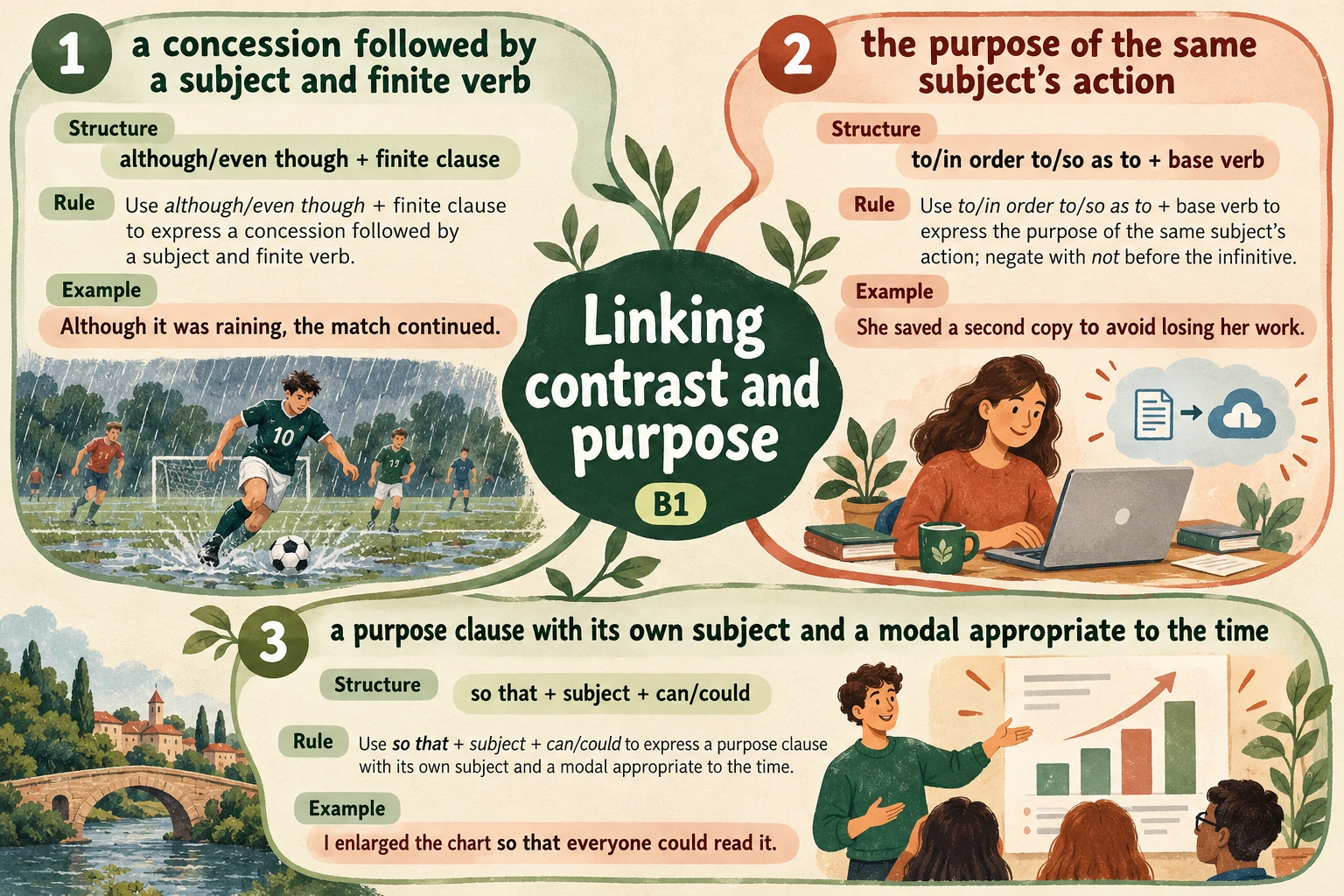
01a concession followed by a subject and finite verb
Use although/even though + finite clause to express a concession followed by a subject and finite verb.
Although it was raining, the match continued.
Linking contrast and purpose · B1. Use although/even though + finite clause to express a concession followed by a subject and finite verb.
Complete 12 original tasks. Use the situation to choose the intended meaning, practise the form, then apply it in a fresh context.
Use although/even though + finite clause to express a concession followed by a subject and finite verb.
Although it was raining, the match continued.Use to/in order to/so as to + base verb to express the purpose of the same subject’s action; negate with not before the infinitive.
She saved a second copy to avoid losing her work.Use so that + subject + can/could to express a purpose clause with its own subject and a modal appropriate to the time.
I enlarged the chart so that everyone could read it.
The result is surprising given the bad weather; a full clause follows.
Use although/even though + finite clause to express a concession followed by a subject and finite verb.
Although it was raining, the match continued.Use to/in order to/so as to + base verb to express the purpose of the same subject’s action; negate with not before the infinitive.
She saved a second copy to avoid losing her work.Use so that + subject + can/could to express a purpose clause with its own subject and a modal appropriate to the time.
I enlarged the chart so that everyone could read it.Keep the first try. Understand the change. Check it in a fresh situation.
No practice notes yet. Try a short warm-up.
Use although/even though + finite clause to express a concession followed by a subject and finite verb.
Although it was raining, the match continued.Use to/in order to/so as to + base verb to express the purpose of the same subject’s action; negate with not before the infinitive.
She saved a second copy to avoid losing her work.Use so that + subject + can/could to express a purpose clause with its own subject and a modal appropriate to the time.
I enlarged the chart so that everyone could read it.Opening an answer records help for that question.
The result is surprising given the bad weather; a full clause follows.
Look at “___ it was raining, the match continued.”. Use although/even though + finite clause to express a concession followed by a subject and finite verb. Complete sentence: “Although it was raining, the match continued.”.
The gap states why she saved the file; same subject.
Look at “She saved a second copy ___ avoid losing her work.”. Use to/in order to/so as to + base verb to express the purpose of the same subject’s action; negate with not before the infinitive. Complete sentence: “She saved a second copy to avoid losing her work.”.
A different subject follows the connector and needs an ability modal.
Look at “I enlarged the chart so that everyone ___ read it.”. Use so that + subject + can/could to express a purpose clause with its own subject and a modal appropriate to the time. Complete sentence: “I enlarged the chart so that everyone could read it.”.
A full finite clause presents an unexpected contrast.
Look at “___ the route was longer, it was safer.”. Use although/even though + finite clause to express a concession followed by a subject and finite verb. Complete sentence: “Even though the route was longer, it was safer.”.
Use the three-word purpose expression beginning with in, followed by the correct form of reserve.
Complete sentence: “I called early in order to reserve a quiet table.” Use to/in order to/so as to + base verb to express the purpose of the same subject’s action; negate with not before the infinitive. The subject, time and meaning in the task determine this form. Only reviewed responses are matched automatically; other wording is not automatically wrong.
A purpose clause with a past reference and its own subject.
Look at “We lowered the shelf so that the children ___ reach it.”. Use so that + subject + can/could to express a purpose clause with its own subject and a modal appropriate to the time. Complete sentence: “We lowered the shelf so that the children could reach it.”.
Supply a concessive conjunction before the finite clause.
Complete sentence: “Although the evidence was incomplete, the board made a decision.” Use although/even though + finite clause to express a concession followed by a subject and finite verb. The subject, time and meaning in the task determine this form. Only reviewed responses are matched automatically; other wording is not automatically wrong.
An unexpected result follows a full concession clause.
Look at “___ she had little experience, she solved the problem.”. Use although/even though + finite clause to express a concession followed by a subject and finite verb. Complete sentence: “Although she had little experience, she solved the problem.”.
Use the purpose expression beginning with so as, keeping the negative meaning, followed by disturb.
Complete sentence: “He silenced his phone so as not to disturb the audience.” Use to/in order to/so as to + base verb to express the purpose of the same subject’s action; negate with not before the infinitive. The subject, time and meaning in the task determine this form. Only reviewed responses are matched automatically; other wording is not automatically wrong.
A purpose clause describes what the team would be able to do.
Look at “We shared the data so that the team ___ compare the results.”. Use so that + subject + can/could to express a purpose clause with its own subject and a modal appropriate to the time. Complete sentence: “We shared the data so that the team could compare the results.”.
A complete subject-verb clause follows; the aim is future understanding.
Look at “I will label the cables so that you ___ reconnect them.”. Use to/in order to/so as to + base verb to express the purpose of the same subject’s action; negate with not before the infinitive. Complete sentence: “I will label the cables so that you can reconnect them.”.
Use a past-form ability modal in the purpose clause.
Complete sentence: “The host repeated the question so that everybody could hear it.” Use so that + subject + can/could to express a purpose clause with its own subject and a modal appropriate to the time. The subject, time and meaning in the task determine this form. Only reviewed responses are matched automatically; other wording is not automatically wrong.