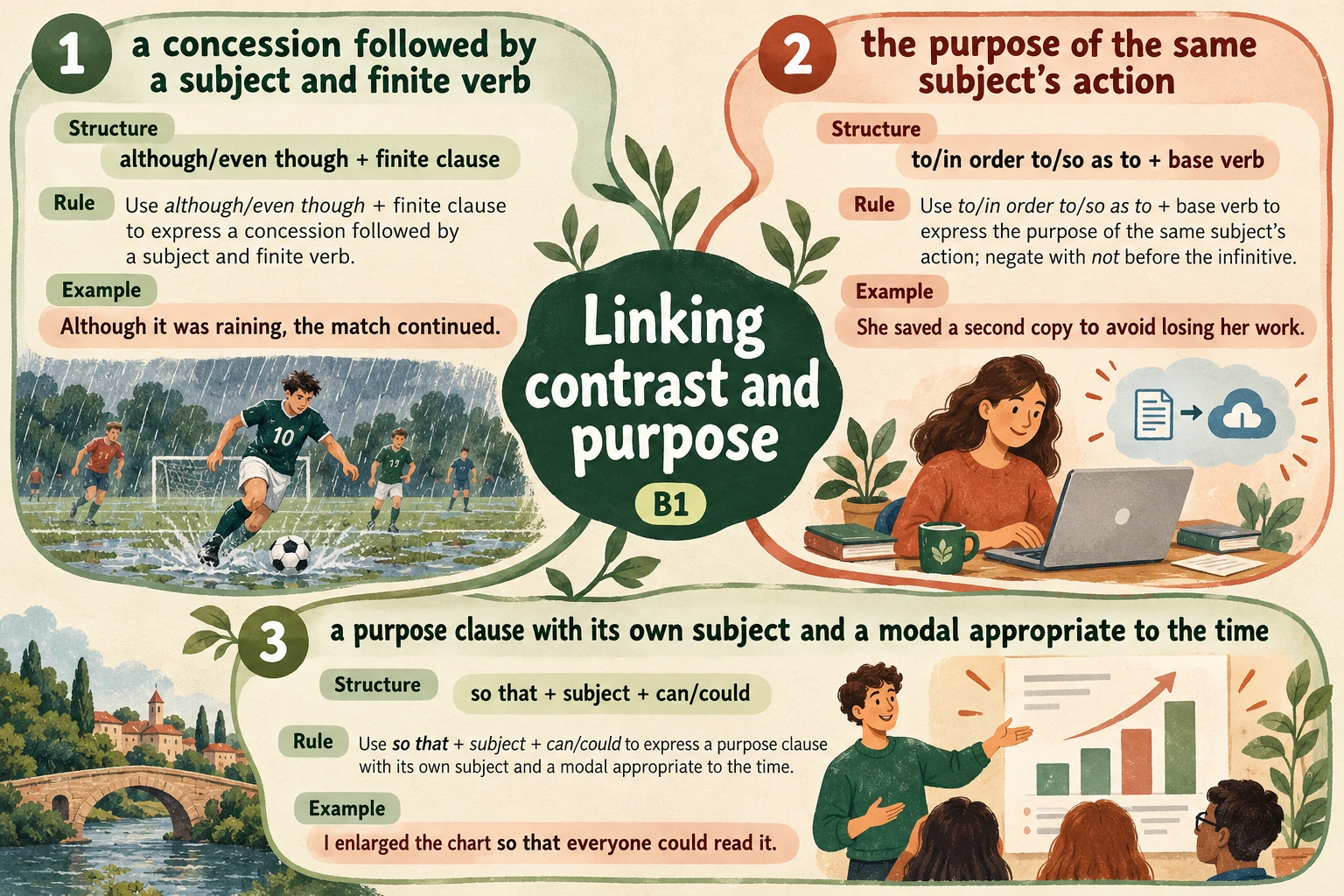
01une concession suivie d’un sujet et d’un verbe conjugué
Utilisez although/even though + finite clause pour exprimer une concession suivie d’un sujet et d’un verbe conjugué.
Although it was raining, the match continued.
Liens d'opposition et de but · B1. Utilisez although/even though + finite clause pour exprimer une concession suivie d’un sujet et d’un verbe conjugué.
Réalisez 12 exercices originaux. Appuyez-vous sur la situation pour interpréter le sens, pratiquer la forme et la réutiliser dans un nouveau contexte.
Utilisez although/even though + finite clause pour exprimer une concession suivie d’un sujet et d’un verbe conjugué.
Although it was raining, the match continued.Utilisez to/in order to/so as to + base verb pour exprimer le but d’une action du même sujet ; not précède l’infinitif.
She saved a second copy to avoid losing her work.Utilisez so that + subject + can/could pour exprimer une proposition de but avec son sujet et un modal adapté au temps.
I enlarged the chart so that everyone could read it.
The result is surprising given the bad weather; a full clause follows.
Utilisez although/even though + finite clause pour exprimer une concession suivie d’un sujet et d’un verbe conjugué.
Although it was raining, the match continued.Utilisez to/in order to/so as to + base verb pour exprimer le but d’une action du même sujet ; not précède l’infinitif.
She saved a second copy to avoid losing her work.Utilisez so that + subject + can/could pour exprimer une proposition de but avec son sujet et un modal adapté au temps.
I enlarged the chart so that everyone could read it.Gardez la première tentative, comprenez le changement et essayez dans une nouvelle situation.
Pas encore de notes. Essayez un court échauffement.
Utilisez although/even though + finite clause pour exprimer une concession suivie d’un sujet et d’un verbe conjugué.
Although it was raining, the match continued.Utilisez to/in order to/so as to + base verb pour exprimer le but d’une action du même sujet ; not précède l’infinitif.
She saved a second copy to avoid losing her work.Utilisez so that + subject + can/could pour exprimer une proposition de but avec son sujet et un modal adapté au temps.
I enlarged the chart so that everyone could read it.Ouvrir une réponse enregistre une aide pour cette question.
The result is surprising given the bad weather; a full clause follows.
Observe « ___ it was raining, the match continued. ». Utilisez although/even though + finite clause pour exprimer une concession suivie d’un sujet et d’un verbe conjugué. Phrase complète : « Although it was raining, the match continued. ».
The gap states why she saved the file; same subject.
Observe « She saved a second copy ___ avoid losing her work. ». Utilisez to/in order to/so as to + base verb pour exprimer le but d’une action du même sujet ; not précède l’infinitif. Phrase complète : « She saved a second copy to avoid losing her work. ».
A different subject follows the connector and needs an ability modal.
Observe « I enlarged the chart so that everyone ___ read it. ». Utilisez so that + subject + can/could pour exprimer une proposition de but avec son sujet et un modal adapté au temps. Phrase complète : « I enlarged the chart so that everyone could read it. ».
A full finite clause presents an unexpected contrast.
Observe « ___ the route was longer, it was safer. ». Utilisez although/even though + finite clause pour exprimer une concession suivie d’un sujet et d’un verbe conjugué. Phrase complète : « Even though the route was longer, it was safer. ».
Use the three-word purpose expression beginning with in, followed by the correct form of reserve.
Phrase complète : « I called early in order to reserve a quiet table. » Utilisez to/in order to/so as to + base verb pour exprimer le but d’une action du même sujet ; not précède l’infinitif. Le sujet, le temps et le sens de la consigne déterminent cette forme. Seules les réponses vérifiées sont comparées automatiquement ; toute autre formulation n’est pas automatiquement fausse.
A purpose clause with a past reference and its own subject.
Observe « We lowered the shelf so that the children ___ reach it. ». Utilisez so that + subject + can/could pour exprimer une proposition de but avec son sujet et un modal adapté au temps. Phrase complète : « We lowered the shelf so that the children could reach it. ».
Supply a concessive conjunction before the finite clause.
Phrase complète : « Although the evidence was incomplete, the board made a decision. » Utilisez although/even though + finite clause pour exprimer une concession suivie d’un sujet et d’un verbe conjugué. Le sujet, le temps et le sens de la consigne déterminent cette forme. Seules les réponses vérifiées sont comparées automatiquement ; toute autre formulation n’est pas automatiquement fausse.
An unexpected result follows a full concession clause.
Observe « ___ she had little experience, she solved the problem. ». Utilisez although/even though + finite clause pour exprimer une concession suivie d’un sujet et d’un verbe conjugué. Phrase complète : « Although she had little experience, she solved the problem. ».
Use the purpose expression beginning with so as, keeping the negative meaning, followed by disturb.
Phrase complète : « He silenced his phone so as not to disturb the audience. » Utilisez to/in order to/so as to + base verb pour exprimer le but d’une action du même sujet ; not précède l’infinitif. Le sujet, le temps et le sens de la consigne déterminent cette forme. Seules les réponses vérifiées sont comparées automatiquement ; toute autre formulation n’est pas automatiquement fausse.
A purpose clause describes what the team would be able to do.
Observe « We shared the data so that the team ___ compare the results. ». Utilisez so that + subject + can/could pour exprimer une proposition de but avec son sujet et un modal adapté au temps. Phrase complète : « We shared the data so that the team could compare the results. ».
A complete subject-verb clause follows; the aim is future understanding.
Observe « I will label the cables so that you ___ reconnect them. ». Utilisez to/in order to/so as to + base verb pour exprimer le but d’une action du même sujet ; not précède l’infinitif. Phrase complète : « I will label the cables so that you can reconnect them. ».
Use a past-form ability modal in the purpose clause.
Phrase complète : « The host repeated the question so that everybody could hear it. » Utilisez so that + subject + can/could pour exprimer une proposition de but avec son sujet et un modal adapté au temps. Le sujet, le temps et le sens de la consigne déterminent cette forme. Seules les réponses vérifiées sont comparées automatiquement ; toute autre formulation n’est pas automatiquement fausse.