01una concesión seguida de sujeto y verbo conjugado
Usa although/even though + finite clause para expresar una concesión seguida de sujeto y verbo conjugado.
Although it was raining, the match continued.
Conectores de contraste y finalidad · B1. Usa although/even though + finite clause para expresar una concesión seguida de sujeto y verbo conjugado.
Completa 12 tareas originales. Deduce el sentido por la situación, practica la forma y aplícala en un contexto nuevo.
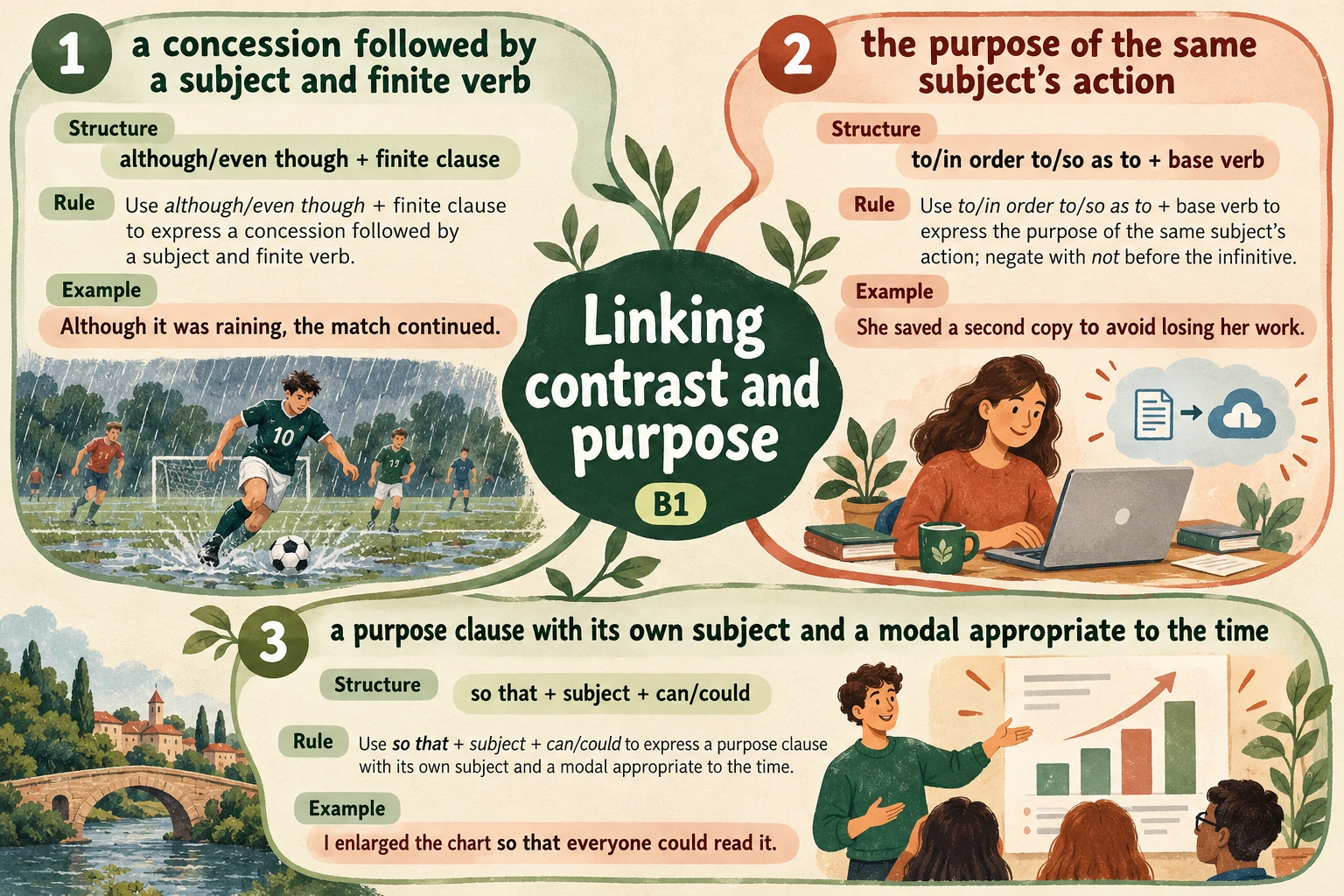
Usa although/even though + finite clause para expresar una concesión seguida de sujeto y verbo conjugado.
Although it was raining, the match continued.Usa to/in order to/so as to + base verb para expresar la finalidad de una acción del mismo sujeto; not precede al infinitivo.
She saved a second copy to avoid losing her work.Usa so that + subject + can/could para expresar una subordinada final con sujeto propio y modal adecuado al tiempo.
I enlarged the chart so that everyone could read it.
The result is surprising given the bad weather; a full clause follows.
Usa although/even though + finite clause para expresar una concesión seguida de sujeto y verbo conjugado.
Although it was raining, the match continued.Usa to/in order to/so as to + base verb para expresar la finalidad de una acción del mismo sujeto; not precede al infinitivo.
She saved a second copy to avoid losing her work.Usa so that + subject + can/could para expresar una subordinada final con sujeto propio y modal adecuado al tiempo.
I enlarged the chart so that everyone could read it.Conserva el primer intento, entiende el cambio y compruébalo en otra situación.
Aún no hay repasos. Prueba un calentamiento corto.
Usa although/even though + finite clause para expresar una concesión seguida de sujeto y verbo conjugado.
Although it was raining, the match continued.Usa to/in order to/so as to + base verb para expresar la finalidad de una acción del mismo sujeto; not precede al infinitivo.
She saved a second copy to avoid losing her work.Usa so that + subject + can/could para expresar una subordinada final con sujeto propio y modal adecuado al tiempo.
I enlarged the chart so that everyone could read it.Abrir una respuesta registra ayuda para esa pregunta.
The result is surprising given the bad weather; a full clause follows.
Mira «___ it was raining, the match continued.». Usa although/even though + finite clause para expresar una concesión seguida de sujeto y verbo conjugado. Oración completa: «Although it was raining, the match continued.».
The gap states why she saved the file; same subject.
Mira «She saved a second copy ___ avoid losing her work.». Usa to/in order to/so as to + base verb para expresar la finalidad de una acción del mismo sujeto; not precede al infinitivo. Oración completa: «She saved a second copy to avoid losing her work.».
A different subject follows the connector and needs an ability modal.
Mira «I enlarged the chart so that everyone ___ read it.». Usa so that + subject + can/could para expresar una subordinada final con sujeto propio y modal adecuado al tiempo. Oración completa: «I enlarged the chart so that everyone could read it.».
A full finite clause presents an unexpected contrast.
Mira «___ the route was longer, it was safer.». Usa although/even though + finite clause para expresar una concesión seguida de sujeto y verbo conjugado. Oración completa: «Even though the route was longer, it was safer.».
Use the three-word purpose expression beginning with in, followed by the correct form of reserve.
Oración completa: «I called early in order to reserve a quiet table.» Usa to/in order to/so as to + base verb para expresar la finalidad de una acción del mismo sujeto; not precede al infinitivo. El sujeto, el tiempo y el sentido de la tarea determinan la forma. Solo se cotejan automáticamente las respuestas revisadas; otra redacción no es automáticamente incorrecta.
A purpose clause with a past reference and its own subject.
Mira «We lowered the shelf so that the children ___ reach it.». Usa so that + subject + can/could para expresar una subordinada final con sujeto propio y modal adecuado al tiempo. Oración completa: «We lowered the shelf so that the children could reach it.».
Supply a concessive conjunction before the finite clause.
Oración completa: «Although the evidence was incomplete, the board made a decision.» Usa although/even though + finite clause para expresar una concesión seguida de sujeto y verbo conjugado. El sujeto, el tiempo y el sentido de la tarea determinan la forma. Solo se cotejan automáticamente las respuestas revisadas; otra redacción no es automáticamente incorrecta.
An unexpected result follows a full concession clause.
Mira «___ she had little experience, she solved the problem.». Usa although/even though + finite clause para expresar una concesión seguida de sujeto y verbo conjugado. Oración completa: «Although she had little experience, she solved the problem.».
Use the purpose expression beginning with so as, keeping the negative meaning, followed by disturb.
Oración completa: «He silenced his phone so as not to disturb the audience.» Usa to/in order to/so as to + base verb para expresar la finalidad de una acción del mismo sujeto; not precede al infinitivo. El sujeto, el tiempo y el sentido de la tarea determinan la forma. Solo se cotejan automáticamente las respuestas revisadas; otra redacción no es automáticamente incorrecta.
A purpose clause describes what the team would be able to do.
Mira «We shared the data so that the team ___ compare the results.». Usa so that + subject + can/could para expresar una subordinada final con sujeto propio y modal adecuado al tiempo. Oración completa: «We shared the data so that the team could compare the results.».
A complete subject-verb clause follows; the aim is future understanding.
Mira «I will label the cables so that you ___ reconnect them.». Usa to/in order to/so as to + base verb para expresar la finalidad de una acción del mismo sujeto; not precede al infinitivo. Oración completa: «I will label the cables so that you can reconnect them.».
Use a past-form ability modal in the purpose clause.
Oración completa: «The host repeated the question so that everybody could hear it.» Usa so that + subject + can/could para expresar una subordinada final con sujeto propio y modal adecuado al tiempo. El sujeto, el tiempo y el sentido de la tarea determinan la forma. Solo se cotejan automáticamente las respuestas revisadas; otra redacción no es automáticamente incorrecta.