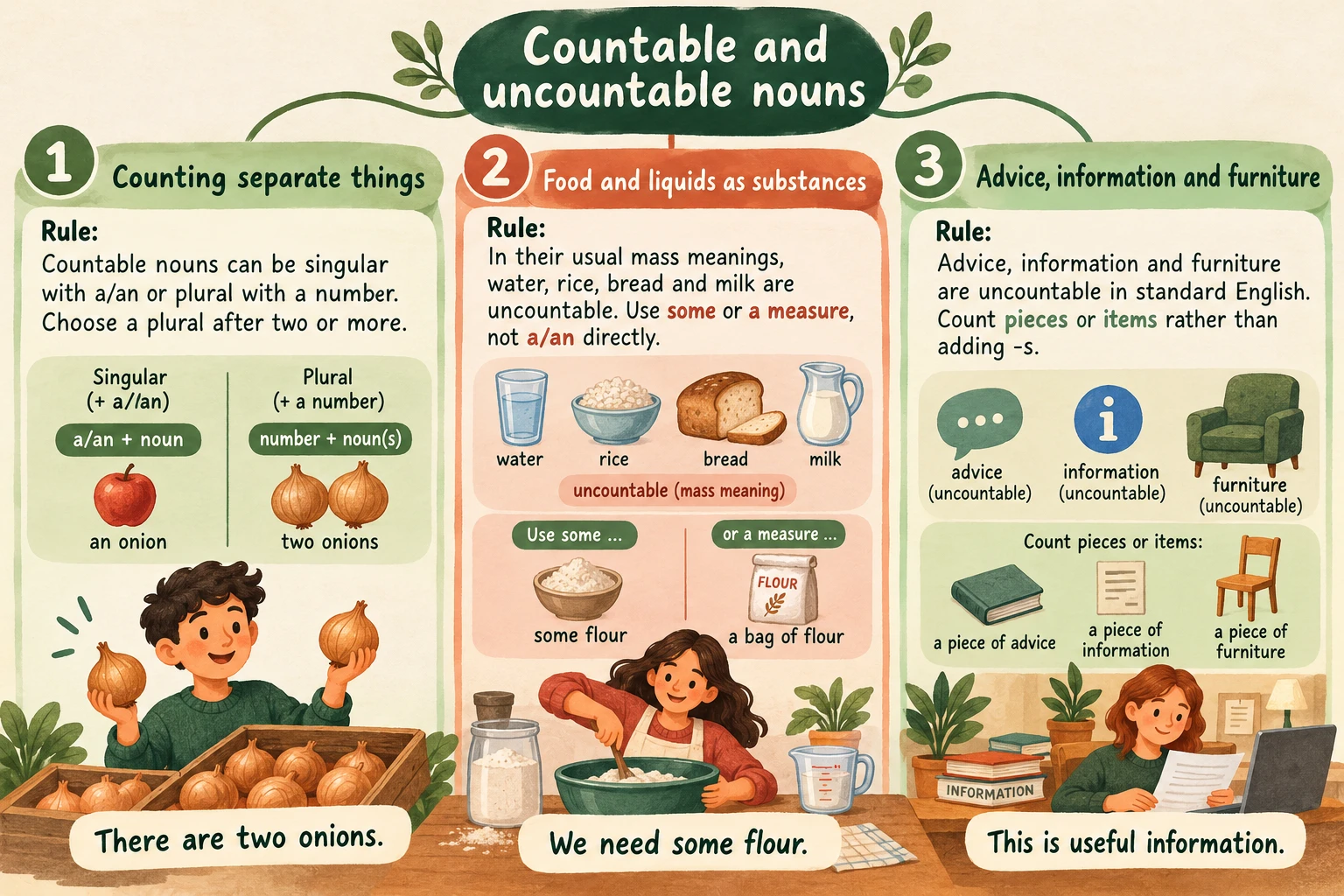
01Counting separate things
Countable nouns can be singular with a/an or plural with a number. Choose a plural after two or more.
There are two onions.
Countable and uncountable nouns · A1. Countable nouns can be singular with a/an or plural with a number. Choose a plural after two or more.
Practise Countable and uncountable nouns in short situations. Read the clue, choose or write a form, then check the reason. The level is an editorial guide.
Countable nouns can be singular with a/an or plural with a number. Choose a plural after two or more.
There are two onions.In their usual mass meanings, water, rice, bread and milk are uncountable. Use some or a measure, not a/an directly.
We need some flour.Advice, information and furniture are uncountable in standard English. Count pieces or items rather than adding -s.
This is useful information.
I packed two ___ for the picnic. (sandwich)
Countable nouns can be singular with a/an or plural with a number. Choose a plural after two or more.
There are two onions.In their usual mass meanings, water, rice, bread and milk are uncountable. Use some or a measure, not a/an directly.
We need some flour.Advice, information and furniture are uncountable in standard English. Count pieces or items rather than adding -s.
This is useful information.Keep the first try. Understand the change. Check it in a fresh situation.
No practice notes yet. Try a short warm-up.
Countable nouns can be singular with a/an or plural with a number. Choose a plural after two or more.
There are two onions.In their usual mass meanings, water, rice, bread and milk are uncountable. Use some or a measure, not a/an directly.
We need some flour.Advice, information and furniture are uncountable in standard English. Count pieces or items rather than adding -s.
This is useful information.Opening an answer records help for that question.
I packed two ___ for the picnic. (sandwich)
Look at “I packed two ___ for the picnic. (sandwich)”. Countable nouns can be singular with a/an or plural with a number. Choose a plural after two or more. Complete sentence: “I packed two sandwiches for the picnic. (sandwich)”.
For the recipe we need ___ rice, not a separate restaurant serving.
Look at “For the recipe we need ___ rice, not a separate restaurant serving.”. In their usual mass meanings, water, rice, bread and milk are uncountable. Use some or a measure, not a/an directly. Complete sentence: “For the recipe we need some rice, not a separate restaurant serving.”.
The guide gave us useful ___ about the city. (information)
Look at “The guide gave us useful ___ about the city. (information)”. Advice, information and furniture are uncountable in standard English. Count pieces or items rather than adding -s. Complete sentence: “The guide gave us useful information about the city. (information)”.
There are three ___ on the table. (apple)
Reference completion: “There are three apples on the table. (apple)”. Countable nouns can be singular with a/an or plural with a number. Choose a plural after two or more.
She bought a loaf of ___ from the baker.
Look at “She bought a loaf of ___ from the baker.”. In their usual mass meanings, water, rice, bread and milk are uncountable. Use some or a measure, not a/an directly. Complete sentence: “She bought a loaf of bread from the baker.”.
My aunt gave me two pieces of ___. (advice)
Look at “My aunt gave me two pieces of ___. (advice)”. Advice, information and furniture are uncountable in standard English. Count pieces or items rather than adding -s. Complete sentence: “My aunt gave me two pieces of advice. (advice)”.
We need four ___ for our guests. (chair)
Reference completion: “We need four chairs for our guests. (chair)”. Countable nouns can be singular with a/an or plural with a number. Choose a plural after two or more.
I ordered two ___, one for each child. (banana)
Look at “I ordered two ___, one for each child. (banana)”. Countable nouns can be singular with a/an or plural with a number. Choose a plural after two or more. Complete sentence: “I ordered two bananas, one for each child. (banana)”.
Add a glass of ___ to the bowl. (water)
Look at “Add a glass of ___ to the bowl. (water)”. In their usual mass meanings, water, rice, bread and milk are uncountable. Use some or a measure, not a/an directly. Complete sentence: “Add a glass of water to the bowl. (water)”.
We bought three items of ___ for the empty flat. (furniture)
Reference completion: “We bought three items of furniture for the empty flat. (furniture)”. Advice, information and furniture are uncountable in standard English. Count pieces or items rather than adding -s.
The jug contains some ___. (milk)
Look at “The jug contains some ___. (milk)”. In their usual mass meanings, water, rice, bread and milk are uncountable. Use some or a measure, not a/an directly. Complete sentence: “The jug contains some milk. (milk)”.
I need one piece of ___ before I decide. (advice)
Reference completion: “I need one piece of advice before I decide. (advice)”. Advice, information and furniture are uncountable in standard English. Count pieces or items rather than adding -s.