Vérifier la construction verbale
Repère le sujet, le temps et les auxiliaires avant de choisir la forme verbale.
Last month, I [1] _____ my first cycling lesson in the park.

Apprendre à faire du vélo · A2. Repère le sujet, le temps et les auxiliaires avant de choisir la forme verbale.
Complète douze blancs numérotés dans un texte anglais original. Lis les deux côtés de chaque blanc et utilise le contexte complet. Le niveau est un repère éditorial.
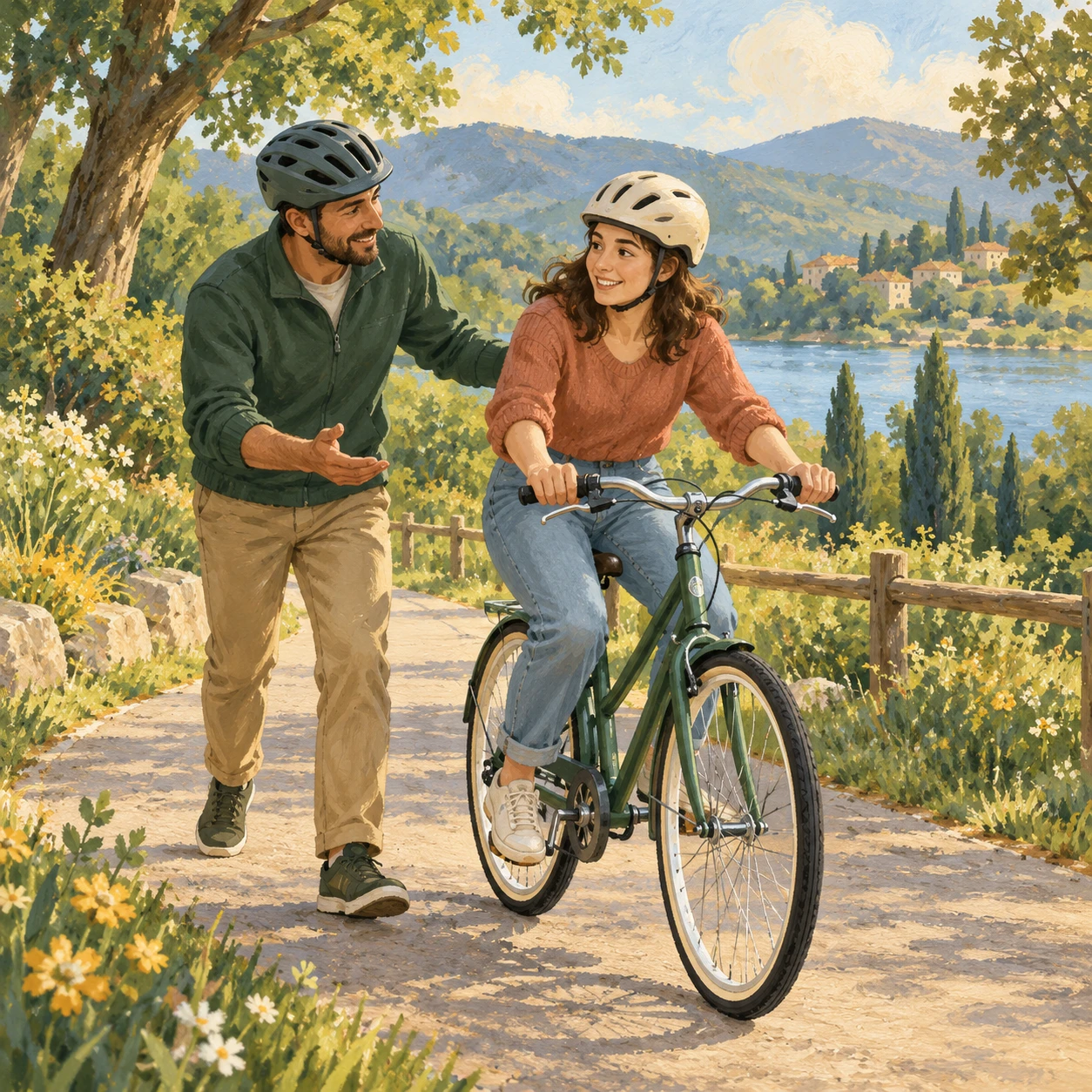
Last month, I [1] _____ my first cycling lesson in the park. The practice path was wider [2] _____ the street outside my home. While we [3] _____ for the instructor, we checked our helmets.
I was interested [4] _____ learning to ride safely, not just quickly. [5] _____ I felt nervous, the instructor spoke calmly and gave me time. I decided [6] _____ a smaller bicycle for the first lesson.
There were only a [7] _____ other learners on the path. The instructor showed me a bicycle [8] _____ had wide tyres and a low seat. She gave a [9] _____ explanation of how the brakes worked.
At the end of the lesson, I [10] _____ all the way to the gate without help. I thanked her [11] _____ she had helped me become more confident. Now I want [12] _____ more often before I ride on a busy road.
Repère le sujet, le temps et les auxiliaires avant de choisir la forme verbale.
Last month, I [1] _____ my first cycling lesson in the park.
Lis les deux côtés du blanc. Vérifie articles, pronoms, prépositions et expressions figées dans leur ensemble.
The practice path was wider [2] _____ the street outside my home.
Détermine s’il s’agit d’une cause, d’une opposition, d’une condition ou d’une référence. Vérifie ensuite la structure exigée.
[5] _____ I felt nervous, the instructor spoke calmly and gave me time.
Last month, I [1] _____ my first cycling lesson in the park. The practice path was wider [2] _____ the street outside my home. While we [3] _____ for the instructor, we checked our helmets.
I was interested [4] _____ learning to ride safely, not just quickly. [5] _____ I felt nervous, the instructor spoke calmly and gave me time. I decided [6] _____ a smaller bicycle for the first lesson.
There were only a [7] _____ other learners on the path. The instructor showed me a bicycle [8] _____ had wide tyres and a low seat. She gave a [9] _____ explanation of how the brakes worked.
At the end of the lesson, I [10] _____ all the way to the gate without help. I thanked her [11] _____ she had helped me become more confident. Now I want [12] _____ more often before I ride on a busy road.
Learning to cycle — gap 1
Lis les deux côtés du blanc. Vérifie articles, pronoms, prépositions et expressions figées dans leur ensemble.
The practice path was wider [2] _____ the street outside my home.Détermine s’il s’agit d’une cause, d’une opposition, d’une condition ou d’une référence. Vérifie ensuite la structure exigée.
[5] _____ I felt nervous, the instructor spoke calmly and gave me time.Repère le sujet, le temps et les auxiliaires avant de choisir la forme verbale.
Last month, I [1] _____ my first cycling lesson in the park.Gardez la première tentative, comprenez le changement et essayez dans une nouvelle situation.
Pas encore de notes. Essayez un court échauffement.
Repère le sujet, le temps et les auxiliaires avant de choisir la forme verbale.
Last month, I [1] _____ my first cycling lesson in the park.Lis les deux côtés du blanc. Vérifie articles, pronoms, prépositions et expressions figées dans leur ensemble.
The practice path was wider [2] _____ the street outside my home.Détermine s’il s’agit d’une cause, d’une opposition, d’une condition ou d’une référence. Vérifie ensuite la structure exigée.
[5] _____ I felt nervous, the instructor spoke calmly and gave me time.Ouvrir une réponse enregistre une aide pour cette question.
Learning to cycle — gap 1
Observe « Last month, I [1] _____ my first cycling lesson in the park. ». L’événement est achevé dans une période passée précisée ; utilise le past simple. Phrase complète : « Last month, I took my first cycling lesson in the park. ».
Learning to cycle — gap 2
« than » relie le comparatif « wider » à la comparaison qui suit. Le comparatif est déjà fourni : le trou porte sur le connecteur, et non sur la formation de l’adjectif. Phrase complète : « The practice path was wider than the street outside my home. »
Learning to cycle — gap 3
Observe « While we [3] _____ for the instructor, we checked our helmets. ». L’action était déjà en cours lorsque l’événement bref s’est produit ; utilise le past continuous. Phrase complète : « While we were waiting for the instructor, we checked our helmets. ».
Learning to cycle — gap 4
Observe « I was interested [4] _____ learning to ride safely, not just quickly. ». Cette construction fixe avec un verbe, un adjectif ou un nom exige cette préposition ; les autres ne conviennent pas à la même structure. Phrase complète : « I was interested in learning to ride safely, not just quickly. ».
Learning to cycle — gap 5
Observe « [5] _____ I felt nervous, the instructor spoke calmly and gave me time. ». Les idées s’opposent. Ce connecteur est suivi d’une proposition complète ; une préposition suivie d’un groupe nominal ne convient pas ici. Phrase complète : « Although I felt nervous, the instructor spoke calmly and gave me time. ».
Learning to cycle — gap 6
Observe « I decided [6] _____ a smaller bicycle for the first lesson. ». Cette construction verbale ou cette expression du but exige to suivi de la base verbale. Phrase complète : « I decided to use a smaller bicycle for the first lesson. ».
Learning to cycle — gap 7
Observe « There were only a [7] _____ other learners on the path. ». Choisis le quantifieur selon que le nom est dénombrable singulier, dénombrable pluriel ou indénombrable. Phrase complète : « There were only a few other learners on the path. ».
Learning to cycle — gap 8
Observe « The instructor showed me a bicycle [8] _____ had wide tyres and a low seat. ». Le relatif doit convenir à l’antécédent et à sa fonction ; vérifie s’il s’agit d’une personne, d’une chose ou de possession. Phrase complète : « The instructor showed me a bicycle which had wide tyres and a low seat. ».
Learning to cycle — gap 9
Observe « She gave a [9] _____ explanation of how the brakes worked. ». La position détermine la nature du mot. Choisis le nom, l’adjectif ou l’adverbe qui remplit la fonction requise. Phrase complète : « She gave a clear explanation of how the brakes worked. ».
Learning to cycle — gap 10
Observe « At the end of the lesson, I [10] _____ all the way to the gate without help. ». L’événement est achevé dans une période passée précisée ; utilise le past simple. Phrase complète : « At the end of the lesson, I rode all the way to the gate without help. ».
Learning to cycle — gap 11
Observe « I thanked her [11] _____ she had helped me become more confident. ». La seconde proposition donne la cause de la première ; utilise un lien causal, pas une opposition ou une conséquence. Phrase complète : « I thanked her because she had helped me become more confident. ».
Learning to cycle — gap 12
Observe « Now I want [12] _____ more often before I ride on a busy road. ». Cette construction verbale ou cette expression du but exige to suivi de la base verbale. Phrase complète : « Now I want to practise more often before I ride on a busy road. ».