Die Verbstruktur prüfen
Bestimme Subjekt, Zeitbezug und Hilfsverb, bevor du die Verbform wählst.
I [1] _____ at a small pet shop with my father today.

Ein Besuch im Tierladen · A1. Bestimme Subjekt, Zeitbezug und Hilfsverb, bevor du die Verbform wählst.
Ergänze zwölf nummerierte Lücken in einem neuen englischen Text. Lies beide Seiten jeder Lücke und beachte den Gesamtzusammenhang. Die Stufe ist eine redaktionelle Orientierung.
Ergänze zwölf nummerierte Lücken in einem neuen englischen Text. Lies beide Seiten jeder Lücke und beachte den Gesamtzusammenhang. Die Stufe ist eine redaktionelle Orientierung.
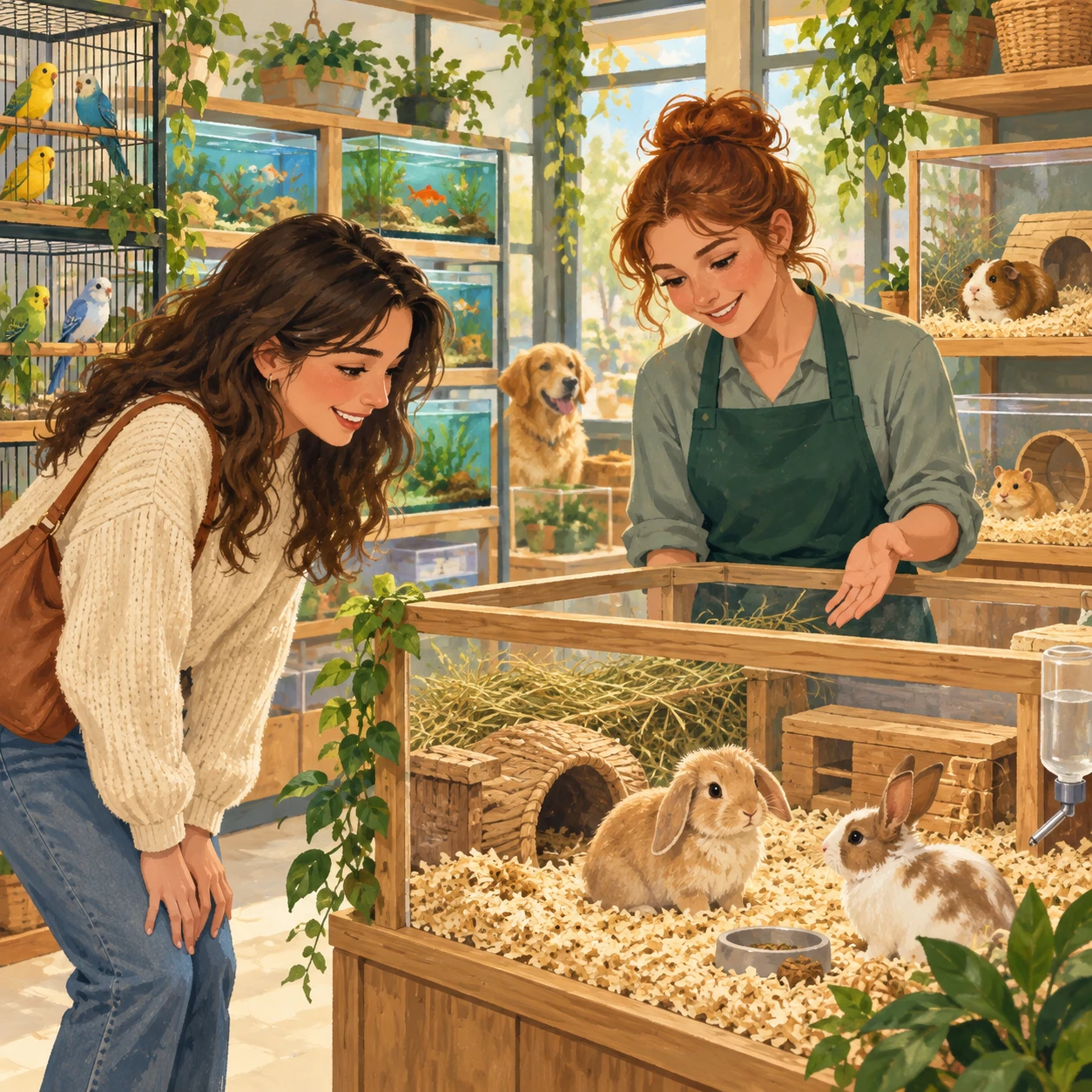
I [1] _____ at a small pet shop with my father today. There is [2] _____ orange fish near the front window. The shop assistant [3] _____ every animal before the shop opens.
She puts fresh food in [4] _____ little dishes. The rabbits need a quiet room [5] _____ loud sounds can frighten them. We must not [6] _____ the animals without asking first.
The shop opens [7] _____ nine o’clock on Saturdays. The assistant gives a care leaflet to my father and [8] _____. The rabbit is small, [9] _____ it needs plenty of space to move.
Its water bowl and food dish [10] _____ on a low shelf. We can [11] _____ everything on the care leaflet at home. We decide to wait before buying a pet [12] _____ we need to prepare a safe home first.
Bestimme Subjekt, Zeitbezug und Hilfsverb, bevor du die Verbform wählst.
I [1] _____ at a small pet shop with my father today.
Lies die Wörter auf beiden Seiten. Prüfe Artikel, Pronomen, Präpositionen und feste Ausdrücke als ganze Verbindung.
There is [2] _____ orange fish near the front window.
Entscheide, ob Ursache, Gegensatz, Bedingung oder Verweis vorliegt. Prüfe dann die vom Bindewort verlangte Grammatik.
The rabbits need a quiet room [5] _____ loud sounds can frighten them.
Ergänze zwölf nummerierte Lücken in einem neuen englischen Text. Lies beide Seiten jeder Lücke und beachte den Gesamtzusammenhang. Die Stufe ist eine redaktionelle Orientierung.
I [1] _____ at a small pet shop with my father today. There is [2] _____ orange fish near the front window. The shop assistant [3] _____ every animal before the shop opens.
She puts fresh food in [4] _____ little dishes. The rabbits need a quiet room [5] _____ loud sounds can frighten them. We must not [6] _____ the animals without asking first.
The shop opens [7] _____ nine o’clock on Saturdays. The assistant gives a care leaflet to my father and [8] _____. The rabbit is small, [9] _____ it needs plenty of space to move.
Its water bowl and food dish [10] _____ on a low shelf. We can [11] _____ everything on the care leaflet at home. We decide to wait before buying a pet [12] _____ we need to prepare a safe home first.
A pet shop visit — gap 1
Lies die Wörter auf beiden Seiten. Prüfe Artikel, Pronomen, Präpositionen und feste Ausdrücke als ganze Verbindung.
There is [2] _____ orange fish near the front window.Entscheide, ob Ursache, Gegensatz, Bedingung oder Verweis vorliegt. Prüfe dann die vom Bindewort verlangte Grammatik.
The rabbits need a quiet room [5] _____ loud sounds can frighten them.Bestimme Subjekt, Zeitbezug und Hilfsverb, bevor du die Verbform wählst.
I [1] _____ at a small pet shop with my father today.Bewahre den ersten Versuch. Verstehe die Änderung. Prüfe sie in einer neuen Situation.
Noch keine Lernnotizen. Starte mit einem kurzen Einstieg.
Bestimme Subjekt, Zeitbezug und Hilfsverb, bevor du die Verbform wählst.
I [1] _____ at a small pet shop with my father today.Lies die Wörter auf beiden Seiten. Prüfe Artikel, Pronomen, Präpositionen und feste Ausdrücke als ganze Verbindung.
There is [2] _____ orange fish near the front window.Entscheide, ob Ursache, Gegensatz, Bedingung oder Verweis vorliegt. Prüfe dann die vom Bindewort verlangte Grammatik.
The rabbits need a quiet room [5] _____ loud sounds can frighten them.Das Öffnen einer Antwort wird für diese Aufgabe als Hilfe erfasst.
A pet shop visit — gap 1
Achte auf „I [1] _____ at a small pet shop with my father today.“. Passe die Form von be an Subjekt und Zeitangabe an. Vollständiger Satz: „I am at a small pet shop with my father today.“.
A pet shop visit — gap 2
Achte auf „There is [2] _____ orange fish near the front window.“. Es geht um ein neu eingeführtes zählbares Ding im Singular; wähle a oder an nach dem Anlaut. Vollständiger Satz: „There is an orange fish near the front window.“.
A pet shop visit — gap 3
Achte auf „The shop assistant [3] _____ every animal before the shop opens.“. Eine regelmäßige gegenwärtige Gewohnheit steht im present simple; die dritte Person Singular erhält -s. Vollständiger Satz: „The shop assistant feeds every animal before the shop opens.“.
A pet shop visit — gap 4
Achte auf „She puts fresh food in [4] _____ little dishes.“. Vor dem Nomen steht ein Possessivbegleiter; ein Objekt- oder alleinstehendes Pronomen passt hier nicht. Vollständiger Satz: „She puts fresh food in her little dishes.“.
A pet shop visit — gap 5
Achte auf „The rabbits need a quiet room [5] _____ loud sounds can frighten them.“. Der zweite Teilsatz begründet den ersten; verwende eine kausale Verbindung, keinen Gegensatz oder eine Folge. Vollständiger Satz: „The rabbits need a quiet room because loud sounds can frighten them.“.
A pet shop visit — gap 6
Achte auf „We must not [6] _____ the animals without asking first.“. Nach diesem Hilfs- oder Modalverb steht die Grundform des Vollverbs. Vollständiger Satz: „We must not touch the animals without asking first.“.
A pet shop visit — gap 7
Achte auf „The shop opens [7] _____ nine o’clock on Saturdays.“. Verwende die passende Zeitpräposition: Uhrzeiten stehen mit at, benannte Tage mit on. Vollständiger Satz: „The shop opens at nine o’clock on Saturdays.“.
A pet shop visit — gap 8
Achte auf „The assistant gives a care leaflet to my father and [8] _____.“. Das Verb oder die Präposition verlangt ein Objektpronomen, kein Subjektpronomen. Vollständiger Satz: „The assistant gives a care leaflet to my father and me.“.
A pet shop visit — gap 9
Achte auf „The rabbit is small, [9] _____ it needs plenty of space to move.“. Die Aussagen stehen im Gegensatz. Auf diese Verbindung folgt ein vollständiger Teilsatz; eine Präposition vor einer Nominalgruppe passt hier nicht. Vollständiger Satz: „The rabbit is small, but it needs plenty of space to move.“.
A pet shop visit — gap 10
Achte auf „Its water bowl and food dish [10] _____ on a low shelf.“. Passe die Form von be an Subjekt und Zeitangabe an. Vollständiger Satz: „Its water bowl and food dish are on a low shelf.“.
A pet shop visit — gap 11
Achte auf „We can [11] _____ everything on the care leaflet at home.“. Nach diesem Hilfs- oder Modalverb steht die Grundform des Vollverbs. Vollständiger Satz: „We can read everything on the care leaflet at home.“.
A pet shop visit — gap 12
Achte auf „We decide to wait before buying a pet [12] _____ we need to prepare a safe home first.“. Der zweite Teilsatz begründet den ersten; verwende eine kausale Verbindung, keinen Gegensatz oder eine Folge. Vollständiger Satz: „We decide to wait before buying a pet because we need to prepare a safe home first.“.