01Too: more than suitable
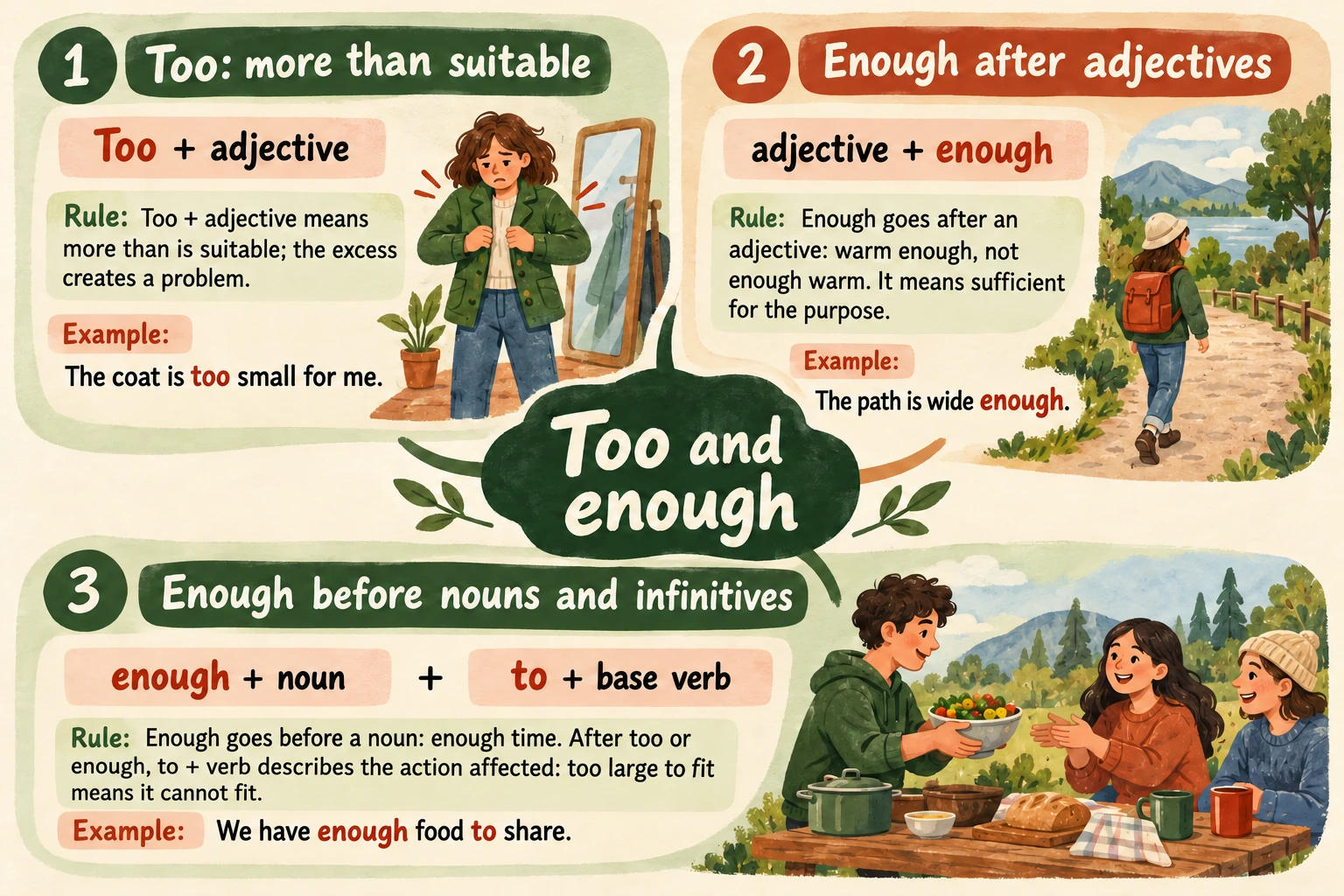
Too + adjective means more than is suitable; the excess creates a problem.
The coat is too small for me.
Too and enough · A2. Too + adjective means more than is suitable; the excess creates a problem.
Practise Too and enough in short situations. Read the clue, choose or write a form, then check the reason. The level is an editorial guide.
Too + adjective means more than is suitable; the excess creates a problem.
The coat is too small for me.Enough goes after an adjective: warm enough, not enough warm. It means sufficient for the purpose.
The path is wide enough.Enough goes before a noun: enough time. After too or enough, an infinitive describes the action affected by the degree: too large to fit means it cannot fit; enough time to finish means sufficient time for finishing.
We have enough food to share.
The soup is ___ hot to eat; it burns my mouth.
Too + adjective means more than is suitable; the excess creates a problem.
The coat is too small for me.Enough goes after an adjective: warm enough, not enough warm. It means sufficient for the purpose.
The path is wide enough.Enough goes before a noun: enough time. After too or enough, an infinitive describes the action affected by the degree: too large to fit means it cannot fit; enough time to finish means sufficient time for finishing.
We have enough food to share.Keep the first try. Understand the change. Check it in a fresh situation.
No practice notes yet. Try a short warm-up.
Too + adjective means more than is suitable; the excess creates a problem.
The coat is too small for me.Enough goes after an adjective: warm enough, not enough warm. It means sufficient for the purpose.
The path is wide enough.Enough goes before a noun: enough time. After too or enough, an infinitive describes the action affected by the degree: too large to fit means it cannot fit; enough time to finish means sufficient time for finishing.
We have enough food to share.Opening an answer records help for that question.
The soup is ___ hot to eat; it burns my mouth.
Look at “The soup is ___ hot to eat; it burns my mouth.”. Too + adjective means more than is suitable; the excess creates a problem. Complete sentence: “The soup is too hot to eat; it burns my mouth.”.
The ladder reaches the window. It is ___.
Look at “The ladder reaches the window. It is ___.”. Enough goes after an adjective: warm enough, not enough warm. It means sufficient for the purpose. Complete sentence: “The ladder reaches the window. It is long enough.”.
We can buy both tickets because we have ___.
Buying both tickets requires a sufficient amount of money. In the noun phrase enough money, enough comes before money. Do not put of directly before this bare noun.
The bag is ___ heavy for me to lift; I cannot move it.
Reference completion: “The bag is too heavy for me to lift; I cannot move it.”. Too + adjective means more than is suitable; the excess creates a problem.
The room has plenty of space. It is ___ for six people.
Look at “The room has plenty of space. It is ___ for six people.”. Enough goes after an adjective: warm enough, not enough warm. It means sufficient for the purpose. Complete sentence: “The room has plenty of space. It is big enough for six people.”.
The shelf is low enough ___ reach. (use the infinitive marker)
The shelf is low enough to reach: its height makes reaching it possible. Use adjective + enough + to + base verb. To introduces the action made possible by the height; it does not state the shelf’s purpose.
The road is ___ narrow for this truck; it cannot pass.
Reference completion: “The road is too narrow for this truck; it cannot pass.”. Too + adjective means more than is suitable; the excess creates a problem.
The music is ___ loud for the baby to sleep.
Look at “The music is ___ loud for the baby to sleep.”. Too + adjective means more than is suitable; the excess creates a problem. Complete sentence: “The music is too loud for the baby to sleep.”.
The water is safe for swimming. It is ___.
Look at “The water is safe for swimming. It is ___.”. Enough goes after an adjective: warm enough, not enough warm. It means sufficient for the purpose. Complete sentence: “The water is safe for swimming. It is warm enough.”.
We finished on time because we had ___ time.
Reference completion: “We finished on time because we had enough time.”. Enough goes before a noun: enough time. After too or enough, an infinitive describes the action affected by the degree: too large to fit means it cannot fit; enough time to finish means sufficient time for finishing. Also accepted in this task: sufficient / ample / plenty of / a lot of / lots of. These are reviewed alternatives, not an exhaustive list of all possible English.
Kai cannot enter the adult class. He is not ___.
Look at “Kai cannot enter the adult class. He is not ___.”. Enough goes after an adjective: warm enough, not enough warm. It means sufficient for the purpose. Complete sentence: “Kai cannot enter the adult class. He is not old enough.”.
This box is too large ___ fit in my bag. (use the infinitive marker)
Too large to fit means the box’s size prevents it fitting in the bag. To introduces the infinitive fit; it does not express the box’s purpose here.