01Too : un excès
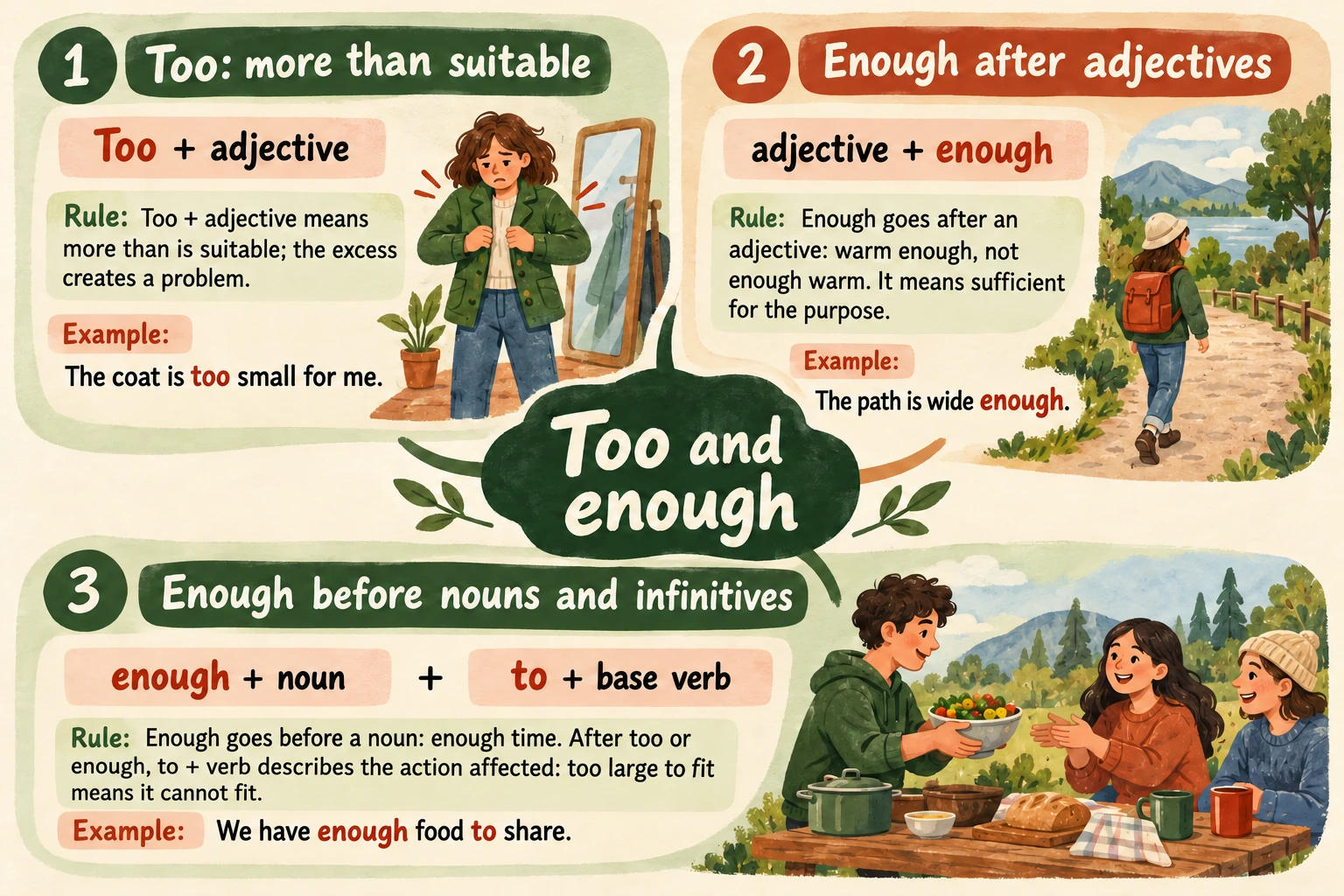
Too + adjectif signifie plus que ce qui convient ; l’excès pose problème.
The coat is too small for me.
Too et enough · A2. Too + adjectif signifie plus que ce qui convient ; l’excès pose problème.
Travaille Too et enough dans de courtes situations. Lis l’indice, choisis ou écris une forme, puis vérifie l’explication. Le niveau est une indication éditoriale.
Too + adjectif signifie plus que ce qui convient ; l’excès pose problème.
The coat is too small for me.Enough suit l’adjectif : warm enough, pas enough warm ; il signifie suffisant pour le but.
The path is wide enough.Enough précède le nom : enough time. Après too ou enough, l’infinitif indique l’action liée au degré : too large to fit signifie que l’objet ne rentre pas ; enough time to finish indique un temps suffisant pour finir.
We have enough food to share.
The soup is ___ hot to eat; it burns my mouth.
Too + adjectif signifie plus que ce qui convient ; l’excès pose problème.
The coat is too small for me.Enough suit l’adjectif : warm enough, pas enough warm ; il signifie suffisant pour le but.
The path is wide enough.Enough précède le nom : enough time. Après too ou enough, l’infinitif indique l’action liée au degré : too large to fit signifie que l’objet ne rentre pas ; enough time to finish indique un temps suffisant pour finir.
We have enough food to share.Gardez la première tentative, comprenez le changement et essayez dans une nouvelle situation.
Pas encore de notes. Essayez un court échauffement.
Too + adjectif signifie plus que ce qui convient ; l’excès pose problème.
The coat is too small for me.Enough suit l’adjectif : warm enough, pas enough warm ; il signifie suffisant pour le but.
The path is wide enough.Enough précède le nom : enough time. Après too ou enough, l’infinitif indique l’action liée au degré : too large to fit signifie que l’objet ne rentre pas ; enough time to finish indique un temps suffisant pour finir.
We have enough food to share.Ouvrir une réponse enregistre une aide pour cette question.
The soup is ___ hot to eat; it burns my mouth.
Observe « The soup is ___ hot to eat; it burns my mouth. ». Too + adjectif signifie plus que ce qui convient ; l’excès pose problème. Phrase complète : « The soup is too hot to eat; it burns my mouth. ».
The ladder reaches the window. It is ___.
Observe « The ladder reaches the window. It is ___. ». Enough suit l’adjectif : warm enough, pas enough warm ; il signifie suffisant pour le but. Phrase complète : « The ladder reaches the window. It is long enough. ».
We can buy both tickets because we have ___.
Acheter les deux billets exige une somme suffisante. Dans enough money, enough précède money. On ne place pas of directement devant ce nom sans déterminant.
The bag is ___ heavy for me to lift; I cannot move it.
Phrase de référence : « The bag is too heavy for me to lift; I cannot move it. ». Too + adjectif signifie plus que ce qui convient ; l’excès pose problème.
The room has plenty of space. It is ___ for six people.
Observe « The room has plenty of space. It is ___ for six people. ». Enough suit l’adjectif : warm enough, pas enough warm ; il signifie suffisant pour le but. Phrase complète : « The room has plenty of space. It is big enough for six people. ».
The shelf is low enough ___ reach. (use the infinitive marker)
The shelf is low enough to reach signifie que sa hauteur permet de l’atteindre. Le schéma est adjectif + enough + to + base verbale. To introduit l’action rendue possible par la hauteur, pas le but de l’étagère.
The road is ___ narrow for this truck; it cannot pass.
Phrase de référence : « The road is too narrow for this truck; it cannot pass. ». Too + adjectif signifie plus que ce qui convient ; l’excès pose problème.
The music is ___ loud for the baby to sleep.
Observe « The music is ___ loud for the baby to sleep. ». Too + adjectif signifie plus que ce qui convient ; l’excès pose problème. Phrase complète : « The music is too loud for the baby to sleep. ».
The water is safe for swimming. It is ___.
Observe « The water is safe for swimming. It is ___. ». Enough suit l’adjectif : warm enough, pas enough warm ; il signifie suffisant pour le but. Phrase complète : « The water is safe for swimming. It is warm enough. ».
We finished on time because we had ___ time.
Phrase de référence : « We finished on time because we had enough time. ». Enough précède le nom : enough time. Après too ou enough, l’infinitif indique l’action liée au degré : too large to fit signifie que l’objet ne rentre pas ; enough time to finish indique un temps suffisant pour finir. Autres variantes vérifiées pour cette tâche : sufficient / ample / plenty of / a lot of / lots of. La liste ne couvre pas toutes les formulations possibles.
Kai cannot enter the adult class. He is not ___.
Observe « Kai cannot enter the adult class. He is not ___. ». Enough suit l’adjectif : warm enough, pas enough warm ; il signifie suffisant pour le but. Phrase complète : « Kai cannot enter the adult class. He is not old enough. ».
This box is too large ___ fit in my bag. (use the infinitive marker)
Too large to fit indique que la taille empêche la boîte de rentrer. To introduit l’infinitif fit ; il n’exprime pas ici le but de la boîte.