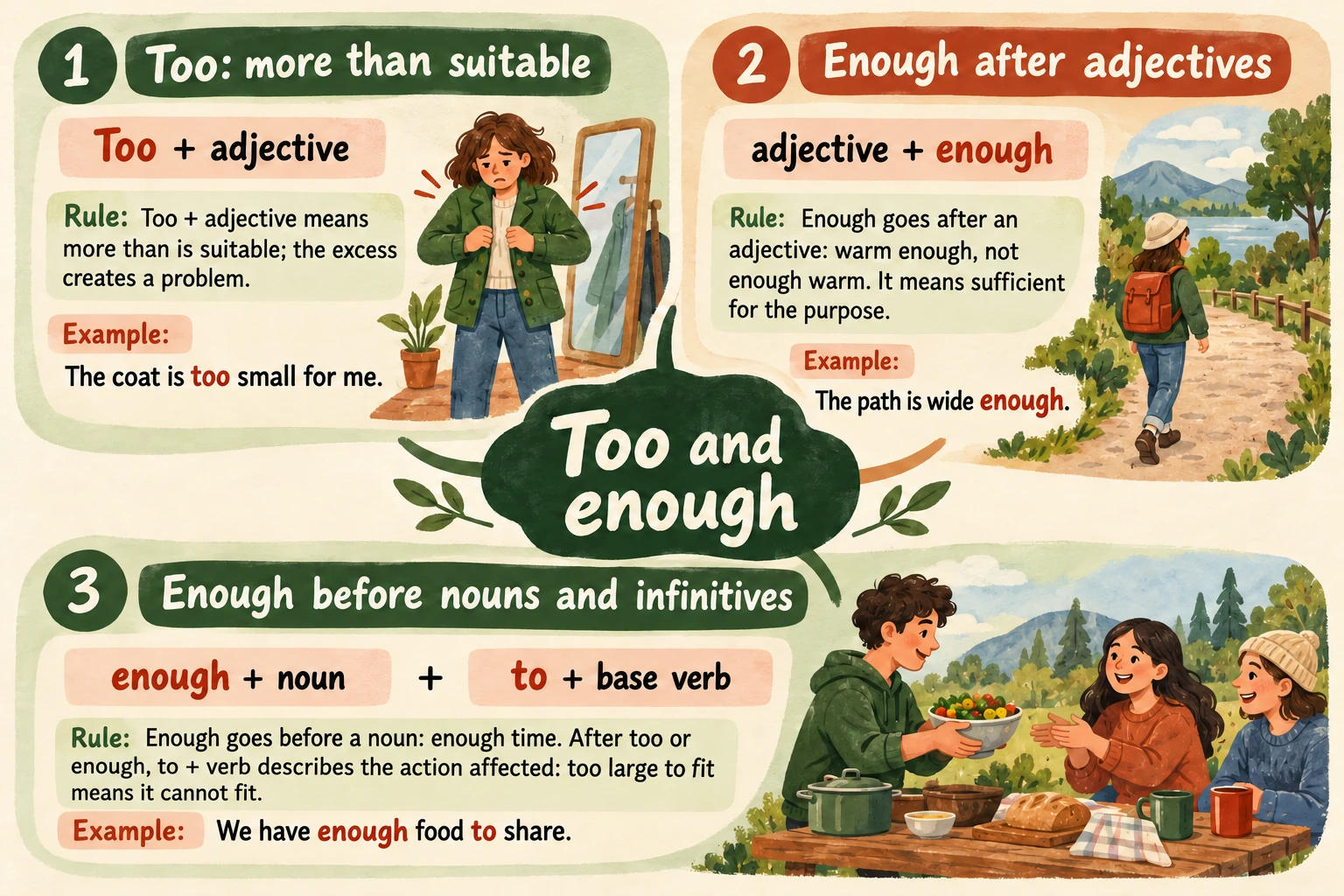
01Too: mehr als passend
Too + Adjektiv bedeutet mehr als passend; das Übermaß verursacht ein Problem.
The coat is too small for me.
Too und enough · A2. Too + Adjektiv bedeutet mehr als passend; das Übermaß verursacht ein Problem.
Übe Too und enough in kurzen Situationen. Lies den Hinweis, wähle oder schreibe eine Form und prüfe die Begründung. Die Stufe dient der redaktionellen Orientierung.
Too + Adjektiv bedeutet mehr als passend; das Übermaß verursacht ein Problem.
The coat is too small for me.Enough steht nach dem Adjektiv: warm enough, nicht enough warm; es bedeutet ausreichend.
The path is wide enough.Enough steht vor Nomen: enough time. Nach too oder enough beschreibt ein Infinitiv die Handlung, die vom Ausmaß abhängt: too large to fit bedeutet, dass es nicht hineinpasst; enough time to finish bedeutet ausreichend Zeit zum Fertigwerden.
We have enough food to share.
The soup is ___ hot to eat; it burns my mouth.
Too + Adjektiv bedeutet mehr als passend; das Übermaß verursacht ein Problem.
The coat is too small for me.Enough steht nach dem Adjektiv: warm enough, nicht enough warm; es bedeutet ausreichend.
The path is wide enough.Enough steht vor Nomen: enough time. Nach too oder enough beschreibt ein Infinitiv die Handlung, die vom Ausmaß abhängt: too large to fit bedeutet, dass es nicht hineinpasst; enough time to finish bedeutet ausreichend Zeit zum Fertigwerden.
We have enough food to share.Bewahre den ersten Versuch. Verstehe die Änderung. Prüfe sie in einer neuen Situation.
Noch keine Lernnotizen. Starte mit einem kurzen Einstieg.
Too + Adjektiv bedeutet mehr als passend; das Übermaß verursacht ein Problem.
The coat is too small for me.Enough steht nach dem Adjektiv: warm enough, nicht enough warm; es bedeutet ausreichend.
The path is wide enough.Enough steht vor Nomen: enough time. Nach too oder enough beschreibt ein Infinitiv die Handlung, die vom Ausmaß abhängt: too large to fit bedeutet, dass es nicht hineinpasst; enough time to finish bedeutet ausreichend Zeit zum Fertigwerden.
We have enough food to share.Das Öffnen einer Antwort wird für diese Aufgabe als Hilfe erfasst.
The soup is ___ hot to eat; it burns my mouth.
Achte auf „The soup is ___ hot to eat; it burns my mouth.“. Too + Adjektiv bedeutet mehr als passend; das Übermaß verursacht ein Problem. Vollständiger Satz: „The soup is too hot to eat; it burns my mouth.“.
The ladder reaches the window. It is ___.
Achte auf „The ladder reaches the window. It is ___.“. Enough steht nach dem Adjektiv: warm enough, nicht enough warm; es bedeutet ausreichend. Vollständiger Satz: „The ladder reaches the window. It is long enough.“.
We can buy both tickets because we have ___.
Für beide Fahrkarten braucht man ausreichend Geld. In der Nominalgruppe enough money steht enough vor money. Vor diesem Nomen ohne Artikel steht nicht direkt of.
The bag is ___ heavy for me to lift; I cannot move it.
Vollständiger Beispielsatz: „The bag is too heavy for me to lift; I cannot move it.“. Too + Adjektiv bedeutet mehr als passend; das Übermaß verursacht ein Problem.
The room has plenty of space. It is ___ for six people.
Achte auf „The room has plenty of space. It is ___ for six people.“. Enough steht nach dem Adjektiv: warm enough, nicht enough warm; es bedeutet ausreichend. Vollständiger Satz: „The room has plenty of space. It is big enough for six people.“.
The shelf is low enough ___ reach. (use the infinitive marker)
The shelf is low enough to reach bedeutet: Die Höhe ermöglicht es, das Regal zu erreichen. Das Muster lautet Adjektiv + enough + to + Grundform. To leitet die dadurch mögliche Handlung ein, nicht den Zweck des Regals.
The road is ___ narrow for this truck; it cannot pass.
Vollständiger Beispielsatz: „The road is too narrow for this truck; it cannot pass.“. Too + Adjektiv bedeutet mehr als passend; das Übermaß verursacht ein Problem.
The music is ___ loud for the baby to sleep.
Achte auf „The music is ___ loud for the baby to sleep.“. Too + Adjektiv bedeutet mehr als passend; das Übermaß verursacht ein Problem. Vollständiger Satz: „The music is too loud for the baby to sleep.“.
The water is safe for swimming. It is ___.
Achte auf „The water is safe for swimming. It is ___.“. Enough steht nach dem Adjektiv: warm enough, nicht enough warm; es bedeutet ausreichend. Vollständiger Satz: „The water is safe for swimming. It is warm enough.“.
We finished on time because we had ___ time.
Vollständiger Beispielsatz: „We finished on time because we had enough time.“. Enough steht vor Nomen: enough time. Nach too oder enough beschreibt ein Infinitiv die Handlung, die vom Ausmaß abhängt: too large to fit bedeutet, dass es nicht hineinpasst; enough time to finish bedeutet ausreichend Zeit zum Fertigwerden. In dieser Aufgabe sind auch diese Formen geprüft: sufficient / ample / plenty of / a lot of / lots of. Die Liste ist nicht vollständig.
Kai cannot enter the adult class. He is not ___.
Achte auf „Kai cannot enter the adult class. He is not ___.“. Enough steht nach dem Adjektiv: warm enough, nicht enough warm; es bedeutet ausreichend. Vollständiger Satz: „Kai cannot enter the adult class. He is not old enough.“.
This box is too large ___ fit in my bag. (use the infinitive marker)
Too large to fit bedeutet, dass die Größe das Hineinpassen verhindert. To leitet den Infinitiv fit ein und bezeichnet hier keinen Zweck des Kartons.