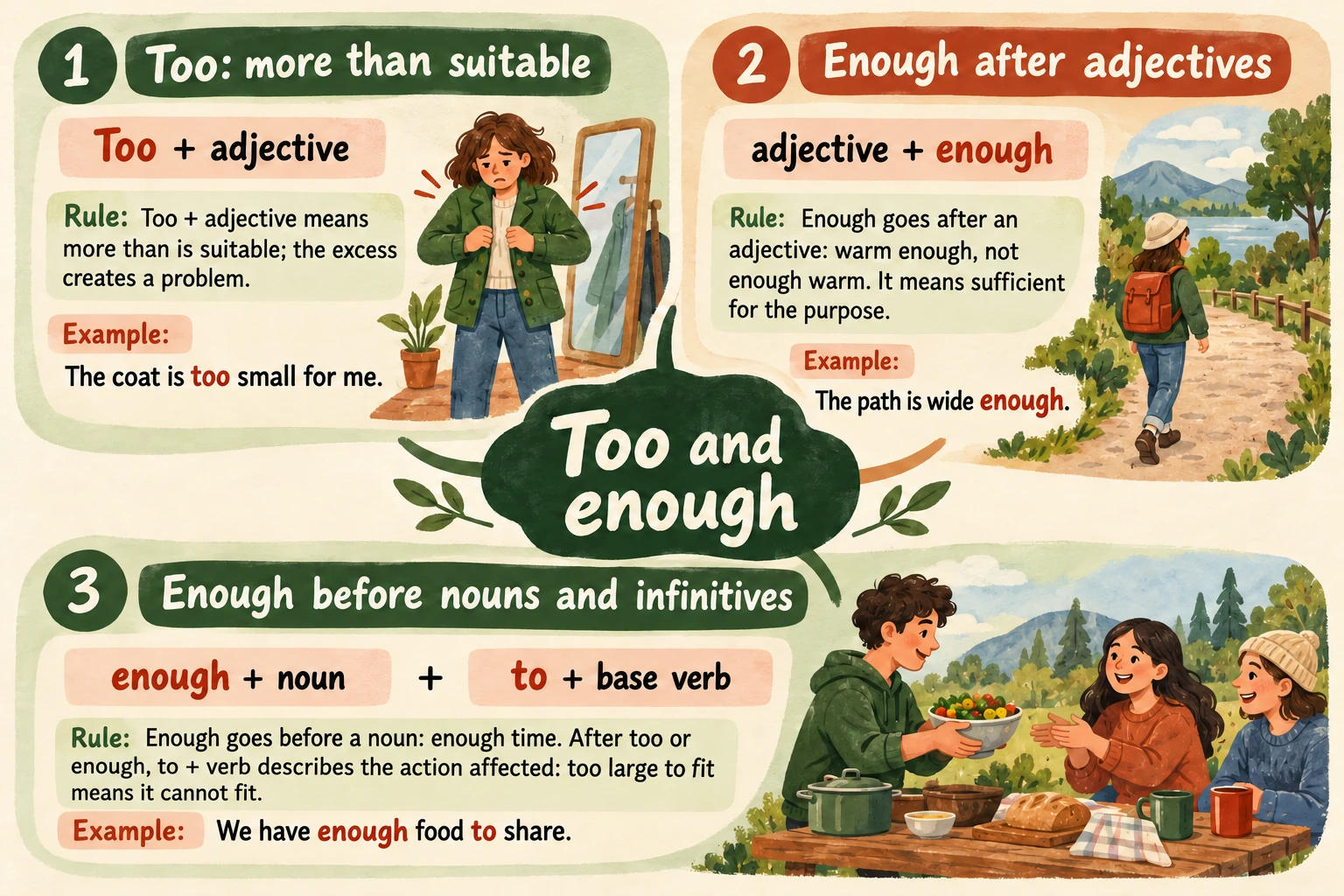
01Too: exceso inadecuado
Too + adjetivo significa más de lo adecuado; el exceso causa un problema.
The coat is too small for me.
Too y enough · A2. Too + adjetivo significa más de lo adecuado; el exceso causa un problema.
Practica Too y enough en situaciones breves. Lee la pista, elige o escribe una forma y revisa la explicación. El nivel es una orientación editorial.
Too + adjetivo significa más de lo adecuado; el exceso causa un problema.
The coat is too small for me.Enough va después del adjetivo: warm enough, no enough warm; significa suficiente para el fin.
The path is wide enough.Enough va antes de un nombre: enough time. Tras too o enough, el infinitivo expresa la acción afectada por el grado: too large to fit significa que no cabe; enough time to finish indica tiempo suficiente para terminar.
We have enough food to share.
The soup is ___ hot to eat; it burns my mouth.
Too + adjetivo significa más de lo adecuado; el exceso causa un problema.
The coat is too small for me.Enough va después del adjetivo: warm enough, no enough warm; significa suficiente para el fin.
The path is wide enough.Enough va antes de un nombre: enough time. Tras too o enough, el infinitivo expresa la acción afectada por el grado: too large to fit significa que no cabe; enough time to finish indica tiempo suficiente para terminar.
We have enough food to share.Conserva el primer intento, entiende el cambio y compruébalo en otra situación.
Aún no hay repasos. Prueba un calentamiento corto.
Too + adjetivo significa más de lo adecuado; el exceso causa un problema.
The coat is too small for me.Enough va después del adjetivo: warm enough, no enough warm; significa suficiente para el fin.
The path is wide enough.Enough va antes de un nombre: enough time. Tras too o enough, el infinitivo expresa la acción afectada por el grado: too large to fit significa que no cabe; enough time to finish indica tiempo suficiente para terminar.
We have enough food to share.Abrir una respuesta registra ayuda para esa pregunta.
The soup is ___ hot to eat; it burns my mouth.
Mira «The soup is ___ hot to eat; it burns my mouth.». Too + adjetivo significa más de lo adecuado; el exceso causa un problema. Oración completa: «The soup is too hot to eat; it burns my mouth.».
The ladder reaches the window. It is ___.
Mira «The ladder reaches the window. It is ___.». Enough va después del adjetivo: warm enough, no enough warm; significa suficiente para el fin. Oración completa: «The ladder reaches the window. It is long enough.».
We can buy both tickets because we have ___.
Comprar ambos billetes requiere dinero suficiente. En enough money, enough va antes de money. No se coloca of directamente ante este nombre sin determinante.
The bag is ___ heavy for me to lift; I cannot move it.
Oración de referencia: «The bag is too heavy for me to lift; I cannot move it.». Too + adjetivo significa más de lo adecuado; el exceso causa un problema.
The room has plenty of space. It is ___ for six people.
Mira «The room has plenty of space. It is ___ for six people.». Enough va después del adjetivo: warm enough, no enough warm; significa suficiente para el fin. Oración completa: «The room has plenty of space. It is big enough for six people.».
The shelf is low enough ___ reach. (use the infinitive marker)
The shelf is low enough to reach significa que su altura permite alcanzarlo. Se usa adjetivo + enough + to + verbo base. To introduce la acción posible gracias a la altura, no la finalidad del estante.
The road is ___ narrow for this truck; it cannot pass.
Oración de referencia: «The road is too narrow for this truck; it cannot pass.». Too + adjetivo significa más de lo adecuado; el exceso causa un problema.
The music is ___ loud for the baby to sleep.
Mira «The music is ___ loud for the baby to sleep.». Too + adjetivo significa más de lo adecuado; el exceso causa un problema. Oración completa: «The music is too loud for the baby to sleep.».
The water is safe for swimming. It is ___.
Mira «The water is safe for swimming. It is ___.». Enough va después del adjetivo: warm enough, no enough warm; significa suficiente para el fin. Oración completa: «The water is safe for swimming. It is warm enough.».
We finished on time because we had ___ time.
Oración de referencia: «We finished on time because we had enough time.». Enough va antes de un nombre: enough time. Tras too o enough, el infinitivo expresa la acción afectada por el grado: too large to fit significa que no cabe; enough time to finish indica tiempo suficiente para terminar. También se admiten estas variantes revisadas: sufficient / ample / plenty of / a lot of / lots of. No es una lista de todas las expresiones posibles.
Kai cannot enter the adult class. He is not ___.
Mira «Kai cannot enter the adult class. He is not ___.». Enough va después del adjetivo: warm enough, no enough warm; significa suficiente para el fin. Oración completa: «Kai cannot enter the adult class. He is not old enough.».
This box is too large ___ fit in my bag. (use the infinitive marker)
Too large to fit indica que el tamaño impide que la caja quepa. To introduce el infinitivo fit; aquí no expresa la finalidad de la caja.