
B2

Participle clauses Exercises

About this lesson

Participle clauses · B2. Use -ing / having + past participle to express an active participle clause whose understood subject is the main-clause subject.

Complete 12 original tasks. Use the situation to choose the intended meaning, practise the form, then apply it in a fresh context.

12 items
Save it to find it in My collection.
Knowledge map

Participle clauses

Start practising
Participle clauses — Knowledge map

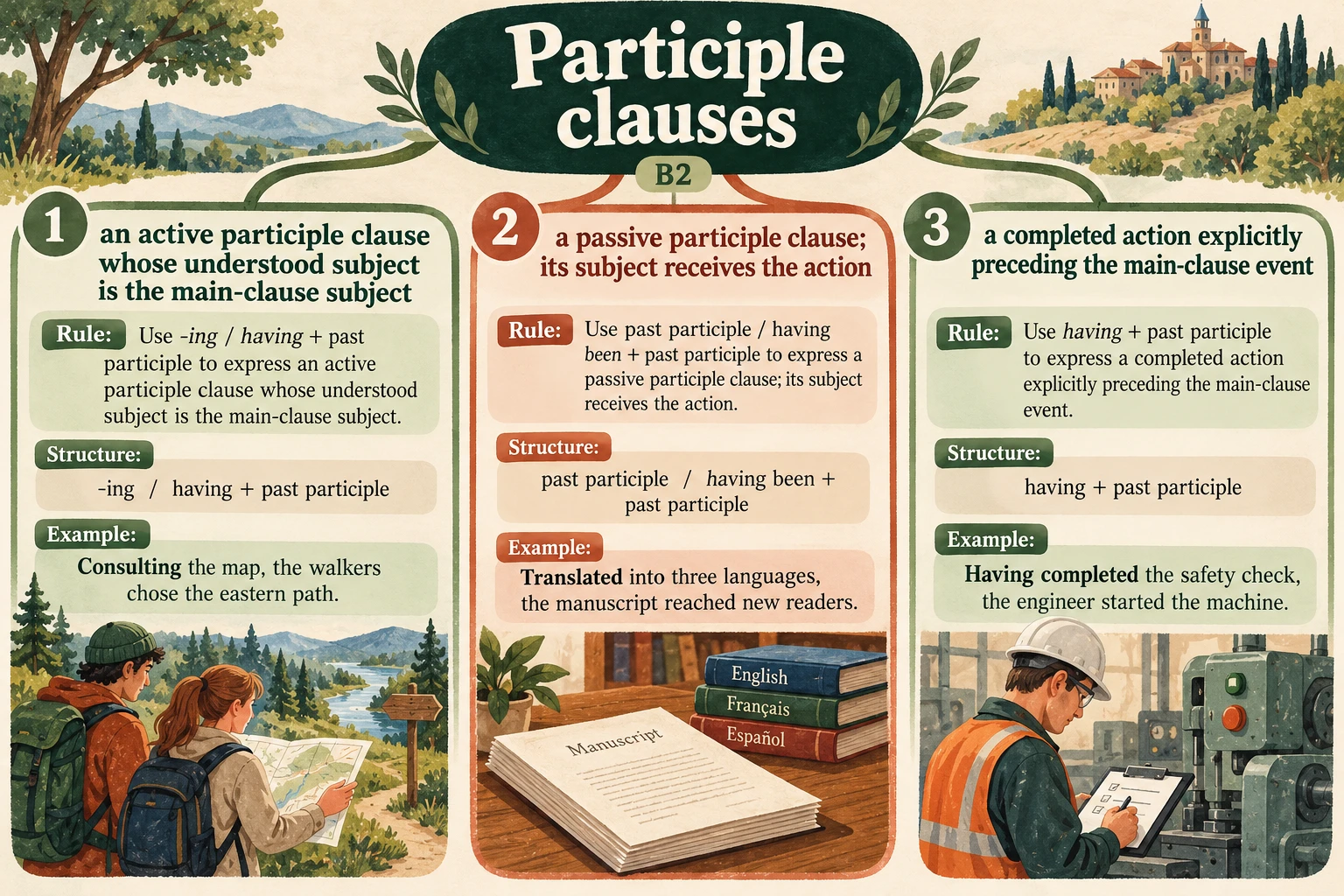
01an active participle clause whose understood subject is the main-clause subject

Use -ing / having + past participle to express an active participle clause whose understood subject is the main-clause subject.

Consulting the map, the walkers chose the eastern path.
02a passive participle clause; its subject receives the action

Use past participle / having been + past participle to express a passive participle clause; its subject receives the action.

Translated into three languages, the manuscript reached new readers.

03a completed action explicitly preceding the main-clause event

Use having + past participle to express a completed action explicitly preceding the main-clause event.

Having completed the safety check, the engineer started the machine.

Illustrated guide

0/12
Questions
01 / 12D01Save it to find it in My collection.

The walkers checked the map; keep the same subject in the main clause.

___ the map, the walkers chose the eastern path.

Your answer
1 / 12

Your learning route

01
Step 1 · Warm-up

Warm-up

0/3
02
Step 2 · Build the skill

an active participle clause whose understood subject is the main-clause subject

0/2

Use -ing / having + past participle to express an active participle clause whose understood subject is the main-clause subject.

Consulting the map, the walkers chose the eastern path.
03
Step 3 · Build the skill

a passive participle clause; its subject receives the action

0/1

Use past participle / having been + past participle to express a passive participle clause; its subject receives the action.

Translated into three languages, the manuscript reached new readers.
04
Step 4 · Build the skill

a completed action explicitly preceding the main-clause event

0/1

Use having + past participle to express a completed action explicitly preceding the main-clause event.

Having completed the safety check, the engineer started the machine.
05
Step 5 · New contexts

New contexts

0/3
06
Step 6 · A fresh challenge

A fresh challenge

0/2
Practice notes in this unit

Make mistakes useful.

Keep the first try. Understand the change. Check it in a fresh situation.

0

No practice notes yet. Try a short warm-up.

Lesson map

Participle clauses

B2
Participle clauses

Lesson points

01

an active participle clause whose understood subject is the main-clause subject

Use -ing / having + past participle to express an active participle clause whose understood subject is the main-clause subject.

Consulting the map, the walkers chose the eastern path.
02

a passive participle clause; its subject receives the action

Use past participle / having been + past participle to express a passive participle clause; its subject receives the action.

Translated into three languages, the manuscript reached new readers.
03

a completed action explicitly preceding the main-clause event

Use having + past participle to express a completed action explicitly preceding the main-clause event.

Having completed the safety check, the engineer started the machine.

Questions & answers

Opening an answer records help for that question.

D01 · Warm-up

The walkers checked the map; keep the same subject in the main clause.

___ the map, the walkers chose the eastern path.

  1. Being consulted
  2. Consulting
  3. Having consult
  4. Consulted
Answer & explanation
Consulting

The deciding clue is “The walkers checked the map; keep the same subject in the main clause.”. Use -ing / having + past participle to express an active participle clause whose understood subject is the main-clause subject. In this task, the completed sentence is “Consulting the map, the walkers chose the eastern path.”.

D02 · Warm-up

The manuscript receives the action of translation.

___ into three languages, the manuscript reached new readers.

  1. Translating
  2. Having translated
  3. Translated
  4. To translate
Answer & explanation
Translated

The deciding clue is “The manuscript receives the action of translation.”. Use past participle / having been + past participle to express a passive participle clause; its subject receives the action. In this task, the completed sentence is “Translated into three languages, the manuscript reached new readers.”.

D03 · Warm-up

The safety check was completed before the machine was started.

___ the safety check, the engineer started the machine.

  1. Being completed
  2. Having completing
  3. Completed by
  4. Having completed
Answer & explanation
Having completed

The deciding clue is “The safety check was completed before the machine was started.”. Use having + past participle to express a completed action explicitly preceding the main-clause event. In this task, the completed sentence is “Having completed the safety check, the engineer started the machine.”.

P01 · Build the skill

The child looked through the window; the implied subject is the child.

___ through the window, the child spotted a fox.

  1. Being looked
  2. Looked
  3. Looking
  4. Having looking
Answer & explanation
Looking

The deciding clue is “The child looked through the window; the implied subject is the child.”. Use -ing / having + past participle to express an active participle clause whose understood subject is the main-clause subject. In this task, the completed sentence is “Looking through the window, the child spotted a fox.”.

P02 · Build the skill

Use a passive participle of surround; trees surround the house.

___ by tall trees, the house stays cool.

Answer & explanation
Surrounded

Complete sentence: “Surrounded by tall trees, the house stays cool.” Use past participle / having been + past participle to express a passive participle clause; its subject receives the action. The subject, time and meaning in the task determine this form. Only reviewed responses are matched automatically; other wording is not automatically wrong.

P03 · Build the skill

The decision follows a completed review.

___ all the applications, the panel announced its shortlist.

  1. Having reviewing
  2. Having reviewed
  3. Reviewed by
  4. Being reviewed
Answer & explanation
Having reviewed

The deciding clue is “The decision follows a completed review.”. Use having + past participle to express a completed action explicitly preceding the main-clause event. In this task, the completed sentence is “Having reviewed all the applications, the panel announced its shortlist.”.

P04 · Build the skill

Use the simple active -ing form of know in a reason clause with the same subject; do not use a perfect participle.

___ the risks, the climbers turned back.

Answer & explanation
Knowing

Complete sentence: “Knowing the risks, the climbers turned back.” Use -ing / having + past participle to express an active participle clause whose understood subject is the main-clause subject. The subject, time and meaning in the task determine this form. Only reviewed responses are matched automatically; other wording is not automatically wrong.

R01 · New contexts

The same person holds the rope and guides the climber.

___ the rope firmly, the guide helped the climber.

  1. Holding
  2. Being held
  3. Having holding
  4. Held
Answer & explanation
Holding

The deciding clue is “The same person holds the rope and guides the climber.”. Use -ing / having + past participle to express an active participle clause whose understood subject is the main-clause subject. In this task, the completed sentence is “Holding the rope firmly, the guide helped the climber.”.

R02 · New contexts

Use a perfect passive participle clause with warn for an event preceding the decision.

___ about the ice, we chose the lower path.

Answer & explanation
Having been warned

Complete sentence: “Having been warned about the ice, we chose the lower path.” Use past participle / having been + past participle to express a passive participle clause; its subject receives the action. The subject, time and meaning in the task determine this form. Only reviewed responses are matched automatically; other wording is not automatically wrong.

R03 · New contexts

The report is finished before she sends the invoice.

___ the report, she sent her invoice.

  1. Having finishing
  2. Having finished
  3. Finished by
  4. Being finished
Answer & explanation
Having finished

The deciding clue is “The report is finished before she sends the invoice.”. Use having + past participle to express a completed action explicitly preceding the main-clause event. In this task, the completed sentence is “Having finished the report, she sent her invoice.”.

X01 · A fresh challenge

The supplies receive the action before distribution.

___ for damage, the supplies were distributed.

  1. Having checked
  2. Checked
  3. Checking
  4. To check
Answer & explanation
Checked

The deciding clue is “The supplies receive the action before distribution.”. Use past participle / having been + past participle to express a passive participle clause; its subject receives the action. In this task, the completed sentence is “Checked for damage, the supplies were distributed.”.

X02 · A fresh challenge

Use a perfect active participle clause with lock for an action completed before departure by the same person.

___ the laboratory, the researcher went home.

Answer & explanation
Having locked

Complete sentence: “Having locked the laboratory, the researcher went home.” Use having + past participle to express a completed action explicitly preceding the main-clause event. The subject, time and meaning in the task determine this form. Only reviewed responses are matched automatically; other wording is not automatically wrong.