
B2

Propositions participiales : exercices

À propos de cette leçon

Propositions participiales · B2. Utilisez -ing / having + past participle pour exprimer une participiale active dont le sujet implicite est celui de la principale.

Réalisez 12 exercices originaux. Appuyez-vous sur la situation pour interpréter le sens, pratiquer la forme et la réutiliser dans un nouveau contexte.

12 questions
Retrouvez-le dans Ma collection après enregistrement.
Carte des notions

Participle clauses

Commencer
Participle clauses — Carte des notions

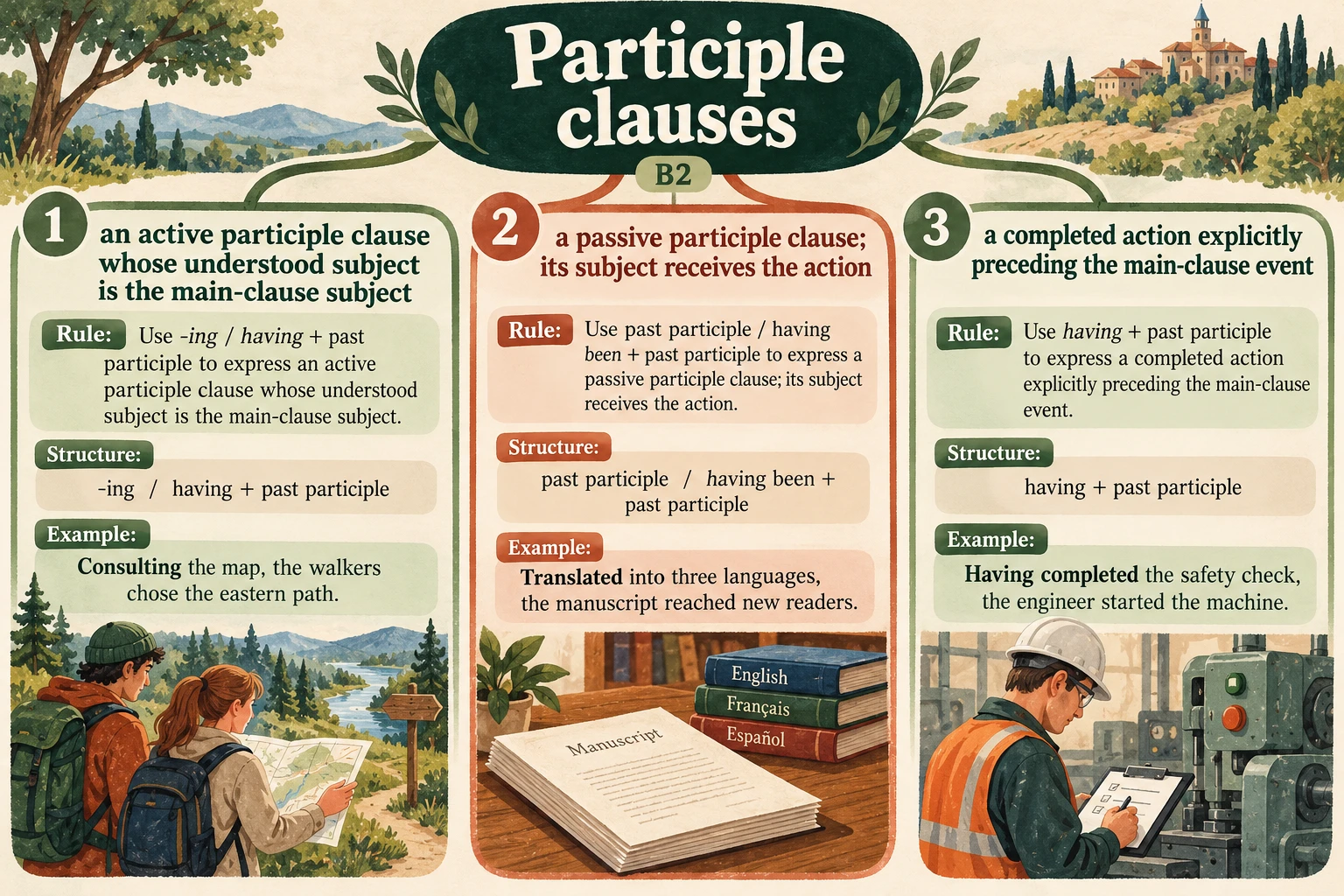
01une participiale active dont le sujet implicite est celui de la principale

Utilisez -ing / having + past participle pour exprimer une participiale active dont le sujet implicite est celui de la principale.

Consulting the map, the walkers chose the eastern path.

02une participiale passive dont le sujet subit l’action

Utilisez past participle / having been + past participle pour exprimer une participiale passive dont le sujet subit l’action.

Translated into three languages, the manuscript reached new readers.

03une action explicitement achevée avant celle de la principale

Utilisez having + past participle pour exprimer une action explicitement achevée avant celle de la principale.

Having completed the safety check, the engineer started the machine.

Guide illustré

0/12
Questions
01 / 12D01Retrouvez-le dans Ma collection après enregistrement.

The walkers checked the map; keep the same subject in the main clause.

___ the map, the walkers chose the eastern path.

Votre réponse
1 / 12

Votre parcours

01
Étape 1 · Échauffement

Échauffement

0/3
02
Étape 2 · Développer la compétence

une participiale active dont le sujet implicite est celui de la principale

0/2

Utilisez -ing / having + past participle pour exprimer une participiale active dont le sujet implicite est celui de la principale.

Consulting the map, the walkers chose the eastern path.
03
Étape 3 · Développer la compétence

une participiale passive dont le sujet subit l’action

0/1

Utilisez past participle / having been + past participle pour exprimer une participiale passive dont le sujet subit l’action.

Translated into three languages, the manuscript reached new readers.
04
Étape 4 · Développer la compétence

une action explicitement achevée avant celle de la principale

0/1

Utilisez having + past participle pour exprimer une action explicitement achevée avant celle de la principale.

Having completed the safety check, the engineer started the machine.
05
Étape 5 · Nouveaux contextes

Nouveaux contextes

0/3
06
Étape 6 · Un nouveau défi

Un nouveau défi

0/2
Révisions de cette unité

Apprenez de vos erreurs.

Gardez la première tentative, comprenez le changement et essayez dans une nouvelle situation.

0

Pas encore de notes. Essayez un court échauffement.

Carte de la leçon

Propositions participiales

B2
Participle clauses

Points de la leçon

01

une participiale active dont le sujet implicite est celui de la principale

Utilisez -ing / having + past participle pour exprimer une participiale active dont le sujet implicite est celui de la principale.

Consulting the map, the walkers chose the eastern path.
02

une participiale passive dont le sujet subit l’action

Utilisez past participle / having been + past participle pour exprimer une participiale passive dont le sujet subit l’action.

Translated into three languages, the manuscript reached new readers.
03

une action explicitement achevée avant celle de la principale

Utilisez having + past participle pour exprimer une action explicitement achevée avant celle de la principale.

Having completed the safety check, the engineer started the machine.

Questions et réponses

Ouvrir une réponse enregistre une aide pour cette question.

D01 · Échauffement

The walkers checked the map; keep the same subject in the main clause.

___ the map, the walkers chose the eastern path.

  1. Being consulted
  2. Consulting
  3. Having consult
  4. Consulted
Réponse et explication
Consulting

L’indice décisif est « The walkers checked the map; keep the same subject in the main clause. ». Utilisez -ing / having + past participle pour exprimer une participiale active dont le sujet implicite est celui de la principale. Dans cette tâche, la phrase complète est « Consulting the map, the walkers chose the eastern path. ».

D02 · Échauffement

The manuscript receives the action of translation.

___ into three languages, the manuscript reached new readers.

  1. Translating
  2. Having translated
  3. Translated
  4. To translate
Réponse et explication
Translated

L’indice décisif est « The manuscript receives the action of translation. ». Utilisez past participle / having been + past participle pour exprimer une participiale passive dont le sujet subit l’action. Dans cette tâche, la phrase complète est « Translated into three languages, the manuscript reached new readers. ».

D03 · Échauffement

The safety check was completed before the machine was started.

___ the safety check, the engineer started the machine.

  1. Being completed
  2. Having completing
  3. Completed by
  4. Having completed
Réponse et explication
Having completed

L’indice décisif est « The safety check was completed before the machine was started. ». Utilisez having + past participle pour exprimer une action explicitement achevée avant celle de la principale. Dans cette tâche, la phrase complète est « Having completed the safety check, the engineer started the machine. ».

P01 · Développer la compétence

The child looked through the window; the implied subject is the child.

___ through the window, the child spotted a fox.

  1. Being looked
  2. Looked
  3. Looking
  4. Having looking
Réponse et explication
Looking

L’indice décisif est « The child looked through the window; the implied subject is the child. ». Utilisez -ing / having + past participle pour exprimer une participiale active dont le sujet implicite est celui de la principale. Dans cette tâche, la phrase complète est « Looking through the window, the child spotted a fox. ».

P02 · Développer la compétence

Use a passive participle of surround; trees surround the house.

___ by tall trees, the house stays cool.

Réponse et explication
Surrounded

Phrase complète : « Surrounded by tall trees, the house stays cool. » Utilisez past participle / having been + past participle pour exprimer une participiale passive dont le sujet subit l’action. Le sujet, le temps et le sens de la consigne déterminent cette forme. Seules les réponses vérifiées sont comparées automatiquement ; toute autre formulation n’est pas automatiquement fausse.

P03 · Développer la compétence

The decision follows a completed review.

___ all the applications, the panel announced its shortlist.

  1. Having reviewing
  2. Having reviewed
  3. Reviewed by
  4. Being reviewed
Réponse et explication
Having reviewed

L’indice décisif est « The decision follows a completed review. ». Utilisez having + past participle pour exprimer une action explicitement achevée avant celle de la principale. Dans cette tâche, la phrase complète est « Having reviewed all the applications, the panel announced its shortlist. ».

P04 · Développer la compétence

Use the simple active -ing form of know in a reason clause with the same subject; do not use a perfect participle.

___ the risks, the climbers turned back.

Réponse et explication
Knowing

Phrase complète : « Knowing the risks, the climbers turned back. » Utilisez -ing / having + past participle pour exprimer une participiale active dont le sujet implicite est celui de la principale. Le sujet, le temps et le sens de la consigne déterminent cette forme. Seules les réponses vérifiées sont comparées automatiquement ; toute autre formulation n’est pas automatiquement fausse.

R01 · Nouveaux contextes

The same person holds the rope and guides the climber.

___ the rope firmly, the guide helped the climber.

  1. Holding
  2. Being held
  3. Having holding
  4. Held
Réponse et explication
Holding

L’indice décisif est « The same person holds the rope and guides the climber. ». Utilisez -ing / having + past participle pour exprimer une participiale active dont le sujet implicite est celui de la principale. Dans cette tâche, la phrase complète est « Holding the rope firmly, the guide helped the climber. ».

R02 · Nouveaux contextes

Use a perfect passive participle clause with warn for an event preceding the decision.

___ about the ice, we chose the lower path.

Réponse et explication
Having been warned

Phrase complète : « Having been warned about the ice, we chose the lower path. » Utilisez past participle / having been + past participle pour exprimer une participiale passive dont le sujet subit l’action. Le sujet, le temps et le sens de la consigne déterminent cette forme. Seules les réponses vérifiées sont comparées automatiquement ; toute autre formulation n’est pas automatiquement fausse.

R03 · Nouveaux contextes

The report is finished before she sends the invoice.

___ the report, she sent her invoice.

  1. Having finishing
  2. Having finished
  3. Finished by
  4. Being finished
Réponse et explication
Having finished

L’indice décisif est « The report is finished before she sends the invoice. ». Utilisez having + past participle pour exprimer une action explicitement achevée avant celle de la principale. Dans cette tâche, la phrase complète est « Having finished the report, she sent her invoice. ».

X01 · Un nouveau défi

The supplies receive the action before distribution.

___ for damage, the supplies were distributed.

  1. Having checked
  2. Checked
  3. Checking
  4. To check
Réponse et explication
Checked

L’indice décisif est « The supplies receive the action before distribution. ». Utilisez past participle / having been + past participle pour exprimer une participiale passive dont le sujet subit l’action. Dans cette tâche, la phrase complète est « Checked for damage, the supplies were distributed. ».

X02 · Un nouveau défi

Use a perfect active participle clause with lock for an action completed before departure by the same person.

___ the laboratory, the researcher went home.

Réponse et explication
Having locked

Phrase complète : « Having locked the laboratory, the researcher went home. » Utilisez having + past participle pour exprimer une action explicitement achevée avant celle de la principale. Le sujet, le temps et le sens de la consigne déterminent cette forme. Seules les réponses vérifiées sont comparées automatiquement ; toute autre formulation n’est pas automatiquement fausse.