
B2

Oraciones de participio: ejercicios

Sobre esta lección

Oraciones de participio · B2. Usa -ing / having + past participle para expresar una cláusula participial activa con el mismo sujeto implícito que la principal.

Completa 12 tareas originales. Deduce el sentido por la situación, practica la forma y aplícala en un contexto nuevo.

12 preguntas
Guárdalo para encontrarlo en Mi colección.
Mapa de conceptos

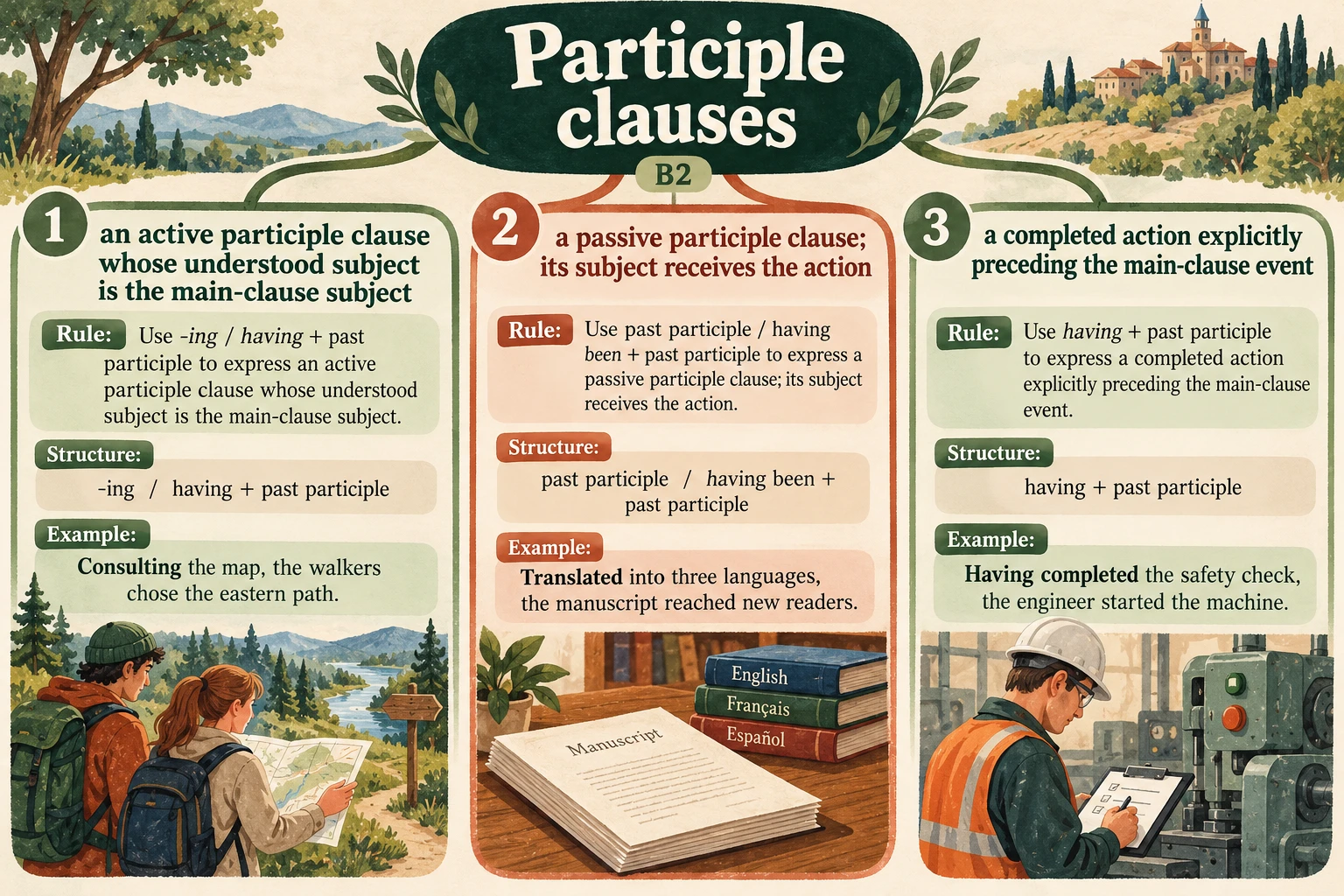
Participle clauses

Empezar a practicar
Participle clauses — Mapa de conceptos

01una cláusula participial activa con el mismo sujeto implícito que la principal

Usa -ing / having + past participle para expresar una cláusula participial activa con el mismo sujeto implícito que la principal.

Consulting the map, the walkers chose the eastern path.
02una cláusula participial pasiva; su sujeto recibe la acción

Usa past participle / having been + past participle para expresar una cláusula participial pasiva; su sujeto recibe la acción.

Translated into three languages, the manuscript reached new readers.

03una acción terminada explícitamente antes del hecho principal

Usa having + past participle para expresar una acción terminada explícitamente antes del hecho principal.

Having completed the safety check, the engineer started the machine.

Guía ilustrada

0/12
Preguntas
01 / 12D01Guárdalo para encontrarlo en Mi colección.

The walkers checked the map; keep the same subject in the main clause.

___ the map, the walkers chose the eastern path.

Tu respuesta
1 / 12

Tu ruta de aprendizaje

01
Paso 1 · Calentamiento

Calentamiento

0/3
02
Paso 2 · Practicar la habilidad

una cláusula participial activa con el mismo sujeto implícito que la principal

0/2

Usa -ing / having + past participle para expresar una cláusula participial activa con el mismo sujeto implícito que la principal.

Consulting the map, the walkers chose the eastern path.
03
Paso 3 · Practicar la habilidad

una cláusula participial pasiva; su sujeto recibe la acción

0/1

Usa past participle / having been + past participle para expresar una cláusula participial pasiva; su sujeto recibe la acción.

Translated into three languages, the manuscript reached new readers.
04
Paso 4 · Practicar la habilidad

una acción terminada explícitamente antes del hecho principal

0/1

Usa having + past participle para expresar una acción terminada explícitamente antes del hecho principal.

Having completed the safety check, the engineer started the machine.
05
Paso 5 · Nuevos contextos

Nuevos contextos

0/3
06
Paso 6 · Un nuevo reto

Un nuevo reto

0/2
Repasos de esta unidad

Haz que los errores sirvan.

Conserva el primer intento, entiende el cambio y compruébalo en otra situación.

0

Aún no hay repasos. Prueba un calentamiento corto.

Mapa de la lección

Oraciones de participio

B2
Participle clauses

Puntos de la lección

01

una cláusula participial activa con el mismo sujeto implícito que la principal

Usa -ing / having + past participle para expresar una cláusula participial activa con el mismo sujeto implícito que la principal.

Consulting the map, the walkers chose the eastern path.
02

una cláusula participial pasiva; su sujeto recibe la acción

Usa past participle / having been + past participle para expresar una cláusula participial pasiva; su sujeto recibe la acción.

Translated into three languages, the manuscript reached new readers.
03

una acción terminada explícitamente antes del hecho principal

Usa having + past participle para expresar una acción terminada explícitamente antes del hecho principal.

Having completed the safety check, the engineer started the machine.

Preguntas y respuestas

Abrir una respuesta registra ayuda para esa pregunta.

D01 · Calentamiento

The walkers checked the map; keep the same subject in the main clause.

___ the map, the walkers chose the eastern path.

  1. Being consulted
  2. Consulting
  3. Having consult
  4. Consulted
Respuesta y explicación
Consulting

La pista decisiva es «The walkers checked the map; keep the same subject in the main clause.». Usa -ing / having + past participle para expresar una cláusula participial activa con el mismo sujeto implícito que la principal. En esta tarea, la oración completa es «Consulting the map, the walkers chose the eastern path.».

D02 · Calentamiento

The manuscript receives the action of translation.

___ into three languages, the manuscript reached new readers.

  1. Translating
  2. Having translated
  3. Translated
  4. To translate
Respuesta y explicación
Translated

La pista decisiva es «The manuscript receives the action of translation.». Usa past participle / having been + past participle para expresar una cláusula participial pasiva; su sujeto recibe la acción. En esta tarea, la oración completa es «Translated into three languages, the manuscript reached new readers.».

D03 · Calentamiento

The safety check was completed before the machine was started.

___ the safety check, the engineer started the machine.

  1. Being completed
  2. Having completing
  3. Completed by
  4. Having completed
Respuesta y explicación
Having completed

La pista decisiva es «The safety check was completed before the machine was started.». Usa having + past participle para expresar una acción terminada explícitamente antes del hecho principal. En esta tarea, la oración completa es «Having completed the safety check, the engineer started the machine.».

P01 · Practicar la habilidad

The child looked through the window; the implied subject is the child.

___ through the window, the child spotted a fox.

  1. Being looked
  2. Looked
  3. Looking
  4. Having looking
Respuesta y explicación
Looking

La pista decisiva es «The child looked through the window; the implied subject is the child.». Usa -ing / having + past participle para expresar una cláusula participial activa con el mismo sujeto implícito que la principal. En esta tarea, la oración completa es «Looking through the window, the child spotted a fox.».

P02 · Practicar la habilidad

Use a passive participle of surround; trees surround the house.

___ by tall trees, the house stays cool.

Respuesta y explicación
Surrounded

Oración completa: «Surrounded by tall trees, the house stays cool.» Usa past participle / having been + past participle para expresar una cláusula participial pasiva; su sujeto recibe la acción. El sujeto, el tiempo y el sentido de la tarea determinan la forma. Solo se cotejan automáticamente las respuestas revisadas; otra redacción no es automáticamente incorrecta.

P03 · Practicar la habilidad

The decision follows a completed review.

___ all the applications, the panel announced its shortlist.

  1. Having reviewing
  2. Having reviewed
  3. Reviewed by
  4. Being reviewed
Respuesta y explicación
Having reviewed

La pista decisiva es «The decision follows a completed review.». Usa having + past participle para expresar una acción terminada explícitamente antes del hecho principal. En esta tarea, la oración completa es «Having reviewed all the applications, the panel announced its shortlist.».

P04 · Practicar la habilidad

Use the simple active -ing form of know in a reason clause with the same subject; do not use a perfect participle.

___ the risks, the climbers turned back.

Respuesta y explicación
Knowing

Oración completa: «Knowing the risks, the climbers turned back.» Usa -ing / having + past participle para expresar una cláusula participial activa con el mismo sujeto implícito que la principal. El sujeto, el tiempo y el sentido de la tarea determinan la forma. Solo se cotejan automáticamente las respuestas revisadas; otra redacción no es automáticamente incorrecta.

R01 · Nuevos contextos

The same person holds the rope and guides the climber.

___ the rope firmly, the guide helped the climber.

  1. Holding
  2. Being held
  3. Having holding
  4. Held
Respuesta y explicación
Holding

La pista decisiva es «The same person holds the rope and guides the climber.». Usa -ing / having + past participle para expresar una cláusula participial activa con el mismo sujeto implícito que la principal. En esta tarea, la oración completa es «Holding the rope firmly, the guide helped the climber.».

R02 · Nuevos contextos

Use a perfect passive participle clause with warn for an event preceding the decision.

___ about the ice, we chose the lower path.

Respuesta y explicación
Having been warned

Oración completa: «Having been warned about the ice, we chose the lower path.» Usa past participle / having been + past participle para expresar una cláusula participial pasiva; su sujeto recibe la acción. El sujeto, el tiempo y el sentido de la tarea determinan la forma. Solo se cotejan automáticamente las respuestas revisadas; otra redacción no es automáticamente incorrecta.

R03 · Nuevos contextos

The report is finished before she sends the invoice.

___ the report, she sent her invoice.

  1. Having finishing
  2. Having finished
  3. Finished by
  4. Being finished
Respuesta y explicación
Having finished

La pista decisiva es «The report is finished before she sends the invoice.». Usa having + past participle para expresar una acción terminada explícitamente antes del hecho principal. En esta tarea, la oración completa es «Having finished the report, she sent her invoice.».

X01 · Un nuevo reto

The supplies receive the action before distribution.

___ for damage, the supplies were distributed.

  1. Having checked
  2. Checked
  3. Checking
  4. To check
Respuesta y explicación
Checked

La pista decisiva es «The supplies receive the action before distribution.». Usa past participle / having been + past participle para expresar una cláusula participial pasiva; su sujeto recibe la acción. En esta tarea, la oración completa es «Checked for damage, the supplies were distributed.».

X02 · Un nuevo reto

Use a perfect active participle clause with lock for an action completed before departure by the same person.

___ the laboratory, the researcher went home.

Respuesta y explicación
Having locked

Oración completa: «Having locked the laboratory, the researcher went home.» Usa having + past participle para expresar una acción terminada explícitamente antes del hecho principal. El sujeto, el tiempo y el sentido de la tarea determinan la forma. Solo se cotejan automáticamente las respuestas revisadas; otra redacción no es automáticamente incorrecta.