
B2

Orações participiais: exercícios

Sobre esta lição

Orações participiais · B2. Use -ing / having + past participle para expressar uma oração participial ativa com o mesmo sujeito implícito da principal.

Resolva 12 tarefas originais. Use a situação para interpretar o sentido, praticar a estrutura e aplicá-la em um novo contexto.

12 questões
Salve para encontrar em Minha coleção.
Mapa de conceitos

Participle clauses

Começar a praticar
Participle clauses — Mapa de conceitos

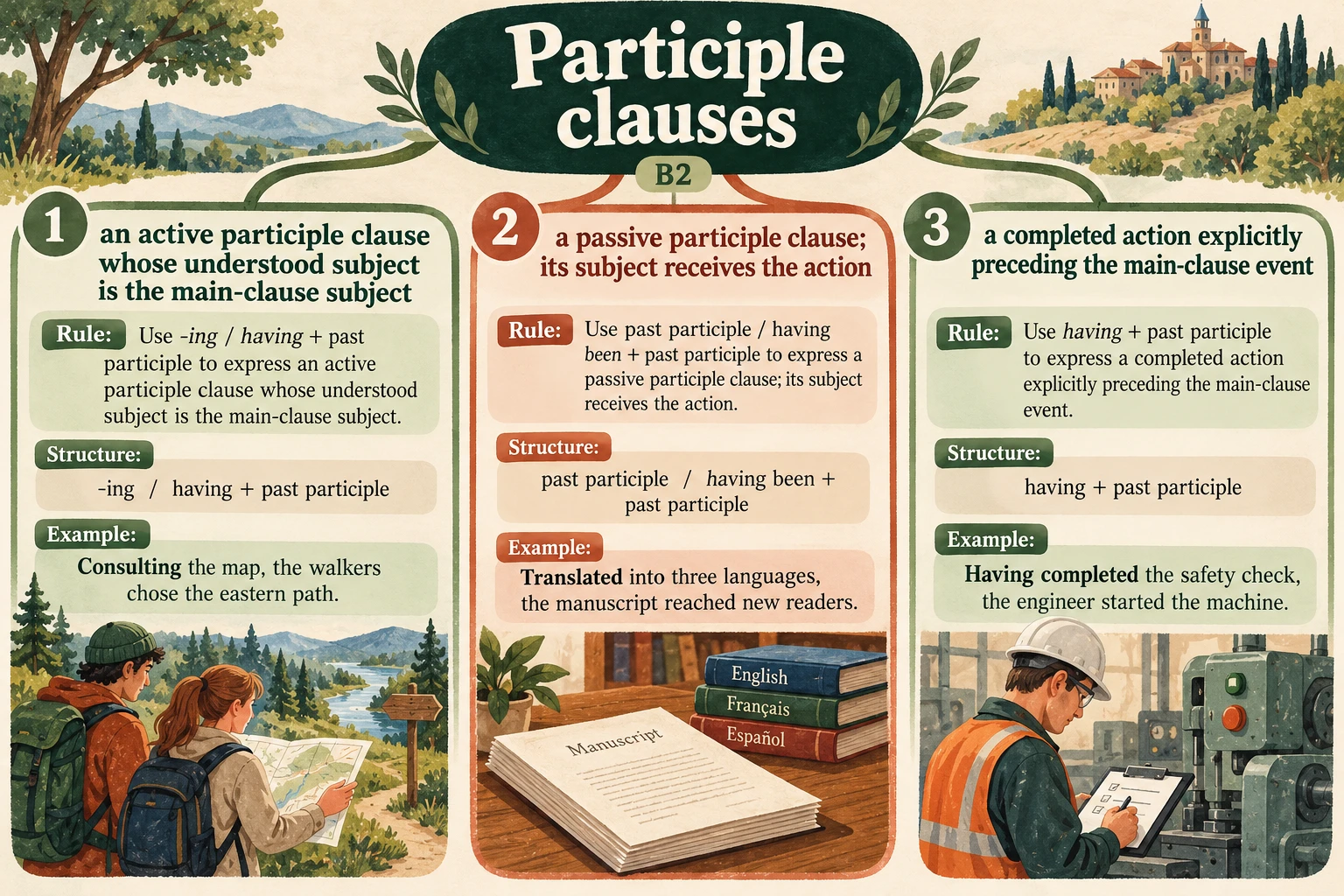
01uma oração participial ativa com o mesmo sujeito implícito da principal

Use -ing / having + past participle para expressar uma oração participial ativa com o mesmo sujeito implícito da principal.

Consulting the map, the walkers chose the eastern path.

02uma oração participial passiva cujo sujeito recebe a ação

Use past participle / having been + past participle para expressar uma oração participial passiva cujo sujeito recebe a ação.

Translated into three languages, the manuscript reached new readers.

03uma ação explicitamente concluída antes do evento principal

Use having + past participle para expressar uma ação explicitamente concluída antes do evento principal.

Having completed the safety check, the engineer started the machine.

Guia ilustrado

0/12
Questões
01 / 12D01Salve para encontrar em Minha coleção.

The walkers checked the map; keep the same subject in the main clause.

___ the map, the walkers chose the eastern path.

Sua resposta
1 / 12

Seu caminho de aprendizagem

01
Etapa 1 · Aquecimento

Aquecimento

0/3
02
Etapa 2 · Praticar a habilidade

uma oração participial ativa com o mesmo sujeito implícito da principal

0/2

Use -ing / having + past participle para expressar uma oração participial ativa com o mesmo sujeito implícito da principal.

Consulting the map, the walkers chose the eastern path.
03
Etapa 3 · Praticar a habilidade

uma oração participial passiva cujo sujeito recebe a ação

0/1

Use past participle / having been + past participle para expressar uma oração participial passiva cujo sujeito recebe a ação.

Translated into three languages, the manuscript reached new readers.
04
Etapa 4 · Praticar a habilidade

uma ação explicitamente concluída antes do evento principal

0/1

Use having + past participle para expressar uma ação explicitamente concluída antes do evento principal.

Having completed the safety check, the engineer started the machine.
05
Etapa 5 · Novos contextos

Novos contextos

0/3
06
Etapa 6 · Um novo desafio

Um novo desafio

0/2
Revisões desta unidade

Transforme erros em aprendizado.

Guarde a primeira tentativa, entenda a mudança e confira em outra situação.

0

Ainda não há revisões. Faça um aquecimento curto.

Mapa da aula

Orações participiais

B2
Participle clauses

Pontos da aula

01

uma oração participial ativa com o mesmo sujeito implícito da principal

Use -ing / having + past participle para expressar uma oração participial ativa com o mesmo sujeito implícito da principal.

Consulting the map, the walkers chose the eastern path.
02

uma oração participial passiva cujo sujeito recebe a ação

Use past participle / having been + past participle para expressar uma oração participial passiva cujo sujeito recebe a ação.

Translated into three languages, the manuscript reached new readers.
03

uma ação explicitamente concluída antes do evento principal

Use having + past participle para expressar uma ação explicitamente concluída antes do evento principal.

Having completed the safety check, the engineer started the machine.

Perguntas e respostas

Abrir uma resposta registra ajuda para essa questão.

D01 · Aquecimento

The walkers checked the map; keep the same subject in the main clause.

___ the map, the walkers chose the eastern path.

  1. Being consulted
  2. Consulting
  3. Having consult
  4. Consulted
Resposta e explicação
Consulting

A pista decisiva é “The walkers checked the map; keep the same subject in the main clause.”. Use -ing / having + past participle para expressar uma oração participial ativa com o mesmo sujeito implícito da principal. Nesta tarefa, a frase completa é “Consulting the map, the walkers chose the eastern path.”.

D02 · Aquecimento

The manuscript receives the action of translation.

___ into three languages, the manuscript reached new readers.

  1. Translating
  2. Having translated
  3. Translated
  4. To translate
Resposta e explicação
Translated

A pista decisiva é “The manuscript receives the action of translation.”. Use past participle / having been + past participle para expressar uma oração participial passiva cujo sujeito recebe a ação. Nesta tarefa, a frase completa é “Translated into three languages, the manuscript reached new readers.”.

D03 · Aquecimento

The safety check was completed before the machine was started.

___ the safety check, the engineer started the machine.

  1. Being completed
  2. Having completing
  3. Completed by
  4. Having completed
Resposta e explicação
Having completed

A pista decisiva é “The safety check was completed before the machine was started.”. Use having + past participle para expressar uma ação explicitamente concluída antes do evento principal. Nesta tarefa, a frase completa é “Having completed the safety check, the engineer started the machine.”.

P01 · Praticar a habilidade

The child looked through the window; the implied subject is the child.

___ through the window, the child spotted a fox.

  1. Being looked
  2. Looked
  3. Looking
  4. Having looking
Resposta e explicação
Looking

A pista decisiva é “The child looked through the window; the implied subject is the child.”. Use -ing / having + past participle para expressar uma oração participial ativa com o mesmo sujeito implícito da principal. Nesta tarefa, a frase completa é “Looking through the window, the child spotted a fox.”.

P02 · Praticar a habilidade

Use a passive participle of surround; trees surround the house.

___ by tall trees, the house stays cool.

Resposta e explicação
Surrounded

Frase completa: “Surrounded by tall trees, the house stays cool.” Use past participle / having been + past participle para expressar uma oração participial passiva cujo sujeito recebe a ação. O sujeito, o tempo e o sentido da tarefa determinam esta forma. Só as respostas revisadas são comparadas automaticamente; outras formulações não estão automaticamente erradas.

P03 · Praticar a habilidade

The decision follows a completed review.

___ all the applications, the panel announced its shortlist.

  1. Having reviewing
  2. Having reviewed
  3. Reviewed by
  4. Being reviewed
Resposta e explicação
Having reviewed

A pista decisiva é “The decision follows a completed review.”. Use having + past participle para expressar uma ação explicitamente concluída antes do evento principal. Nesta tarefa, a frase completa é “Having reviewed all the applications, the panel announced its shortlist.”.

P04 · Praticar a habilidade

Use the simple active -ing form of know in a reason clause with the same subject; do not use a perfect participle.

___ the risks, the climbers turned back.

Resposta e explicação
Knowing

Frase completa: “Knowing the risks, the climbers turned back.” Use -ing / having + past participle para expressar uma oração participial ativa com o mesmo sujeito implícito da principal. O sujeito, o tempo e o sentido da tarefa determinam esta forma. Só as respostas revisadas são comparadas automaticamente; outras formulações não estão automaticamente erradas.

R01 · Novos contextos

The same person holds the rope and guides the climber.

___ the rope firmly, the guide helped the climber.

  1. Holding
  2. Being held
  3. Having holding
  4. Held
Resposta e explicação
Holding

A pista decisiva é “The same person holds the rope and guides the climber.”. Use -ing / having + past participle para expressar uma oração participial ativa com o mesmo sujeito implícito da principal. Nesta tarefa, a frase completa é “Holding the rope firmly, the guide helped the climber.”.

R02 · Novos contextos

Use a perfect passive participle clause with warn for an event preceding the decision.

___ about the ice, we chose the lower path.

Resposta e explicação
Having been warned

Frase completa: “Having been warned about the ice, we chose the lower path.” Use past participle / having been + past participle para expressar uma oração participial passiva cujo sujeito recebe a ação. O sujeito, o tempo e o sentido da tarefa determinam esta forma. Só as respostas revisadas são comparadas automaticamente; outras formulações não estão automaticamente erradas.

R03 · Novos contextos

The report is finished before she sends the invoice.

___ the report, she sent her invoice.

  1. Having finishing
  2. Having finished
  3. Finished by
  4. Being finished
Resposta e explicação
Having finished

A pista decisiva é “The report is finished before she sends the invoice.”. Use having + past participle para expressar uma ação explicitamente concluída antes do evento principal. Nesta tarefa, a frase completa é “Having finished the report, she sent her invoice.”.

X01 · Um novo desafio

The supplies receive the action before distribution.

___ for damage, the supplies were distributed.

  1. Having checked
  2. Checked
  3. Checking
  4. To check
Resposta e explicação
Checked

A pista decisiva é “The supplies receive the action before distribution.”. Use past participle / having been + past participle para expressar uma oração participial passiva cujo sujeito recebe a ação. Nesta tarefa, a frase completa é “Checked for damage, the supplies were distributed.”.

X02 · Um novo desafio

Use a perfect active participle clause with lock for an action completed before departure by the same person.

___ the laboratory, the researcher went home.

Resposta e explicação
Having locked

Frase completa: “Having locked the laboratory, the researcher went home.” Use having + past participle para expressar uma ação explicitamente concluída antes do evento principal. O sujeito, o tempo e o sentido da tarefa determinam esta forma. Só as respostas revisadas são comparadas automaticamente; outras formulações não estão automaticamente erradas.