
B2

Inversion after negative adverbials Exercises

About this lesson

Inversion after negative adverbials · B2. Use negative fronted adverbial + auxiliary + subject to express subject–auxiliary inversion when a negative or restrictive adverbial is fronted.

Complete 12 original tasks. Use the situation to choose the intended meaning, practise the form, then apply it in a fresh context.

12 items
Save it to find it in My collection.
Knowledge map

Inversion after negative adverbials

Start practising
Inversion after negative adverbials — Knowledge map

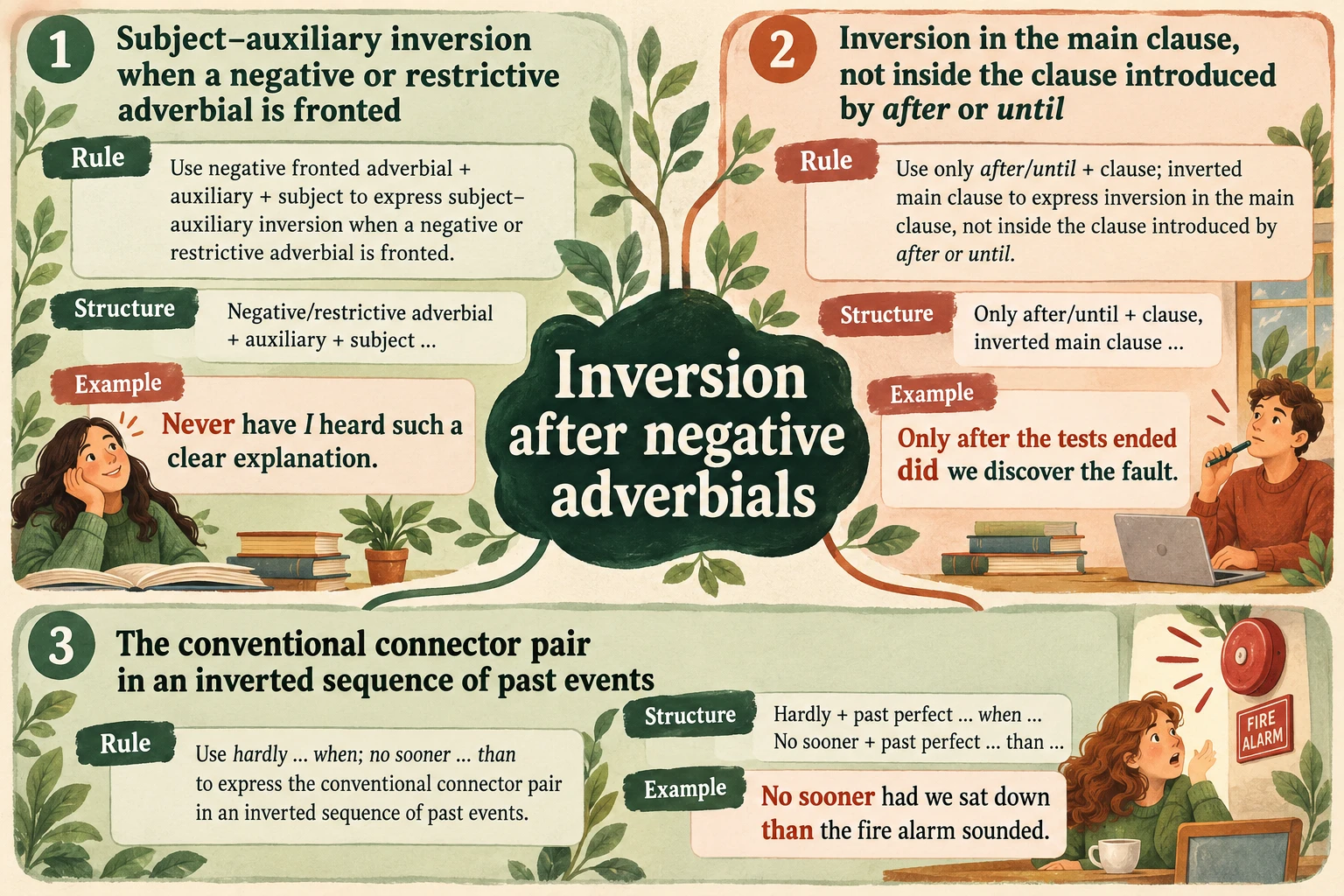
01subject–auxiliary inversion when a negative or restrictive adverbial is fronted

Use negative fronted adverbial + auxiliary + subject to express subject–auxiliary inversion when a negative or restrictive adverbial is fronted.

Never have I heard such a clear explanation.
02inversion in the main clause, not inside the clause introduced by after or until

Use only after/until + clause; inverted main clause to express inversion in the main clause, not inside the clause introduced by after or until.

Only after the tests ended did we discover the fault.

03the conventional connector pair in an inverted sequence of past events

Use hardly ... when; no sooner ... than to express the conventional connector pair in an inverted sequence of past events.

No sooner had we sat down than the fire alarm sounded.

Illustrated guide

0/12
Questions
01 / 12D01Save it to find it in My collection.

Never is fronted for formal emphasis; invert auxiliary and subject.

Never ___ such a clear explanation.

Your answer
1 / 12

Your learning route

01
Step 1 · Warm-up

Warm-up

0/3
02
Step 2 · Build the skill

subject–auxiliary inversion when a negative or restrictive adverbial is fronted

0/2

Use negative fronted adverbial + auxiliary + subject to express subject–auxiliary inversion when a negative or restrictive adverbial is fronted.

Never have I heard such a clear explanation.
03
Step 3 · Build the skill

inversion in the main clause, not inside the clause introduced by after or until

0/1

Use only after/until + clause; inverted main clause to express inversion in the main clause, not inside the clause introduced by after or until.

Only after the tests ended did we discover the fault.
04
Step 4 · Build the skill

the conventional connector pair in an inverted sequence of past events

0/1

Use hardly ... when; no sooner ... than to express the conventional connector pair in an inverted sequence of past events.

No sooner had we sat down than the fire alarm sounded.
05
Step 5 · New contexts

New contexts

0/3
06
Step 6 · A fresh challenge

A fresh challenge

0/2
Practice notes in this unit

Make mistakes useful.

Keep the first try. Understand the change. Check it in a fresh situation.

0

No practice notes yet. Try a short warm-up.

Lesson map

Inversion after negative adverbials

B2
Inversion after negative adverbials

Lesson points

01

subject–auxiliary inversion when a negative or restrictive adverbial is fronted

Use negative fronted adverbial + auxiliary + subject to express subject–auxiliary inversion when a negative or restrictive adverbial is fronted.

Never have I heard such a clear explanation.
02

inversion in the main clause, not inside the clause introduced by after or until

Use only after/until + clause; inverted main clause to express inversion in the main clause, not inside the clause introduced by after or until.

Only after the tests ended did we discover the fault.
03

the conventional connector pair in an inverted sequence of past events

Use hardly ... when; no sooner ... than to express the conventional connector pair in an inverted sequence of past events.

No sooner had we sat down than the fire alarm sounded.

Questions & answers

Opening an answer records help for that question.

D01 · Warm-up

Never is fronted for formal emphasis; invert auxiliary and subject.

Never ___ such a clear explanation.

  1. I heard
  2. have I heard
  3. I have heard
  4. have heard I
Answer & explanation
have I heard

The deciding clue is “Never is fronted for formal emphasis; invert auxiliary and subject.”. Use negative fronted adverbial + auxiliary + subject to express subject–auxiliary inversion when a negative or restrictive adverbial is fronted. In this task, the completed sentence is “Never have I heard such a clear explanation.”.

D02 · Warm-up

The after-clause keeps normal order; invert the main clause.

Only after the tests ended ___ the fault.

  1. did we discover
  2. discovered we
  3. we discovered
  4. we did discover
Answer & explanation
did we discover

The deciding clue is “The after-clause keeps normal order; invert the main clause.”. Use only after/until + clause; inverted main clause to express inversion in the main clause, not inside the clause introduced by after or until. In this task, the completed sentence is “Only after the tests ended did we discover the fault.”.

D03 · Warm-up

Select the conventional connector after no sooner.

No sooner had we sat down ___ the fire alarm sounded.

  1. then
  2. when
  3. than
  4. that
Answer & explanation
than

The deciding clue is “Select the conventional connector after no sooner.”. Use hardly ... when; no sooner ... than to express the conventional connector pair in an inverted sequence of past events. In this task, the completed sentence is “No sooner had we sat down than the fire alarm sounded.”.

P01 · Build the skill

Under no circumstances requires inversion.

Under no circumstances ___ this door.

  1. should you open
  2. you should open
  3. you open should
  4. should open you
Answer & explanation
should you open

The deciding clue is “Under no circumstances requires inversion.”. Use negative fronted adverbial + auxiliary + subject to express subject–auxiliary inversion when a negative or restrictive adverbial is fronted. In this task, the completed sentence is “Under no circumstances should you open this door.”.

P02 · Build the skill

Use she and the past simple of realise in the main clause after Only then.

Only then ___ the scale of the problem.

Answer & explanation
did she realise

Complete sentence: “Only then did she realise the scale of the problem.” Use only after/until + clause; inverted main clause to express inversion in the main clause, not inside the clause introduced by after or until. The subject, time and meaning in the task determine this form. Only reviewed responses are matched automatically; other wording is not automatically wrong.

Other accepted versions
  • did she realize
P03 · Build the skill

Select the conventional connector after hardly.

Hardly had the lecture begun ___ the power failed.

  1. that
  2. than
  3. when
  4. then
Answer & explanation
when

The deciding clue is “Select the conventional connector after hardly.”. Use hardly ... when; no sooner ... than to express the conventional connector pair in an inverted sequence of past events. In this task, the completed sentence is “Hardly had the lecture begun when the power failed.”.

P04 · Build the skill

Use we and the present perfect of see after Rarely.

Rarely ___ such rapid progress.

Answer & explanation
have we seen

Complete sentence: “Rarely have we seen such rapid progress.” Use negative fronted adverbial + auxiliary + subject to express subject–auxiliary inversion when a negative or restrictive adverbial is fronted. The subject, time and meaning in the task determine this form. Only reviewed responses are matched automatically; other wording is not automatically wrong.

R01 · New contexts

Not only is fronted; the auxiliary must precede the subject.

Not only ___ the deadline, but she also reduced the cost.

  1. she did meet
  2. did she meet
  3. met she
  4. she met
Answer & explanation
did she meet

The deciding clue is “Not only is fronted; the auxiliary must precede the subject.”. Use negative fronted adverbial + auxiliary + subject to express subject–auxiliary inversion when a negative or restrictive adverbial is fronted. In this task, the completed sentence is “Not only did she meet the deadline, but she also reduced the cost.”.

R02 · New contexts

Use he and the past simple of speak in the main clause after the complete until-clause.

Not until the room was silent ___ again.

Answer & explanation
did he speak

Complete sentence: “Not until the room was silent did he speak again.” Use only after/until + clause; inverted main clause to express inversion in the main clause, not inside the clause introduced by after or until. The subject, time and meaning in the task determine this form. Only reviewed responses are matched automatically; other wording is not automatically wrong.

R03 · New contexts

A conventional inverted sequence starts with scarcely.

Scarcely had they landed ___ the storm began.

  1. when
  2. then
  3. that
  4. than
Answer & explanation
when

The deciding clue is “A conventional inverted sequence starts with scarcely.”. Use hardly ... when; no sooner ... than to express the conventional connector pair in an inverted sequence of past events. In this task, the completed sentence is “Scarcely had they landed when the storm began.”.

X01 · A fresh challenge

The main clause inverts after a fronted restrictive time phrase.

Only when the audit was complete ___ the accounts.

  1. they did publish
  2. they published
  3. published they
  4. did they publish
Answer & explanation
did they publish

The deciding clue is “The main clause inverts after a fronted restrictive time phrase.”. Use only after/until + clause; inverted main clause to express inversion in the main clause, not inside the clause introduced by after or until. In this task, the completed sentence is “Only when the audit was complete did they publish the accounts.”.

X02 · A fresh challenge

Complete the conventional connector pair after No sooner.

No sooner had I opened the file ___ the program crashed.

Answer & explanation
than

Complete sentence: “No sooner had I opened the file than the program crashed.” Use hardly ... when; no sooner ... than to express the conventional connector pair in an inverted sequence of past events. The subject, time and meaning in the task determine this form. Only reviewed responses are matched automatically; other wording is not automatically wrong.