
B2

Inversão após expressões negativas: exercícios

Sobre esta lição

Inversão após expressões negativas · B2. Use negative fronted adverbial + auxiliary + subject para expressar inversão sujeito-auxiliar após expressão negativa ou restritiva antecipada.

Resolva 12 tarefas originais. Use a situação para interpretar o sentido, praticar a estrutura e aplicá-la em um novo contexto.

12 questões
Salve para encontrar em Minha coleção.
Mapa de conceitos

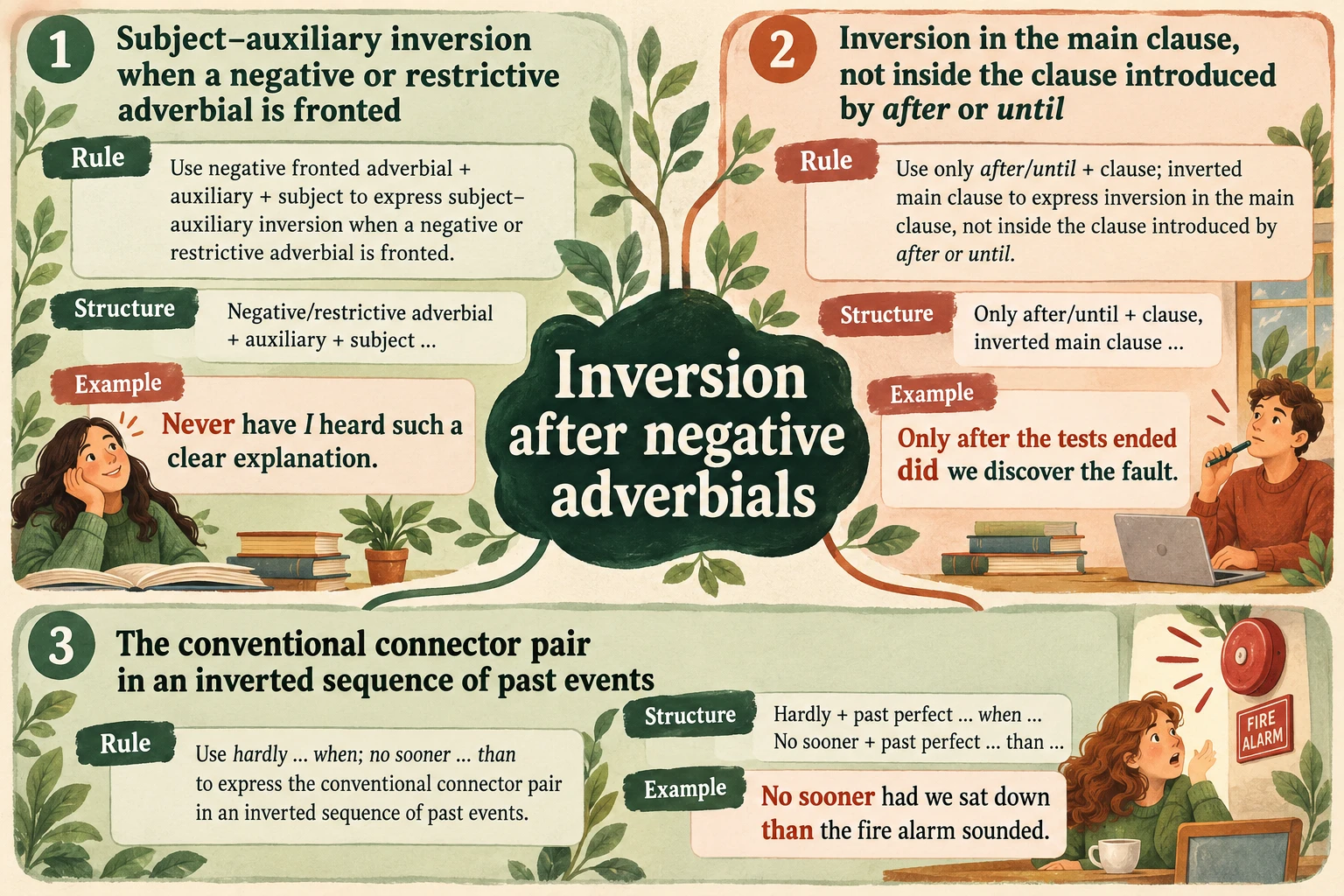
Inversion after negative adverbials

Começar a praticar
Inversion after negative adverbials — Mapa de conceitos

01inversão sujeito-auxiliar após expressão negativa ou restritiva antecipada

Use negative fronted adverbial + auxiliary + subject para expressar inversão sujeito-auxiliar após expressão negativa ou restritiva antecipada.

Never have I heard such a clear explanation.
02inversão na principal, não dentro da oração com after ou until

Use only after/until + clause; inverted main clause para expressar inversão na principal, não dentro da oração com after ou until.

Only after the tests ended did we discover the fault.

03o par convencional de conectores em sequência passada com inversão

Use hardly ... when; no sooner ... than para expressar o par convencional de conectores em sequência passada com inversão.

No sooner had we sat down than the fire alarm sounded.

Guia ilustrado

0/12
Questões
01 / 12D01Salve para encontrar em Minha coleção.

Never is fronted for formal emphasis; invert auxiliary and subject.

Never ___ such a clear explanation.

Sua resposta
1 / 12

Seu caminho de aprendizagem

01
Etapa 1 · Aquecimento

Aquecimento

0/3
02
Etapa 2 · Praticar a habilidade

inversão sujeito-auxiliar após expressão negativa ou restritiva antecipada

0/2

Use negative fronted adverbial + auxiliary + subject para expressar inversão sujeito-auxiliar após expressão negativa ou restritiva antecipada.

Never have I heard such a clear explanation.
03
Etapa 3 · Praticar a habilidade

inversão na principal, não dentro da oração com after ou until

0/1

Use only after/until + clause; inverted main clause para expressar inversão na principal, não dentro da oração com after ou until.

Only after the tests ended did we discover the fault.
04
Etapa 4 · Praticar a habilidade

o par convencional de conectores em sequência passada com inversão

0/1

Use hardly ... when; no sooner ... than para expressar o par convencional de conectores em sequência passada com inversão.

No sooner had we sat down than the fire alarm sounded.
05
Etapa 5 · Novos contextos

Novos contextos

0/3
06
Etapa 6 · Um novo desafio

Um novo desafio

0/2
Revisões desta unidade

Transforme erros em aprendizado.

Guarde a primeira tentativa, entenda a mudança e confira em outra situação.

0

Ainda não há revisões. Faça um aquecimento curto.

Mapa da aula

Inversão após expressões negativas

B2
Inversion after negative adverbials

Pontos da aula

01

inversão sujeito-auxiliar após expressão negativa ou restritiva antecipada

Use negative fronted adverbial + auxiliary + subject para expressar inversão sujeito-auxiliar após expressão negativa ou restritiva antecipada.

Never have I heard such a clear explanation.
02

inversão na principal, não dentro da oração com after ou until

Use only after/until + clause; inverted main clause para expressar inversão na principal, não dentro da oração com after ou until.

Only after the tests ended did we discover the fault.
03

o par convencional de conectores em sequência passada com inversão

Use hardly ... when; no sooner ... than para expressar o par convencional de conectores em sequência passada com inversão.

No sooner had we sat down than the fire alarm sounded.

Perguntas e respostas

Abrir uma resposta registra ajuda para essa questão.

D01 · Aquecimento

Never is fronted for formal emphasis; invert auxiliary and subject.

Never ___ such a clear explanation.

  1. I heard
  2. have I heard
  3. I have heard
  4. have heard I
Resposta e explicação
have I heard

A pista decisiva é “Never is fronted for formal emphasis; invert auxiliary and subject.”. Use negative fronted adverbial + auxiliary + subject para expressar inversão sujeito-auxiliar após expressão negativa ou restritiva antecipada. Nesta tarefa, a frase completa é “Never have I heard such a clear explanation.”.

D02 · Aquecimento

The after-clause keeps normal order; invert the main clause.

Only after the tests ended ___ the fault.

  1. did we discover
  2. discovered we
  3. we discovered
  4. we did discover
Resposta e explicação
did we discover

A pista decisiva é “The after-clause keeps normal order; invert the main clause.”. Use only after/until + clause; inverted main clause para expressar inversão na principal, não dentro da oração com after ou until. Nesta tarefa, a frase completa é “Only after the tests ended did we discover the fault.”.

D03 · Aquecimento

Select the conventional connector after no sooner.

No sooner had we sat down ___ the fire alarm sounded.

  1. then
  2. when
  3. than
  4. that
Resposta e explicação
than

A pista decisiva é “Select the conventional connector after no sooner.”. Use hardly ... when; no sooner ... than para expressar o par convencional de conectores em sequência passada com inversão. Nesta tarefa, a frase completa é “No sooner had we sat down than the fire alarm sounded.”.

P01 · Praticar a habilidade

Under no circumstances requires inversion.

Under no circumstances ___ this door.

  1. should you open
  2. you should open
  3. you open should
  4. should open you
Resposta e explicação
should you open

A pista decisiva é “Under no circumstances requires inversion.”. Use negative fronted adverbial + auxiliary + subject para expressar inversão sujeito-auxiliar após expressão negativa ou restritiva antecipada. Nesta tarefa, a frase completa é “Under no circumstances should you open this door.”.

P02 · Praticar a habilidade

Use she and the past simple of realise in the main clause after Only then.

Only then ___ the scale of the problem.

Resposta e explicação
did she realise

Frase completa: “Only then did she realise the scale of the problem.” Use only after/until + clause; inverted main clause para expressar inversão na principal, não dentro da oração com after ou until. O sujeito, o tempo e o sentido da tarefa determinam esta forma. Só as respostas revisadas são comparadas automaticamente; outras formulações não estão automaticamente erradas.

Outras respostas aceitas
  • did she realize
P03 · Praticar a habilidade

Select the conventional connector after hardly.

Hardly had the lecture begun ___ the power failed.

  1. that
  2. than
  3. when
  4. then
Resposta e explicação
when

A pista decisiva é “Select the conventional connector after hardly.”. Use hardly ... when; no sooner ... than para expressar o par convencional de conectores em sequência passada com inversão. Nesta tarefa, a frase completa é “Hardly had the lecture begun when the power failed.”.

P04 · Praticar a habilidade

Use we and the present perfect of see after Rarely.

Rarely ___ such rapid progress.

Resposta e explicação
have we seen

Frase completa: “Rarely have we seen such rapid progress.” Use negative fronted adverbial + auxiliary + subject para expressar inversão sujeito-auxiliar após expressão negativa ou restritiva antecipada. O sujeito, o tempo e o sentido da tarefa determinam esta forma. Só as respostas revisadas são comparadas automaticamente; outras formulações não estão automaticamente erradas.

R01 · Novos contextos

Not only is fronted; the auxiliary must precede the subject.

Not only ___ the deadline, but she also reduced the cost.

  1. she did meet
  2. did she meet
  3. met she
  4. she met
Resposta e explicação
did she meet

A pista decisiva é “Not only is fronted; the auxiliary must precede the subject.”. Use negative fronted adverbial + auxiliary + subject para expressar inversão sujeito-auxiliar após expressão negativa ou restritiva antecipada. Nesta tarefa, a frase completa é “Not only did she meet the deadline, but she also reduced the cost.”.

R02 · Novos contextos

Use he and the past simple of speak in the main clause after the complete until-clause.

Not until the room was silent ___ again.

Resposta e explicação
did he speak

Frase completa: “Not until the room was silent did he speak again.” Use only after/until + clause; inverted main clause para expressar inversão na principal, não dentro da oração com after ou until. O sujeito, o tempo e o sentido da tarefa determinam esta forma. Só as respostas revisadas são comparadas automaticamente; outras formulações não estão automaticamente erradas.

R03 · Novos contextos

A conventional inverted sequence starts with scarcely.

Scarcely had they landed ___ the storm began.

  1. when
  2. then
  3. that
  4. than
Resposta e explicação
when

A pista decisiva é “A conventional inverted sequence starts with scarcely.”. Use hardly ... when; no sooner ... than para expressar o par convencional de conectores em sequência passada com inversão. Nesta tarefa, a frase completa é “Scarcely had they landed when the storm began.”.

X01 · Um novo desafio

The main clause inverts after a fronted restrictive time phrase.

Only when the audit was complete ___ the accounts.

  1. they did publish
  2. they published
  3. published they
  4. did they publish
Resposta e explicação
did they publish

A pista decisiva é “The main clause inverts after a fronted restrictive time phrase.”. Use only after/until + clause; inverted main clause para expressar inversão na principal, não dentro da oração com after ou until. Nesta tarefa, a frase completa é “Only when the audit was complete did they publish the accounts.”.

X02 · Um novo desafio

Complete the conventional connector pair after No sooner.

No sooner had I opened the file ___ the program crashed.

Resposta e explicação
than

Frase completa: “No sooner had I opened the file than the program crashed.” Use hardly ... when; no sooner ... than para expressar o par convencional de conectores em sequência passada com inversão. O sujeito, o tempo e o sentido da tarefa determinam esta forma. Só as respostas revisadas são comparadas automaticamente; outras formulações não estão automaticamente erradas.