
B2

Inversion après les adverbiaux négatifs : exercices

À propos de cette leçon

Inversion après les adverbiaux négatifs · B2. Utilisez negative fronted adverbial + auxiliary + subject pour exprimer une inversion sujet-auxiliaire après un adverbial négatif ou restrictif antéposé.

Réalisez 12 exercices originaux. Appuyez-vous sur la situation pour interpréter le sens, pratiquer la forme et la réutiliser dans un nouveau contexte.

12 questions
Retrouvez-le dans Ma collection après enregistrement.
Carte des notions

Inversion after negative adverbials

Commencer
Inversion after negative adverbials — Carte des notions

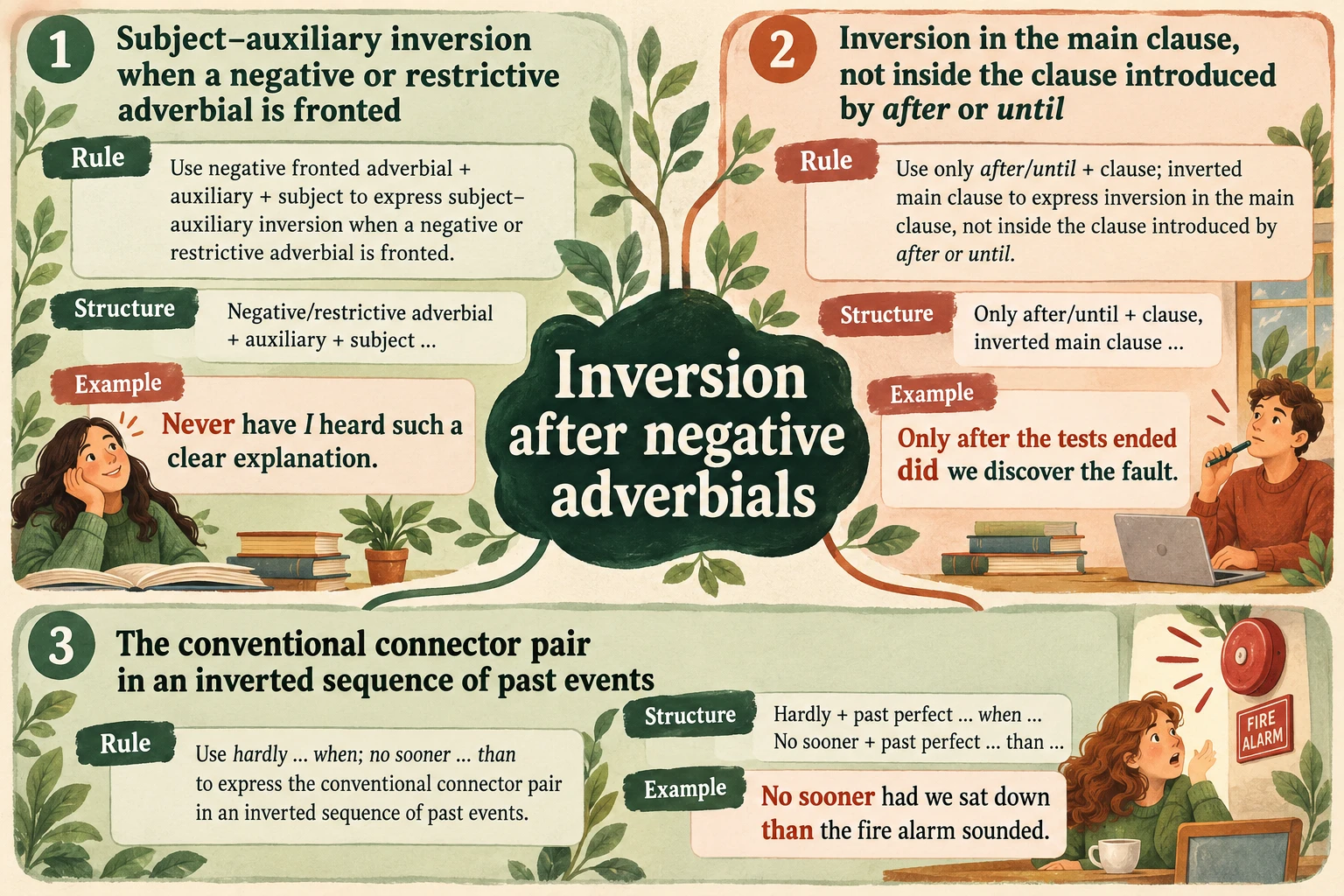
01une inversion sujet-auxiliaire après un adverbial négatif ou restrictif antéposé

Utilisez negative fronted adverbial + auxiliary + subject pour exprimer une inversion sujet-auxiliaire après un adverbial négatif ou restrictif antéposé.

Never have I heard such a clear explanation.
02une inversion dans la principale, pas dans la subordonnée avec after ou until

Utilisez only after/until + clause; inverted main clause pour exprimer une inversion dans la principale, pas dans la subordonnée avec after ou until.

Only after the tests ended did we discover the fault.

03la paire de connecteurs usuelle dans une suite passée avec inversion

Utilisez hardly ... when; no sooner ... than pour exprimer la paire de connecteurs usuelle dans une suite passée avec inversion.

No sooner had we sat down than the fire alarm sounded.

Guide illustré

0/12
Questions
01 / 12D01Retrouvez-le dans Ma collection après enregistrement.

Never is fronted for formal emphasis; invert auxiliary and subject.

Never ___ such a clear explanation.

Votre réponse
1 / 12

Votre parcours

01
Étape 1 · Échauffement

Échauffement

0/3
02
Étape 2 · Développer la compétence

une inversion sujet-auxiliaire après un adverbial négatif ou restrictif antéposé

0/2

Utilisez negative fronted adverbial + auxiliary + subject pour exprimer une inversion sujet-auxiliaire après un adverbial négatif ou restrictif antéposé.

Never have I heard such a clear explanation.
03
Étape 3 · Développer la compétence

une inversion dans la principale, pas dans la subordonnée avec after ou until

0/1

Utilisez only after/until + clause; inverted main clause pour exprimer une inversion dans la principale, pas dans la subordonnée avec after ou until.

Only after the tests ended did we discover the fault.
04
Étape 4 · Développer la compétence

la paire de connecteurs usuelle dans une suite passée avec inversion

0/1

Utilisez hardly ... when; no sooner ... than pour exprimer la paire de connecteurs usuelle dans une suite passée avec inversion.

No sooner had we sat down than the fire alarm sounded.
05
Étape 5 · Nouveaux contextes

Nouveaux contextes

0/3
06
Étape 6 · Un nouveau défi

Un nouveau défi

0/2
Révisions de cette unité

Apprenez de vos erreurs.

Gardez la première tentative, comprenez le changement et essayez dans une nouvelle situation.

0

Pas encore de notes. Essayez un court échauffement.

Carte de la leçon

Inversion après les adverbiaux négatifs

B2
Inversion after negative adverbials

Points de la leçon

01

une inversion sujet-auxiliaire après un adverbial négatif ou restrictif antéposé

Utilisez negative fronted adverbial + auxiliary + subject pour exprimer une inversion sujet-auxiliaire après un adverbial négatif ou restrictif antéposé.

Never have I heard such a clear explanation.
02

une inversion dans la principale, pas dans la subordonnée avec after ou until

Utilisez only after/until + clause; inverted main clause pour exprimer une inversion dans la principale, pas dans la subordonnée avec after ou until.

Only after the tests ended did we discover the fault.
03

la paire de connecteurs usuelle dans une suite passée avec inversion

Utilisez hardly ... when; no sooner ... than pour exprimer la paire de connecteurs usuelle dans une suite passée avec inversion.

No sooner had we sat down than the fire alarm sounded.

Questions et réponses

Ouvrir une réponse enregistre une aide pour cette question.

D01 · Échauffement

Never is fronted for formal emphasis; invert auxiliary and subject.

Never ___ such a clear explanation.

  1. I heard
  2. have I heard
  3. I have heard
  4. have heard I
Réponse et explication
have I heard

L’indice décisif est « Never is fronted for formal emphasis; invert auxiliary and subject. ». Utilisez negative fronted adverbial + auxiliary + subject pour exprimer une inversion sujet-auxiliaire après un adverbial négatif ou restrictif antéposé. Dans cette tâche, la phrase complète est « Never have I heard such a clear explanation. ».

D02 · Échauffement

The after-clause keeps normal order; invert the main clause.

Only after the tests ended ___ the fault.

  1. did we discover
  2. discovered we
  3. we discovered
  4. we did discover
Réponse et explication
did we discover

L’indice décisif est « The after-clause keeps normal order; invert the main clause. ». Utilisez only after/until + clause; inverted main clause pour exprimer une inversion dans la principale, pas dans la subordonnée avec after ou until. Dans cette tâche, la phrase complète est « Only after the tests ended did we discover the fault. ».

D03 · Échauffement

Select the conventional connector after no sooner.

No sooner had we sat down ___ the fire alarm sounded.

  1. then
  2. when
  3. than
  4. that
Réponse et explication
than

L’indice décisif est « Select the conventional connector after no sooner. ». Utilisez hardly ... when; no sooner ... than pour exprimer la paire de connecteurs usuelle dans une suite passée avec inversion. Dans cette tâche, la phrase complète est « No sooner had we sat down than the fire alarm sounded. ».

P01 · Développer la compétence

Under no circumstances requires inversion.

Under no circumstances ___ this door.

  1. should you open
  2. you should open
  3. you open should
  4. should open you
Réponse et explication
should you open

L’indice décisif est « Under no circumstances requires inversion. ». Utilisez negative fronted adverbial + auxiliary + subject pour exprimer une inversion sujet-auxiliaire après un adverbial négatif ou restrictif antéposé. Dans cette tâche, la phrase complète est « Under no circumstances should you open this door. ».

P02 · Développer la compétence

Use she and the past simple of realise in the main clause after Only then.

Only then ___ the scale of the problem.

Réponse et explication
did she realise

Phrase complète : « Only then did she realise the scale of the problem. » Utilisez only after/until + clause; inverted main clause pour exprimer une inversion dans la principale, pas dans la subordonnée avec after ou until. Le sujet, le temps et le sens de la consigne déterminent cette forme. Seules les réponses vérifiées sont comparées automatiquement ; toute autre formulation n’est pas automatiquement fausse.

Autres réponses acceptées
  • did she realize
P03 · Développer la compétence

Select the conventional connector after hardly.

Hardly had the lecture begun ___ the power failed.

  1. that
  2. than
  3. when
  4. then
Réponse et explication
when

L’indice décisif est « Select the conventional connector after hardly. ». Utilisez hardly ... when; no sooner ... than pour exprimer la paire de connecteurs usuelle dans une suite passée avec inversion. Dans cette tâche, la phrase complète est « Hardly had the lecture begun when the power failed. ».

P04 · Développer la compétence

Use we and the present perfect of see after Rarely.

Rarely ___ such rapid progress.

Réponse et explication
have we seen

Phrase complète : « Rarely have we seen such rapid progress. » Utilisez negative fronted adverbial + auxiliary + subject pour exprimer une inversion sujet-auxiliaire après un adverbial négatif ou restrictif antéposé. Le sujet, le temps et le sens de la consigne déterminent cette forme. Seules les réponses vérifiées sont comparées automatiquement ; toute autre formulation n’est pas automatiquement fausse.

R01 · Nouveaux contextes

Not only is fronted; the auxiliary must precede the subject.

Not only ___ the deadline, but she also reduced the cost.

  1. she did meet
  2. did she meet
  3. met she
  4. she met
Réponse et explication
did she meet

L’indice décisif est « Not only is fronted; the auxiliary must precede the subject. ». Utilisez negative fronted adverbial + auxiliary + subject pour exprimer une inversion sujet-auxiliaire après un adverbial négatif ou restrictif antéposé. Dans cette tâche, la phrase complète est « Not only did she meet the deadline, but she also reduced the cost. ».

R02 · Nouveaux contextes

Use he and the past simple of speak in the main clause after the complete until-clause.

Not until the room was silent ___ again.

Réponse et explication
did he speak

Phrase complète : « Not until the room was silent did he speak again. » Utilisez only after/until + clause; inverted main clause pour exprimer une inversion dans la principale, pas dans la subordonnée avec after ou until. Le sujet, le temps et le sens de la consigne déterminent cette forme. Seules les réponses vérifiées sont comparées automatiquement ; toute autre formulation n’est pas automatiquement fausse.

R03 · Nouveaux contextes

A conventional inverted sequence starts with scarcely.

Scarcely had they landed ___ the storm began.

  1. when
  2. then
  3. that
  4. than
Réponse et explication
when

L’indice décisif est « A conventional inverted sequence starts with scarcely. ». Utilisez hardly ... when; no sooner ... than pour exprimer la paire de connecteurs usuelle dans une suite passée avec inversion. Dans cette tâche, la phrase complète est « Scarcely had they landed when the storm began. ».

X01 · Un nouveau défi

The main clause inverts after a fronted restrictive time phrase.

Only when the audit was complete ___ the accounts.

  1. they did publish
  2. they published
  3. published they
  4. did they publish
Réponse et explication
did they publish

L’indice décisif est « The main clause inverts after a fronted restrictive time phrase. ». Utilisez only after/until + clause; inverted main clause pour exprimer une inversion dans la principale, pas dans la subordonnée avec after ou until. Dans cette tâche, la phrase complète est « Only when the audit was complete did they publish the accounts. ».

X02 · Un nouveau défi

Complete the conventional connector pair after No sooner.

No sooner had I opened the file ___ the program crashed.

Réponse et explication
than

Phrase complète : « No sooner had I opened the file than the program crashed. » Utilisez hardly ... when; no sooner ... than pour exprimer la paire de connecteurs usuelle dans une suite passée avec inversion. Le sujet, le temps et le sens de la consigne déterminent cette forme. Seules les réponses vérifiées sont comparées automatiquement ; toute autre formulation n’est pas automatiquement fausse.