01individual distribution across a group; use a singular noun and verb
Use each/every + singular noun to express individual distribution across a group; use a singular noun and verb.
Every attendee receives a card.
Each, every, all, both and neither · B1. Use each/every + singular noun to express individual distribution across a group; use a singular noun and verb.
Complete 12 original tasks. Use the situation to choose the intended meaning, practise the form, then apply it in a fresh context.
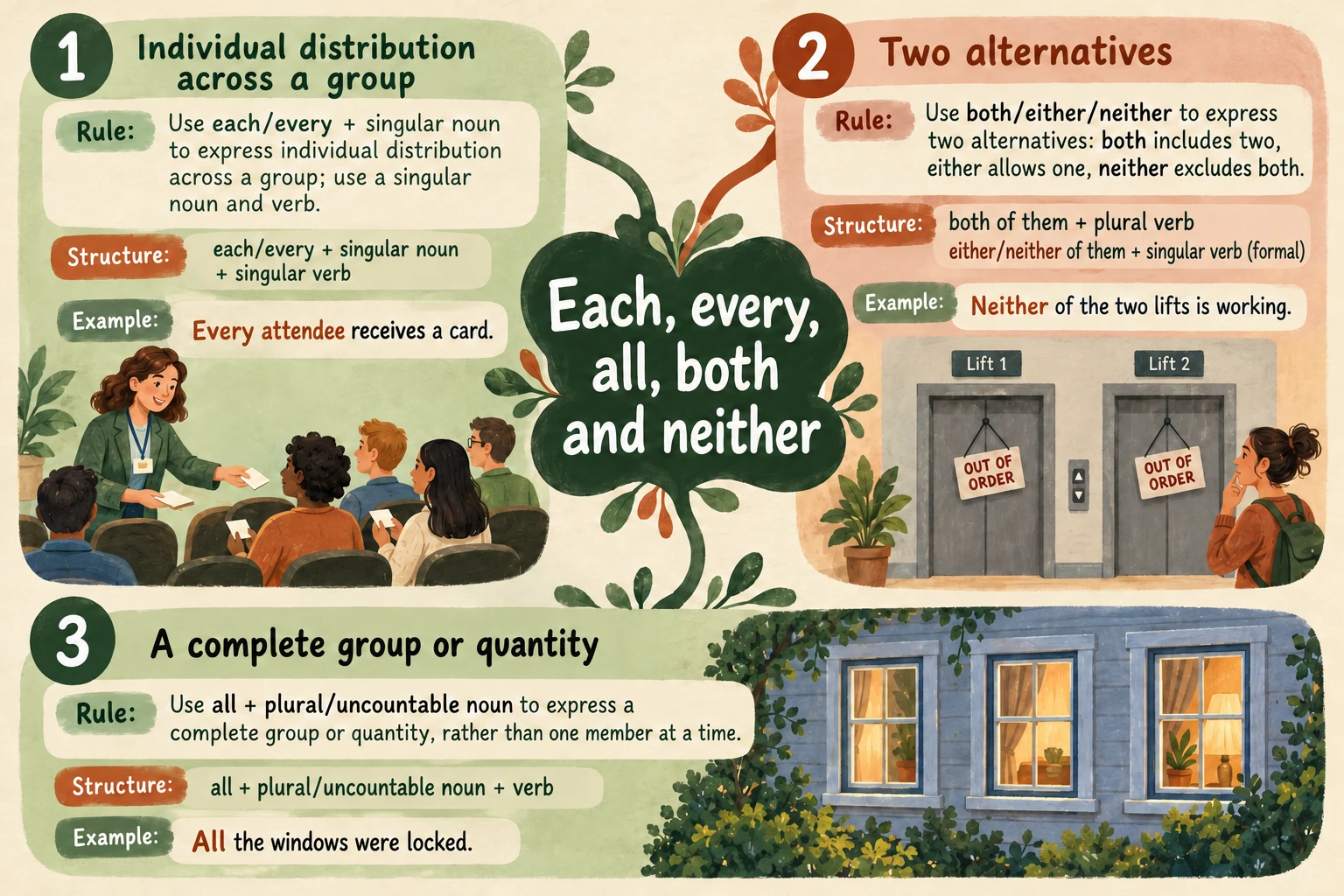
Use each/every + singular noun to express individual distribution across a group; use a singular noun and verb.
Every attendee receives a card.Use both/either/neither to express two alternatives: both includes two, either allows one, neither excludes both.
Neither of the two lifts is working.Use all + plural/uncountable noun to express a complete group or quantity, rather than one member at a time.
All the windows were locked.
Distribute one identical card to every individual attendee.
Use each/every + singular noun to express individual distribution across a group; use a singular noun and verb.
Every attendee receives a card.Use both/either/neither to express two alternatives: both includes two, either allows one, neither excludes both.
Neither of the two lifts is working.Use all + plural/uncountable noun to express a complete group or quantity, rather than one member at a time.
All the windows were locked.Keep the first try. Understand the change. Check it in a fresh situation.
No practice notes yet. Try a short warm-up.
Use each/every + singular noun to express individual distribution across a group; use a singular noun and verb.
Every attendee receives a card.Use both/either/neither to express two alternatives: both includes two, either allows one, neither excludes both.
Neither of the two lifts is working.Use all + plural/uncountable noun to express a complete group or quantity, rather than one member at a time.
All the windows were locked.Opening an answer records help for that question.
Distribute one identical card to every individual attendee.
Look at “Every attendee ___ a card.”. Use each/every + singular noun to express individual distribution across a group; use a singular noun and verb. Complete sentence: “Every attendee receives a card.”.
There are exactly two lifts and neither works.
Look at “___ of the two lifts is working.”. Use both/either/neither to express two alternatives: both includes two, either allows one, neither excludes both. Complete sentence: “Neither of the two lifts is working.”.
Refer to the entire plural group.
Look at “___ the windows were locked.”. Use all + plural/uncountable noun to express a complete group or quantity, rather than one member at a time. Complete sentence: “All the windows were locked.”.
Consider members individually; the verb is singular.
Look at “Each of the boxes ___ a serial number.”. Use each/every + singular noun to express individual distribution across a group; use a singular noun and verb. Complete sentence: “Each of the boxes has a serial number.”.
The two named routes are available; refer to the pair together without exclusion.
Complete sentence: “Both routes are open, so you may choose either.” Use both/either/neither to express two alternatives: both includes two, either allows one, neither excludes both. The subject, time and meaning in the task determine this form. Only reviewed responses are matched automatically; other wording is not automatically wrong.
The full quantity of uncountable equipment was checked.
Look at “___ the equipment was inspected.”. Use all + plural/uncountable noun to express a complete group or quantity, rather than one member at a time. Complete sentence: “All the equipment was inspected.”.
Refer to all members individually using a determiner with singular applicant.
Complete sentence: “Every applicant must provide an address.” Use each/every + singular noun to express individual distribution across a group; use a singular noun and verb. The subject, time and meaning in the task determine this form. Only reviewed responses are matched automatically; other wording is not automatically wrong.
The sentence treats members one at a time.
Look at “Each participant ___ their own password.”. Use each/every + singular noun to express individual distribution across a group; use a singular noun and verb. Complete sentence: “Each participant chooses their own password.”.
Both proposed dates are impossible for me. Supply one negative determiner.
Complete sentence: “Neither date suits me; I am away on both days.” Use both/either/neither to express two alternatives: both includes two, either allows one, neither excludes both. The subject, time and meaning in the task determine this form. Only reviewed responses are matched automatically; other wording is not automatically wrong.
The whole plural group is included.
Look at “___ three copies contain the same error.”. Use all + plural/uncountable noun to express a complete group or quantity, rather than one member at a time. Complete sentence: “All three copies contain the same error.”.
Exactly two candidates share this qualification.
Look at “___ candidates have experience; one worked here and the other abroad.”. Use both/either/neither to express two alternatives: both includes two, either allows one, neither excludes both. Complete sentence: “Both candidates have experience; one worked here and the other abroad.”.
Refer to the whole quantity of uncountable information.
Complete sentence: “We have verified all the information you supplied.” Use all + plural/uncountable noun to express a complete group or quantity, rather than one member at a time. The subject, time and meaning in the task determine this form. Only reviewed responses are matched automatically; other wording is not automatically wrong.