01distribuição individual em um grupo; nome e verbo ficam no singular
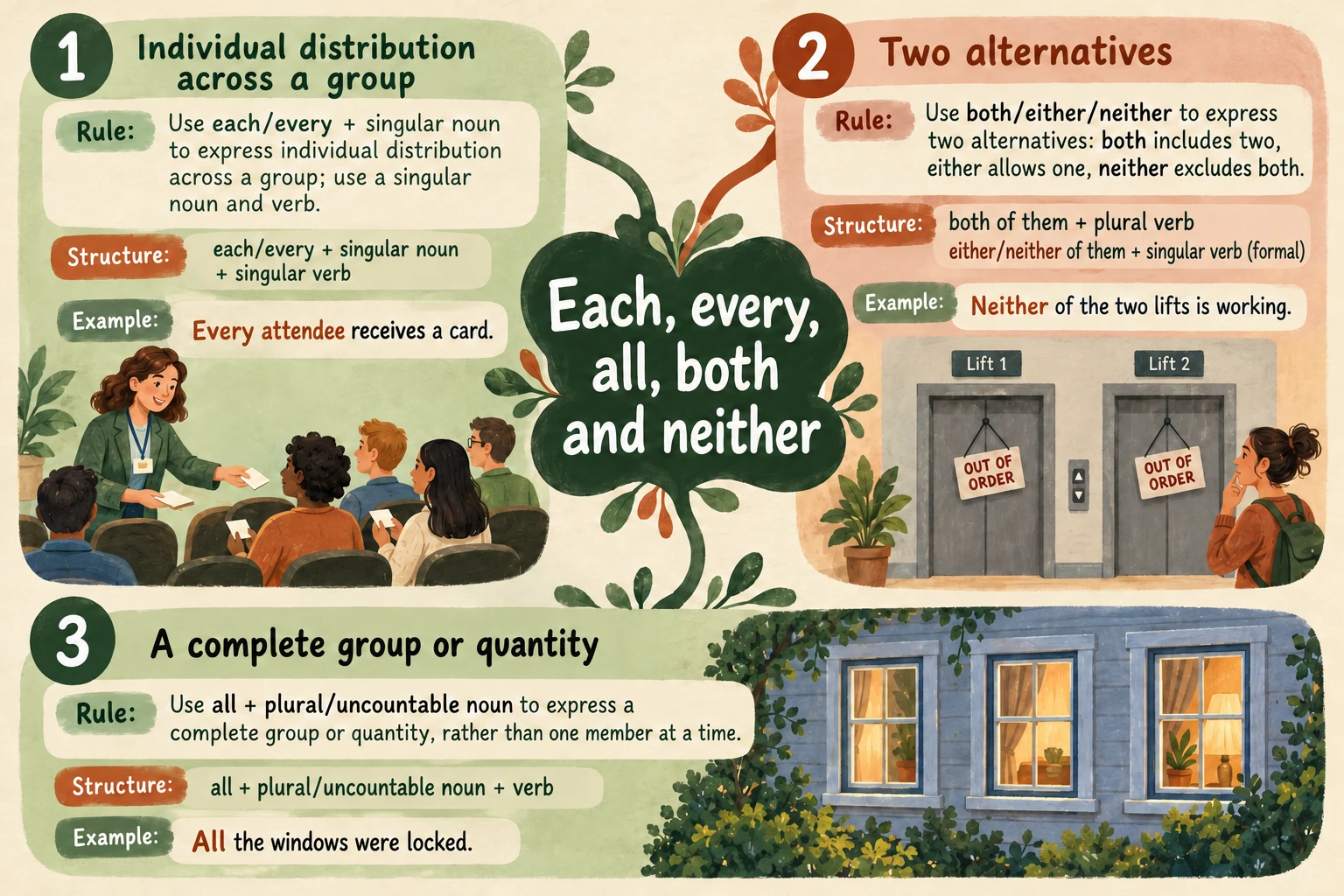
Use each/every + singular noun para expressar distribuição individual em um grupo; nome e verbo ficam no singular.
Every attendee receives a card.
Each, every, all, both e neither · B1. Use each/every + singular noun para expressar distribuição individual em um grupo; nome e verbo ficam no singular.
Resolva 12 tarefas originais. Use a situação para interpretar o sentido, praticar a estrutura e aplicá-la em um novo contexto.
Use each/every + singular noun para expressar distribuição individual em um grupo; nome e verbo ficam no singular.
Every attendee receives a card.Use both/either/neither para expressar duas alternativas: both inclui duas, either permite uma, neither exclui ambas.
Neither of the two lifts is working.Use all + plural/uncountable noun para expressar um grupo ou quantidade completos, não um membro por vez.
All the windows were locked.
Distribute one identical card to every individual attendee.
Use each/every + singular noun para expressar distribuição individual em um grupo; nome e verbo ficam no singular.
Every attendee receives a card.Use both/either/neither para expressar duas alternativas: both inclui duas, either permite uma, neither exclui ambas.
Neither of the two lifts is working.Use all + plural/uncountable noun para expressar um grupo ou quantidade completos, não um membro por vez.
All the windows were locked.Guarde a primeira tentativa, entenda a mudança e confira em outra situação.
Ainda não há revisões. Faça um aquecimento curto.
Use each/every + singular noun para expressar distribuição individual em um grupo; nome e verbo ficam no singular.
Every attendee receives a card.Use both/either/neither para expressar duas alternativas: both inclui duas, either permite uma, neither exclui ambas.
Neither of the two lifts is working.Use all + plural/uncountable noun para expressar um grupo ou quantidade completos, não um membro por vez.
All the windows were locked.Abrir uma resposta registra ajuda para essa questão.
Distribute one identical card to every individual attendee.
Observe “Every attendee ___ a card.”. Use each/every + singular noun para expressar distribuição individual em um grupo; nome e verbo ficam no singular. Frase completa: “Every attendee receives a card.”.
There are exactly two lifts and neither works.
Observe “___ of the two lifts is working.”. Use both/either/neither para expressar duas alternativas: both inclui duas, either permite uma, neither exclui ambas. Frase completa: “Neither of the two lifts is working.”.
Refer to the entire plural group.
Observe “___ the windows were locked.”. Use all + plural/uncountable noun para expressar um grupo ou quantidade completos, não um membro por vez. Frase completa: “All the windows were locked.”.
Consider members individually; the verb is singular.
Observe “Each of the boxes ___ a serial number.”. Use each/every + singular noun para expressar distribuição individual em um grupo; nome e verbo ficam no singular. Frase completa: “Each of the boxes has a serial number.”.
The two named routes are available; refer to the pair together without exclusion.
Frase completa: “Both routes are open, so you may choose either.” Use both/either/neither para expressar duas alternativas: both inclui duas, either permite uma, neither exclui ambas. O sujeito, o tempo e o sentido da tarefa determinam esta forma. Só as respostas revisadas são comparadas automaticamente; outras formulações não estão automaticamente erradas.
The full quantity of uncountable equipment was checked.
Observe “___ the equipment was inspected.”. Use all + plural/uncountable noun para expressar um grupo ou quantidade completos, não um membro por vez. Frase completa: “All the equipment was inspected.”.
Refer to all members individually using a determiner with singular applicant.
Frase completa: “Every applicant must provide an address.” Use each/every + singular noun para expressar distribuição individual em um grupo; nome e verbo ficam no singular. O sujeito, o tempo e o sentido da tarefa determinam esta forma. Só as respostas revisadas são comparadas automaticamente; outras formulações não estão automaticamente erradas.
The sentence treats members one at a time.
Observe “Each participant ___ their own password.”. Use each/every + singular noun para expressar distribuição individual em um grupo; nome e verbo ficam no singular. Frase completa: “Each participant chooses their own password.”.
Both proposed dates are impossible for me. Supply one negative determiner.
Frase completa: “Neither date suits me; I am away on both days.” Use both/either/neither para expressar duas alternativas: both inclui duas, either permite uma, neither exclui ambas. O sujeito, o tempo e o sentido da tarefa determinam esta forma. Só as respostas revisadas são comparadas automaticamente; outras formulações não estão automaticamente erradas.
The whole plural group is included.
Observe “___ three copies contain the same error.”. Use all + plural/uncountable noun para expressar um grupo ou quantidade completos, não um membro por vez. Frase completa: “All three copies contain the same error.”.
Exactly two candidates share this qualification.
Observe “___ candidates have experience; one worked here and the other abroad.”. Use both/either/neither para expressar duas alternativas: both inclui duas, either permite uma, neither exclui ambas. Frase completa: “Both candidates have experience; one worked here and the other abroad.”.
Refer to the whole quantity of uncountable information.
Frase completa: “We have verified all the information you supplied.” Use all + plural/uncountable noun para expressar um grupo ou quantidade completos, não um membro por vez. O sujeito, o tempo e o sentido da tarefa determinam esta forma. Só as respostas revisadas são comparadas automaticamente; outras formulações não estão automaticamente erradas.