01une distribution individuelle ; nom et verbe sont au singulier
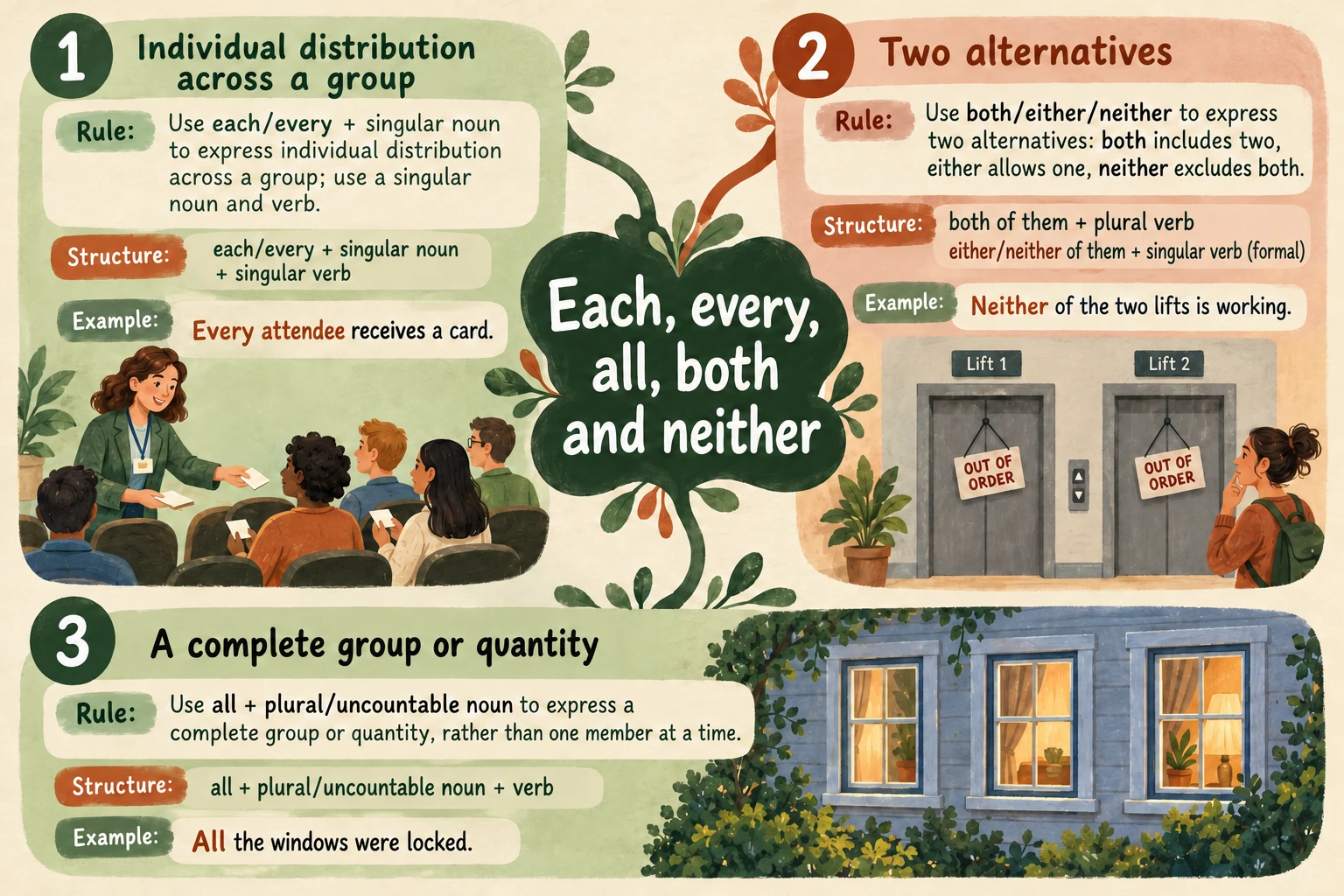
Utilisez each/every + singular noun pour exprimer une distribution individuelle ; nom et verbe sont au singulier.
Every attendee receives a card.
Each, every, all, both et neither · B1. Utilisez each/every + singular noun pour exprimer une distribution individuelle ; nom et verbe sont au singulier.
Réalisez 12 exercices originaux. Appuyez-vous sur la situation pour interpréter le sens, pratiquer la forme et la réutiliser dans un nouveau contexte.
Utilisez each/every + singular noun pour exprimer une distribution individuelle ; nom et verbe sont au singulier.
Every attendee receives a card.Utilisez both/either/neither pour exprimer deux possibilités : both inclut les deux, either en admet une, neither les exclut.
Neither of the two lifts is working.Utilisez all + plural/uncountable noun pour exprimer un groupe ou une quantité entiers, pas les membres un par un.
All the windows were locked.
Distribute one identical card to every individual attendee.
Utilisez each/every + singular noun pour exprimer une distribution individuelle ; nom et verbe sont au singulier.
Every attendee receives a card.Utilisez both/either/neither pour exprimer deux possibilités : both inclut les deux, either en admet une, neither les exclut.
Neither of the two lifts is working.Utilisez all + plural/uncountable noun pour exprimer un groupe ou une quantité entiers, pas les membres un par un.
All the windows were locked.Gardez la première tentative, comprenez le changement et essayez dans une nouvelle situation.
Pas encore de notes. Essayez un court échauffement.
Utilisez each/every + singular noun pour exprimer une distribution individuelle ; nom et verbe sont au singulier.
Every attendee receives a card.Utilisez both/either/neither pour exprimer deux possibilités : both inclut les deux, either en admet une, neither les exclut.
Neither of the two lifts is working.Utilisez all + plural/uncountable noun pour exprimer un groupe ou une quantité entiers, pas les membres un par un.
All the windows were locked.Ouvrir une réponse enregistre une aide pour cette question.
Distribute one identical card to every individual attendee.
Observe « Every attendee ___ a card. ». Utilisez each/every + singular noun pour exprimer une distribution individuelle ; nom et verbe sont au singulier. Phrase complète : « Every attendee receives a card. ».
There are exactly two lifts and neither works.
Observe « ___ of the two lifts is working. ». Utilisez both/either/neither pour exprimer deux possibilités : both inclut les deux, either en admet une, neither les exclut. Phrase complète : « Neither of the two lifts is working. ».
Refer to the entire plural group.
Observe « ___ the windows were locked. ». Utilisez all + plural/uncountable noun pour exprimer un groupe ou une quantité entiers, pas les membres un par un. Phrase complète : « All the windows were locked. ».
Consider members individually; the verb is singular.
Observe « Each of the boxes ___ a serial number. ». Utilisez each/every + singular noun pour exprimer une distribution individuelle ; nom et verbe sont au singulier. Phrase complète : « Each of the boxes has a serial number. ».
The two named routes are available; refer to the pair together without exclusion.
Phrase complète : « Both routes are open, so you may choose either. » Utilisez both/either/neither pour exprimer deux possibilités : both inclut les deux, either en admet une, neither les exclut. Le sujet, le temps et le sens de la consigne déterminent cette forme. Seules les réponses vérifiées sont comparées automatiquement ; toute autre formulation n’est pas automatiquement fausse.
The full quantity of uncountable equipment was checked.
Observe « ___ the equipment was inspected. ». Utilisez all + plural/uncountable noun pour exprimer un groupe ou une quantité entiers, pas les membres un par un. Phrase complète : « All the equipment was inspected. ».
Refer to all members individually using a determiner with singular applicant.
Phrase complète : « Every applicant must provide an address. » Utilisez each/every + singular noun pour exprimer une distribution individuelle ; nom et verbe sont au singulier. Le sujet, le temps et le sens de la consigne déterminent cette forme. Seules les réponses vérifiées sont comparées automatiquement ; toute autre formulation n’est pas automatiquement fausse.
The sentence treats members one at a time.
Observe « Each participant ___ their own password. ». Utilisez each/every + singular noun pour exprimer une distribution individuelle ; nom et verbe sont au singulier. Phrase complète : « Each participant chooses their own password. ».
Both proposed dates are impossible for me. Supply one negative determiner.
Phrase complète : « Neither date suits me; I am away on both days. » Utilisez both/either/neither pour exprimer deux possibilités : both inclut les deux, either en admet une, neither les exclut. Le sujet, le temps et le sens de la consigne déterminent cette forme. Seules les réponses vérifiées sont comparées automatiquement ; toute autre formulation n’est pas automatiquement fausse.
The whole plural group is included.
Observe « ___ three copies contain the same error. ». Utilisez all + plural/uncountable noun pour exprimer un groupe ou une quantité entiers, pas les membres un par un. Phrase complète : « All three copies contain the same error. ».
Exactly two candidates share this qualification.
Observe « ___ candidates have experience; one worked here and the other abroad. ». Utilisez both/either/neither pour exprimer deux possibilités : both inclut les deux, either en admet une, neither les exclut. Phrase complète : « Both candidates have experience; one worked here and the other abroad. ».
Refer to the whole quantity of uncountable information.
Phrase complète : « We have verified all the information you supplied. » Utilisez all + plural/uncountable noun pour exprimer un groupe ou une quantité entiers, pas les membres un par un. Le sujet, le temps et le sens de la consigne déterminent cette forme. Seules les réponses vérifiées sont comparées automatiquement ; toute autre formulation n’est pas automatiquement fausse.