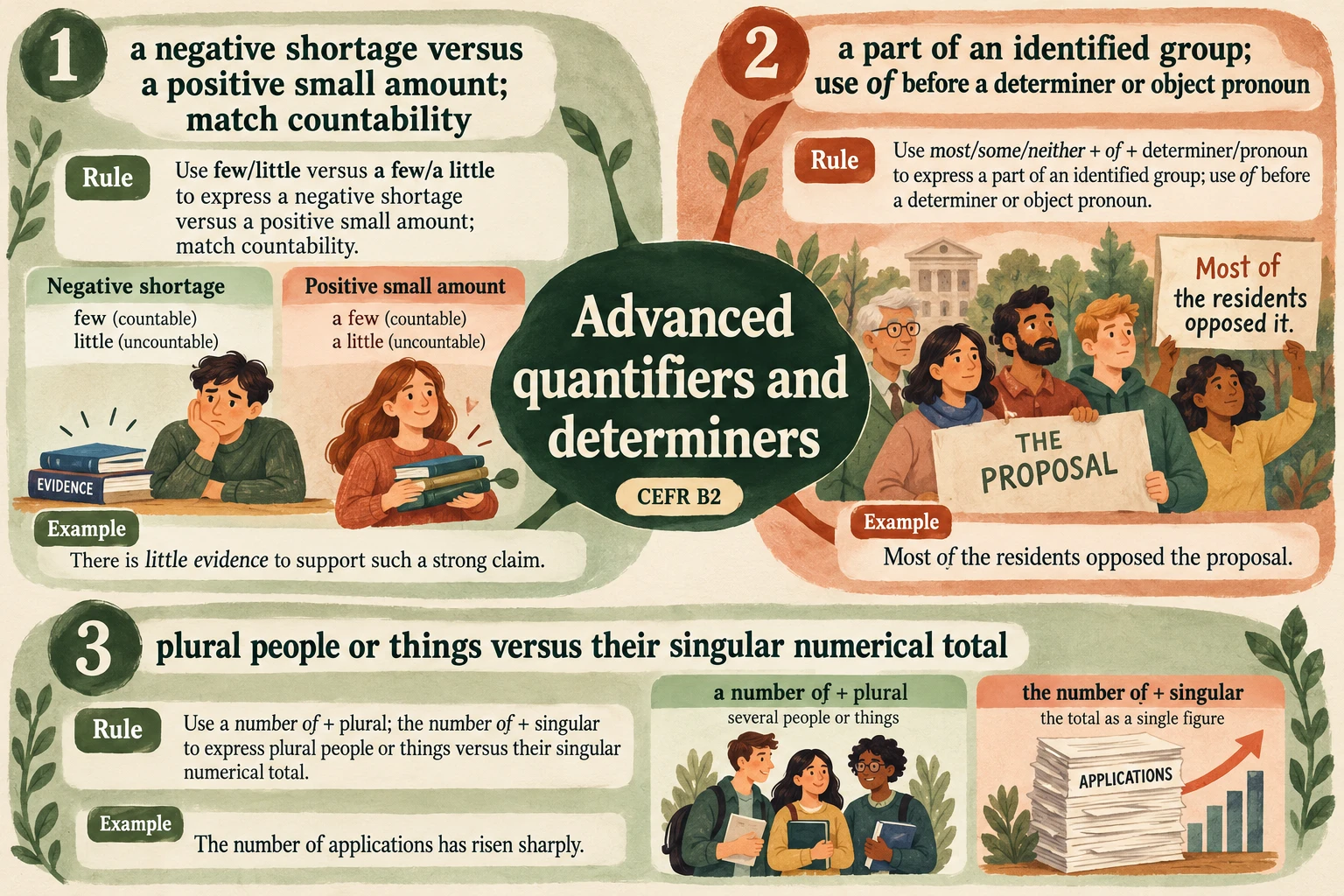
01a negative shortage versus a positive small amount; match countability
Use few/little versus a few/a little to express a negative shortage versus a positive small amount; match countability.
There is little evidence to support such a strong claim.
Advanced quantifiers and determiners · B2. Use few/little versus a few/a little to express a negative shortage versus a positive small amount; match countability.
Complete 12 original tasks. Use the situation to choose the intended meaning, practise the form, then apply it in a fresh context.
Use few/little versus a few/a little to express a negative shortage versus a positive small amount; match countability.
There is little evidence to support such a strong claim.Use most/some/neither + of + determiner/pronoun to express a part of an identified group; use of before a determiner or object pronoun.
Most of the residents opposed the proposal.Use a number of + plural; the number of + singular to express plural people or things versus their singular numerical total.
The number of applications has risen sharply.
The speaker stresses insufficient evidence; evidence is uncountable.
Use few/little versus a few/a little to express a negative shortage versus a positive small amount; match countability.
There is little evidence to support such a strong claim.Use most/some/neither + of + determiner/pronoun to express a part of an identified group; use of before a determiner or object pronoun.
Most of the residents opposed the proposal.Use a number of + plural; the number of + singular to express plural people or things versus their singular numerical total.
The number of applications has risen sharply.Keep the first try. Understand the change. Check it in a fresh situation.
No practice notes yet. Try a short warm-up.
Use few/little versus a few/a little to express a negative shortage versus a positive small amount; match countability.
There is little evidence to support such a strong claim.Use most/some/neither + of + determiner/pronoun to express a part of an identified group; use of before a determiner or object pronoun.
Most of the residents opposed the proposal.Use a number of + plural; the number of + singular to express plural people or things versus their singular numerical total.
The number of applications has risen sharply.Opening an answer records help for that question.
The speaker stresses insufficient evidence; evidence is uncountable.
The deciding clue is “The speaker stresses insufficient evidence; evidence is uncountable.”. Use few/little versus a few/a little to express a negative shortage versus a positive small amount; match countability. In this task, the completed sentence is “There is little evidence to support such a strong claim.”.
The following noun phrase is definite: the residents.
The deciding clue is “The following noun phrase is definite: the residents.”. Use most/some/neither + of + determiner/pronoun to express a part of an identified group; use of before a determiner or object pronoun. In this task, the completed sentence is “Most of the residents opposed the proposal.”.
The subject is the singular numerical total.
The deciding clue is “The subject is the singular numerical total.”. Use a number of + plural; the number of + singular to express plural people or things versus their singular numerical total. In this task, the completed sentence is “The number of applications has risen sharply.”.
The speaker stresses that some time remains, enough for one question.
The deciding clue is “The speaker stresses that some time remains, enough for one question.”. Use few/little versus a few/a little to express a negative shortage versus a positive small amount; match countability. In this task, the completed sentence is “We have a little time left, so we can take one more question.”.
Complete the partitive construction before the object pronoun them.
Complete sentence: “Neither of them had read the report.” Use most/some/neither + of + determiner/pronoun to express a part of an identified group; use of before a determiner or object pronoun. The subject, time and meaning in the task determine this form. Only reviewed responses are matched automatically; other wording is not automatically wrong.
A number of means several individual people; plural agreement follows.
The deciding clue is “A number of means several individual people; plural agreement follows.”. Use a number of + plural; the number of + singular to express plural people or things versus their singular numerical total. In this task, the completed sentence is “A number of candidates have requested feedback.”.
Express an insufficient number of countable researchers.
Complete sentence: “Too few researchers had access, so the survey was underpowered.” Use few/little versus a few/a little to express a negative shortage versus a positive small amount; match countability. The subject, time and meaning in the task determine this form. Only reviewed responses are matched automatically; other wording is not automatically wrong.
A positive small number remains; copies is countable.
The deciding clue is “A positive small number remains; copies is countable.”. Use few/little versus a few/a little to express a negative shortage versus a positive small amount; match countability. In this task, the completed sentence is “There are a few copies left; you may take one.”.
Complete the partitive construction between some and the definite noun phrase.
Complete sentence: “Some of the original data could not be recovered.” Use most/some/neither + of + determiner/pronoun to express a part of an identified group; use of before a determiner or object pronoun. The subject, time and meaning in the task determine this form. Only reviewed responses are matched automatically; other wording is not automatically wrong.
The subject is the singular numerical total, despite the plural noun after of.
The deciding clue is “The subject is the singular numerical total, despite the plural noun after of.”. Use a number of + plural; the number of + singular to express plural people or things versus their singular numerical total. In this task, the completed sentence is “The number of errors is lower this year.”.
A definite group is introduced after most.
The deciding clue is “A definite group is introduced after most.”. Use most/some/neither + of + determiner/pronoun to express a part of an identified group; use of before a determiner or object pronoun. In this task, the completed sentence is “Most of those proposals were rejected.”.
Use the present-perfect auxiliary agreeing with the plural expression A number of technicians.
Complete sentence: “A number of technicians have already volunteered.” Use a number of + plural; the number of + singular to express plural people or things versus their singular numerical total. The subject, time and meaning in the task determine this form. Only reviewed responses are matched automatically; other wording is not automatically wrong.