01부정적 부족과 긍정적 소량의 차이. 가산성에 맞춤
few/little versus a few/a little 구조를 사용합니다. 의미: 부정적 부족과 긍정적 소량의 차이. 가산성에 맞춤.
There is little evidence to support such a strong claim.
고급 수량사와 한정사 · B2. few/little versus a few/a little 구조를 사용합니다. 의미: 부정적 부족과 긍정적 소량의 차이. 가산성에 맞춤.
새로 만든 12문제입니다. 상황에서 의도를 파악하고 형태를 연습한 뒤 새로운 맥락에 적용하세요.
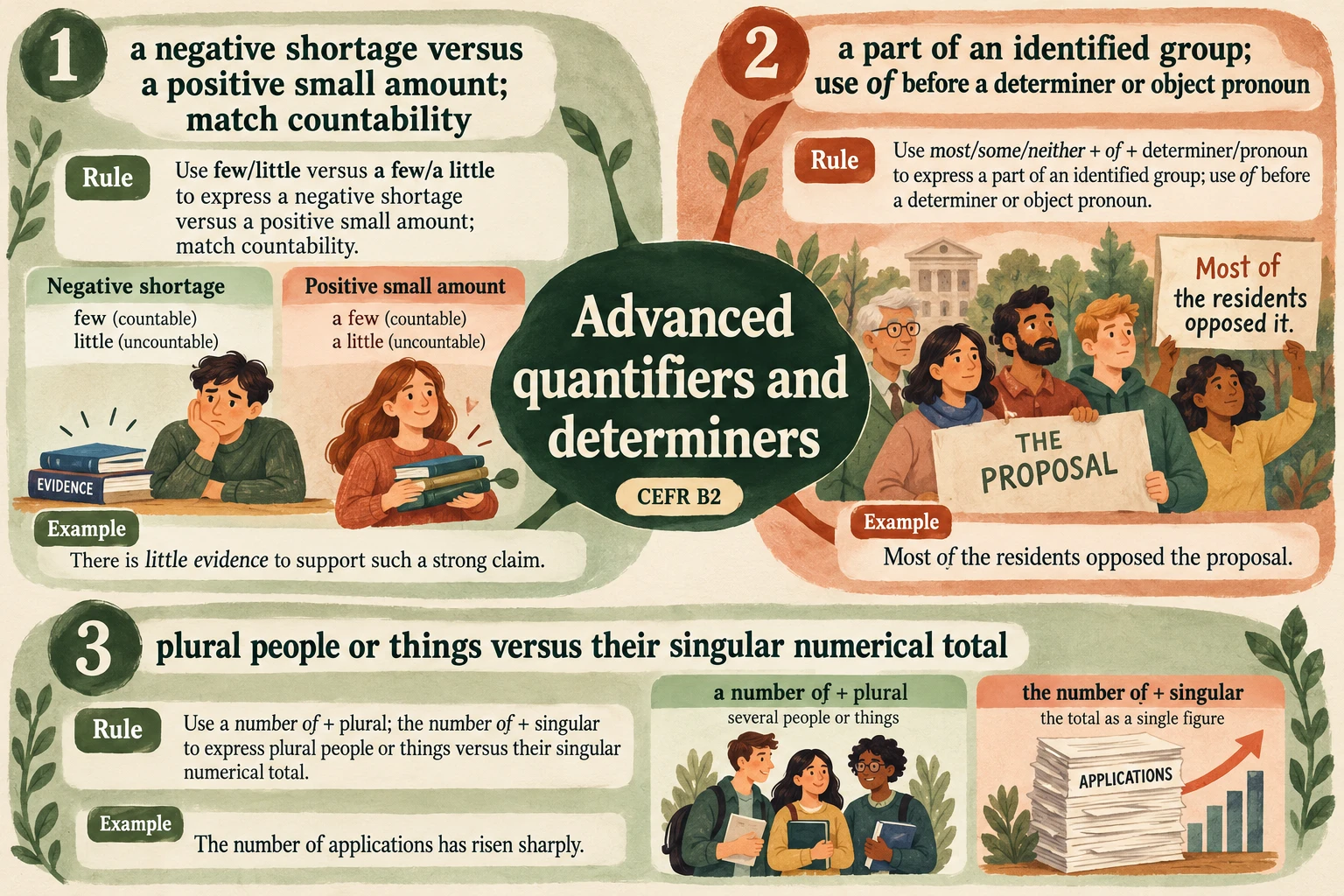
few/little versus a few/a little 구조를 사용합니다. 의미: 부정적 부족과 긍정적 소량의 차이. 가산성에 맞춤.
There is little evidence to support such a strong claim.most/some/neither + of + determiner/pronoun 구조를 사용합니다. 의미: 특정 집단의 일부. 한정사·목적격 대명사 앞 of.
Most of the residents opposed the proposal.a number of + plural; the number of + singular 구조를 사용합니다. 의미: 여러 사람·사물과 단수 취급하는 총수의 차이.
The number of applications has risen sharply.
The speaker stresses insufficient evidence; evidence is uncountable.
few/little versus a few/a little 구조를 사용합니다. 의미: 부정적 부족과 긍정적 소량의 차이. 가산성에 맞춤.
There is little evidence to support such a strong claim.most/some/neither + of + determiner/pronoun 구조를 사용합니다. 의미: 특정 집단의 일부. 한정사·목적격 대명사 앞 of.
Most of the residents opposed the proposal.a number of + plural; the number of + singular 구조를 사용합니다. 의미: 여러 사람·사물과 단수 취급하는 총수의 차이.
The number of applications has risen sharply.첫 시도를 남기고 변화의 이유를 이해한 뒤 새로운 상황에서 확인해 보세요.
아직 복습 노트가 없어요. 짧은 워밍업부터 해보세요.
few/little versus a few/a little 구조를 사용합니다. 의미: 부정적 부족과 긍정적 소량의 차이. 가산성에 맞춤.
There is little evidence to support such a strong claim.most/some/neither + of + determiner/pronoun 구조를 사용합니다. 의미: 특정 집단의 일부. 한정사·목적격 대명사 앞 of.
Most of the residents opposed the proposal.a number of + plural; the number of + singular 구조를 사용합니다. 의미: 여러 사람·사물과 단수 취급하는 총수의 차이.
The number of applications has risen sharply.정답을 열면 해당 문제에 도움 사용이 기록돼요.
The speaker stresses insufficient evidence; evidence is uncountable.
판단 단서는 “The speaker stresses insufficient evidence; evidence is uncountable.”입니다. few/little versus a few/a little 구조를 사용합니다. 의미: 부정적 부족과 긍정적 소량의 차이. 가산성에 맞춤. 이 과제의 완성 문장은 “There is little evidence to support such a strong claim.”입니다.
The following noun phrase is definite: the residents.
판단 단서는 “The following noun phrase is definite: the residents.”입니다. most/some/neither + of + determiner/pronoun 구조를 사용합니다. 의미: 특정 집단의 일부. 한정사·목적격 대명사 앞 of. 이 과제의 완성 문장은 “Most of the residents opposed the proposal.”입니다.
The subject is the singular numerical total.
판단 단서는 “The subject is the singular numerical total.”입니다. a number of + plural; the number of + singular 구조를 사용합니다. 의미: 여러 사람·사물과 단수 취급하는 총수의 차이. 이 과제의 완성 문장은 “The number of applications has risen sharply.”입니다.
The speaker stresses that some time remains, enough for one question.
판단 단서는 “The speaker stresses that some time remains, enough for one question.”입니다. few/little versus a few/a little 구조를 사용합니다. 의미: 부정적 부족과 긍정적 소량의 차이. 가산성에 맞춤. 이 과제의 완성 문장은 “We have a little time left, so we can take one more question.”입니다.
Complete the partitive construction before the object pronoun them.
완성 문장: “Neither of them had read the report.” most/some/neither + of + determiner/pronoun 구조를 사용합니다. 의미: 특정 집단의 일부. 한정사·목적격 대명사 앞 of. 과제의 주어·시간·의미에 맞춘 형태입니다. 검토한 답만 자동으로 확인하며, 다른 표현을 자동으로 틀렸다고 하지 않습니다.
A number of means several individual people; plural agreement follows.
판단 단서는 “A number of means several individual people; plural agreement follows.”입니다. a number of + plural; the number of + singular 구조를 사용합니다. 의미: 여러 사람·사물과 단수 취급하는 총수의 차이. 이 과제의 완성 문장은 “A number of candidates have requested feedback.”입니다.
Express an insufficient number of countable researchers.
완성 문장: “Too few researchers had access, so the survey was underpowered.” few/little versus a few/a little 구조를 사용합니다. 의미: 부정적 부족과 긍정적 소량의 차이. 가산성에 맞춤. 과제의 주어·시간·의미에 맞춘 형태입니다. 검토한 답만 자동으로 확인하며, 다른 표현을 자동으로 틀렸다고 하지 않습니다.
A positive small number remains; copies is countable.
판단 단서는 “A positive small number remains; copies is countable.”입니다. few/little versus a few/a little 구조를 사용합니다. 의미: 부정적 부족과 긍정적 소량의 차이. 가산성에 맞춤. 이 과제의 완성 문장은 “There are a few copies left; you may take one.”입니다.
Complete the partitive construction between some and the definite noun phrase.
완성 문장: “Some of the original data could not be recovered.” most/some/neither + of + determiner/pronoun 구조를 사용합니다. 의미: 특정 집단의 일부. 한정사·목적격 대명사 앞 of. 과제의 주어·시간·의미에 맞춘 형태입니다. 검토한 답만 자동으로 확인하며, 다른 표현을 자동으로 틀렸다고 하지 않습니다.
The subject is the singular numerical total, despite the plural noun after of.
판단 단서는 “The subject is the singular numerical total, despite the plural noun after of.”입니다. a number of + plural; the number of + singular 구조를 사용합니다. 의미: 여러 사람·사물과 단수 취급하는 총수의 차이. 이 과제의 완성 문장은 “The number of errors is lower this year.”입니다.
A definite group is introduced after most.
판단 단서는 “A definite group is introduced after most.”입니다. most/some/neither + of + determiner/pronoun 구조를 사용합니다. 의미: 특정 집단의 일부. 한정사·목적격 대명사 앞 of. 이 과제의 완성 문장은 “Most of those proposals were rejected.”입니다.
Use the present-perfect auxiliary agreeing with the plural expression A number of technicians.
완성 문장: “A number of technicians have already volunteered.” a number of + plural; the number of + singular 구조를 사용합니다. 의미: 여러 사람·사물과 단수 취급하는 총수의 차이. 과제의 주어·시간·의미에 맞춘 형태입니다. 검토한 답만 자동으로 확인하며, 다른 표현을 자동으로 틀렸다고 하지 않습니다.