01Verbo-ing tras enjoy, avoid y finish
Enjoy, avoid y finish llevan después un verbo en -ing.
She enjoys dancing.
Gerundio e infinitivo · A2. Enjoy, avoid y finish llevan después un verbo en -ing.
Practica Gerundio e infinitivo en situaciones breves. Lee la pista, elige o escribe una forma y revisa la explicación. El nivel es una orientación editorial.
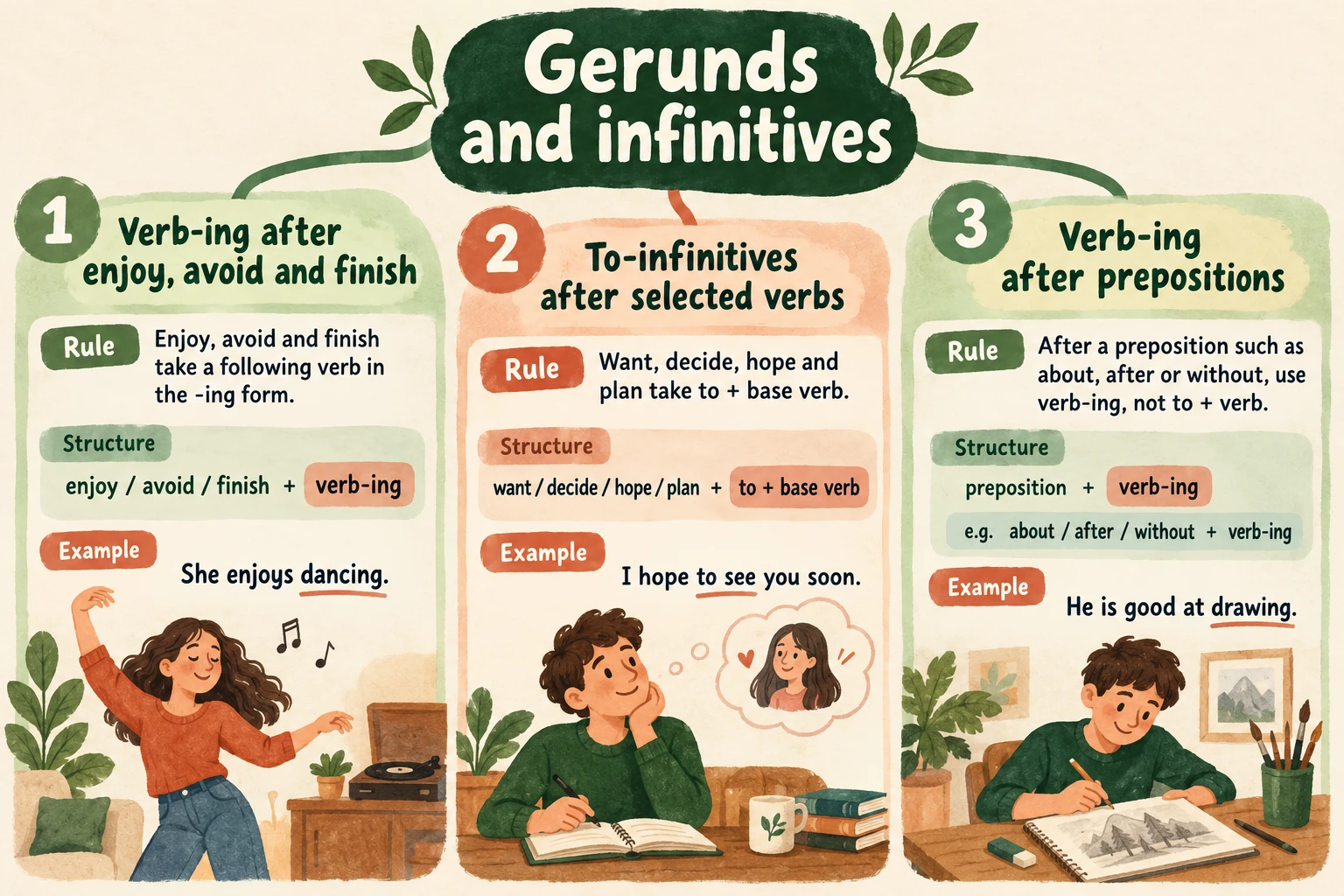
Enjoy, avoid y finish llevan después un verbo en -ing.
She enjoys dancing.Want, decide, hope y plan llevan to + verbo base.
I hope to see you soon.Tras preposiciones como about, after o without usa verbo-ing, no to + verbo.
He is good at drawing.
We enjoy ___ in the sea. (swim)
Enjoy, avoid y finish llevan después un verbo en -ing.
She enjoys dancing.Want, decide, hope y plan llevan to + verbo base.
I hope to see you soon.Tras preposiciones como about, after o without usa verbo-ing, no to + verbo.
He is good at drawing.Conserva el primer intento, entiende el cambio y compruébalo en otra situación.
Aún no hay repasos. Prueba un calentamiento corto.
Enjoy, avoid y finish llevan después un verbo en -ing.
She enjoys dancing.Want, decide, hope y plan llevan to + verbo base.
I hope to see you soon.Tras preposiciones como about, after o without usa verbo-ing, no to + verbo.
He is good at drawing.Abrir una respuesta registra ayuda para esa pregunta.
We enjoy ___ in the sea. (swim)
Mira «We enjoy ___ in the sea. (swim)». Enjoy, avoid y finish llevan después un verbo en -ing. Oración completa: «We enjoy swimming in the sea. (swim)».
Leo wants ___ a new skill. (learn)
Mira «Leo wants ___ a new skill. (learn)». Want, decide, hope y plan llevan to + verbo base. Oración completa: «Leo wants to learn a new skill. (learn)».
She is interested in ___ pottery. (make)
Mira «She is interested in ___ pottery. (make)». Tras preposiciones como about, after o without usa verbo-ing, no to + verbo. Oración completa: «She is interested in making pottery. (make)».
Please avoid ___ near the entrance. (park)
Oración de referencia: «Please avoid parking near the entrance. (park)». Enjoy, avoid y finish llevan después un verbo en -ing.
We decided ___ home early. (go)
Mira «We decided ___ home early. (go)». Want, decide, hope y plan llevan to + verbo base. Oración completa: «We decided to go home early. (go)».
He left without ___ goodbye. (say)
Mira «He left without ___ goodbye. (say)». Tras preposiciones como about, after o without usa verbo-ing, no to + verbo. Oración completa: «He left without saying goodbye. (say)».
I finished ___ the report at six. (write)
Oración de referencia: «I finished writing the report at six. (write)». Enjoy, avoid y finish llevan después un verbo en -ing.
They enjoy ___ old houses. (visit)
Mira «They enjoy ___ old houses. (visit)». Enjoy, avoid y finish llevan después un verbo en -ing. Oración completa: «They enjoy visiting old houses. (visit)».
Mina hopes ___ a doctor. (become)
Mira «Mina hopes ___ a doctor. (become)». Want, decide, hope y plan llevan to + verbo base. Oración completa: «Mina hopes to become a doctor. (become)».
After ___ the dishes, I went out. (wash)
Oración de referencia: «After washing the dishes, I went out. (wash)». Tras preposiciones como about, after o without usa verbo-ing, no to + verbo. También se admiten estas variantes revisadas: having washed. No es una lista de todas las expresiones posibles.
We plan ___ a tent. (buy)
Mira «We plan ___ a tent. (buy)». Want, decide, hope y plan llevan to + verbo base. Oración completa: «We plan to buy a tent. (buy)».
Thank you for ___ me. (help)
Oración de referencia: «Thank you for helping me. (help)». Tras preposiciones como about, after o without usa verbo-ing, no to + verbo.