01Verbe-ing après enjoy, avoid et finish
Enjoy, avoid et finish sont suivis d’un verbe en -ing.
She enjoys dancing.
Gérondif et infinitif · A2. Enjoy, avoid et finish sont suivis d’un verbe en -ing.
Travaille Gérondif et infinitif dans de courtes situations. Lis l’indice, choisis ou écris une forme, puis vérifie l’explication. Le niveau est une indication éditoriale.
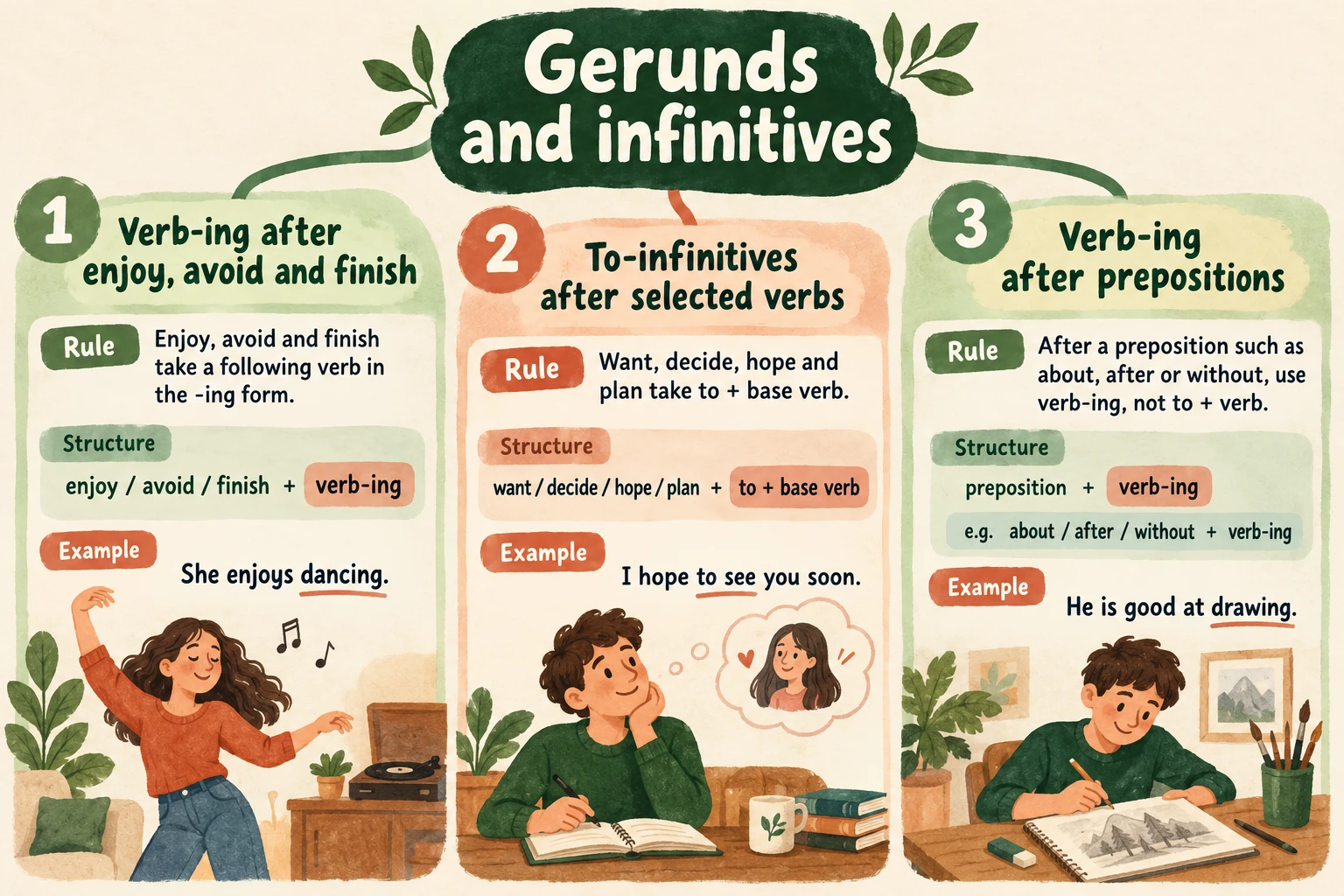
Enjoy, avoid et finish sont suivis d’un verbe en -ing.
She enjoys dancing.Want, decide, hope et plan sont suivis de to + base verbale.
I hope to see you soon.Après une préposition comme about, after ou without, utilise le verbe-ing et non to + verbe.
He is good at drawing.
We enjoy ___ in the sea. (swim)
Enjoy, avoid et finish sont suivis d’un verbe en -ing.
She enjoys dancing.Want, decide, hope et plan sont suivis de to + base verbale.
I hope to see you soon.Après une préposition comme about, after ou without, utilise le verbe-ing et non to + verbe.
He is good at drawing.Gardez la première tentative, comprenez le changement et essayez dans une nouvelle situation.
Pas encore de notes. Essayez un court échauffement.
Enjoy, avoid et finish sont suivis d’un verbe en -ing.
She enjoys dancing.Want, decide, hope et plan sont suivis de to + base verbale.
I hope to see you soon.Après une préposition comme about, after ou without, utilise le verbe-ing et non to + verbe.
He is good at drawing.Ouvrir une réponse enregistre une aide pour cette question.
We enjoy ___ in the sea. (swim)
Observe « We enjoy ___ in the sea. (swim) ». Enjoy, avoid et finish sont suivis d’un verbe en -ing. Phrase complète : « We enjoy swimming in the sea. (swim) ».
Leo wants ___ a new skill. (learn)
Observe « Leo wants ___ a new skill. (learn) ». Want, decide, hope et plan sont suivis de to + base verbale. Phrase complète : « Leo wants to learn a new skill. (learn) ».
She is interested in ___ pottery. (make)
Observe « She is interested in ___ pottery. (make) ». Après une préposition comme about, after ou without, utilise le verbe-ing et non to + verbe. Phrase complète : « She is interested in making pottery. (make) ».
Please avoid ___ near the entrance. (park)
Phrase de référence : « Please avoid parking near the entrance. (park) ». Enjoy, avoid et finish sont suivis d’un verbe en -ing.
We decided ___ home early. (go)
Observe « We decided ___ home early. (go) ». Want, decide, hope et plan sont suivis de to + base verbale. Phrase complète : « We decided to go home early. (go) ».
He left without ___ goodbye. (say)
Observe « He left without ___ goodbye. (say) ». Après une préposition comme about, after ou without, utilise le verbe-ing et non to + verbe. Phrase complète : « He left without saying goodbye. (say) ».
I finished ___ the report at six. (write)
Phrase de référence : « I finished writing the report at six. (write) ». Enjoy, avoid et finish sont suivis d’un verbe en -ing.
They enjoy ___ old houses. (visit)
Observe « They enjoy ___ old houses. (visit) ». Enjoy, avoid et finish sont suivis d’un verbe en -ing. Phrase complète : « They enjoy visiting old houses. (visit) ».
Mina hopes ___ a doctor. (become)
Observe « Mina hopes ___ a doctor. (become) ». Want, decide, hope et plan sont suivis de to + base verbale. Phrase complète : « Mina hopes to become a doctor. (become) ».
After ___ the dishes, I went out. (wash)
Phrase de référence : « After washing the dishes, I went out. (wash) ». Après une préposition comme about, after ou without, utilise le verbe-ing et non to + verbe. Autres variantes vérifiées pour cette tâche : having washed. La liste ne couvre pas toutes les formulations possibles.
We plan ___ a tent. (buy)
Observe « We plan ___ a tent. (buy) ». Want, decide, hope et plan sont suivis de to + base verbale. Phrase complète : « We plan to buy a tent. (buy) ».
Thank you for ___ me. (help)
Phrase de référence : « Thank you for helping me. (help) ». Après une préposition comme about, after ou without, utilise le verbe-ing et non to + verbe.