01Verb-ing nach enjoy, avoid und finish
Nach enjoy, avoid und finish steht ein Verb in der -ing-Form.
She enjoys dancing.
Gerundium und Infinitiv · A2. Nach enjoy, avoid und finish steht ein Verb in der -ing-Form.
Übe Gerundium und Infinitiv in kurzen Situationen. Lies den Hinweis, wähle oder schreibe eine Form und prüfe die Begründung. Die Stufe dient der redaktionellen Orientierung.
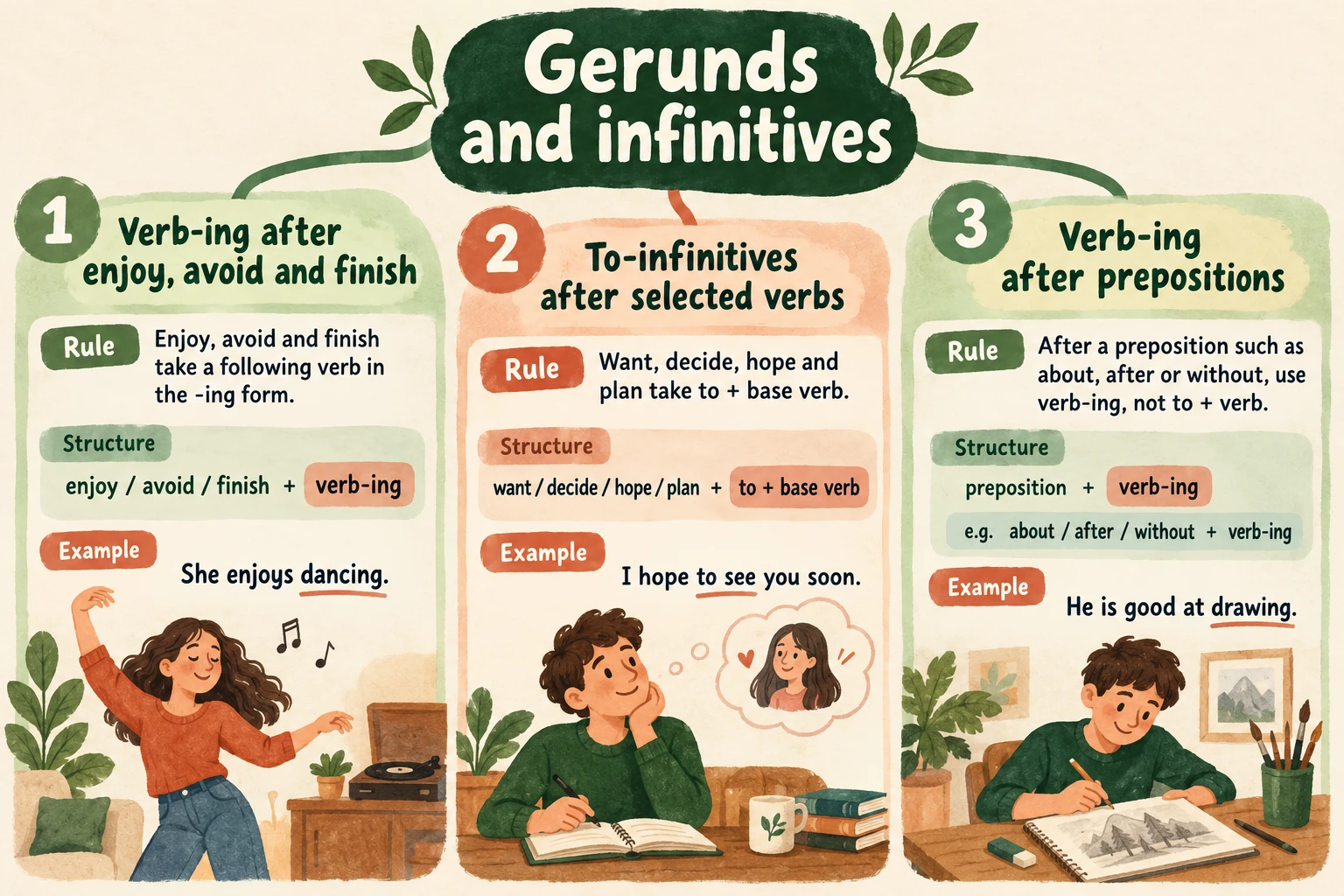
Nach enjoy, avoid und finish steht ein Verb in der -ing-Form.
She enjoys dancing.Nach want, decide, hope und plan steht to + Grundform.
I hope to see you soon.Nach Präpositionen wie about, after oder without steht Verb-ing, nicht to + Verb.
He is good at drawing.
We enjoy ___ in the sea. (swim)
Nach enjoy, avoid und finish steht ein Verb in der -ing-Form.
She enjoys dancing.Nach want, decide, hope und plan steht to + Grundform.
I hope to see you soon.Nach Präpositionen wie about, after oder without steht Verb-ing, nicht to + Verb.
He is good at drawing.Bewahre den ersten Versuch. Verstehe die Änderung. Prüfe sie in einer neuen Situation.
Noch keine Lernnotizen. Starte mit einem kurzen Einstieg.
Nach enjoy, avoid und finish steht ein Verb in der -ing-Form.
She enjoys dancing.Nach want, decide, hope und plan steht to + Grundform.
I hope to see you soon.Nach Präpositionen wie about, after oder without steht Verb-ing, nicht to + Verb.
He is good at drawing.Das Öffnen einer Antwort wird für diese Aufgabe als Hilfe erfasst.
We enjoy ___ in the sea. (swim)
Achte auf „We enjoy ___ in the sea. (swim)“. Nach enjoy, avoid und finish steht ein Verb in der -ing-Form. Vollständiger Satz: „We enjoy swimming in the sea. (swim)“.
Leo wants ___ a new skill. (learn)
Achte auf „Leo wants ___ a new skill. (learn)“. Nach want, decide, hope und plan steht to + Grundform. Vollständiger Satz: „Leo wants to learn a new skill. (learn)“.
She is interested in ___ pottery. (make)
Achte auf „She is interested in ___ pottery. (make)“. Nach Präpositionen wie about, after oder without steht Verb-ing, nicht to + Verb. Vollständiger Satz: „She is interested in making pottery. (make)“.
Please avoid ___ near the entrance. (park)
Vollständiger Beispielsatz: „Please avoid parking near the entrance. (park)“. Nach enjoy, avoid und finish steht ein Verb in der -ing-Form.
We decided ___ home early. (go)
Achte auf „We decided ___ home early. (go)“. Nach want, decide, hope und plan steht to + Grundform. Vollständiger Satz: „We decided to go home early. (go)“.
He left without ___ goodbye. (say)
Achte auf „He left without ___ goodbye. (say)“. Nach Präpositionen wie about, after oder without steht Verb-ing, nicht to + Verb. Vollständiger Satz: „He left without saying goodbye. (say)“.
I finished ___ the report at six. (write)
Vollständiger Beispielsatz: „I finished writing the report at six. (write)“. Nach enjoy, avoid und finish steht ein Verb in der -ing-Form.
They enjoy ___ old houses. (visit)
Achte auf „They enjoy ___ old houses. (visit)“. Nach enjoy, avoid und finish steht ein Verb in der -ing-Form. Vollständiger Satz: „They enjoy visiting old houses. (visit)“.
Mina hopes ___ a doctor. (become)
Achte auf „Mina hopes ___ a doctor. (become)“. Nach want, decide, hope und plan steht to + Grundform. Vollständiger Satz: „Mina hopes to become a doctor. (become)“.
After ___ the dishes, I went out. (wash)
Vollständiger Beispielsatz: „After washing the dishes, I went out. (wash)“. Nach Präpositionen wie about, after oder without steht Verb-ing, nicht to + Verb. In dieser Aufgabe sind auch diese Formen geprüft: having washed. Die Liste ist nicht vollständig.
We plan ___ a tent. (buy)
Achte auf „We plan ___ a tent. (buy)“. Nach want, decide, hope und plan steht to + Grundform. Vollständiger Satz: „We plan to buy a tent. (buy)“.
Thank you for ___ me. (help)
Vollständiger Beispielsatz: „Thank you for helping me. (help)“. Nach Präpositionen wie about, after oder without steht Verb-ing, nicht to + Verb.