
B2

Futuro perfeito contínuo: exercícios

Sobre esta lição

Futuro perfeito contínuo · B2. Use will have been + -ing para expressar a duração acumulada até um ponto futuro, muitas vezes com for ou since.

Resolva 12 tarefas originais. Use a situação para interpretar o sentido, praticar a estrutura e aplicá-la em um novo contexto.

12 questões
Salve para encontrar em Minha coleção.
Mapa de conceitos

Future perfect continuous

Começar a praticar
Future perfect continuous — Mapa de conceitos

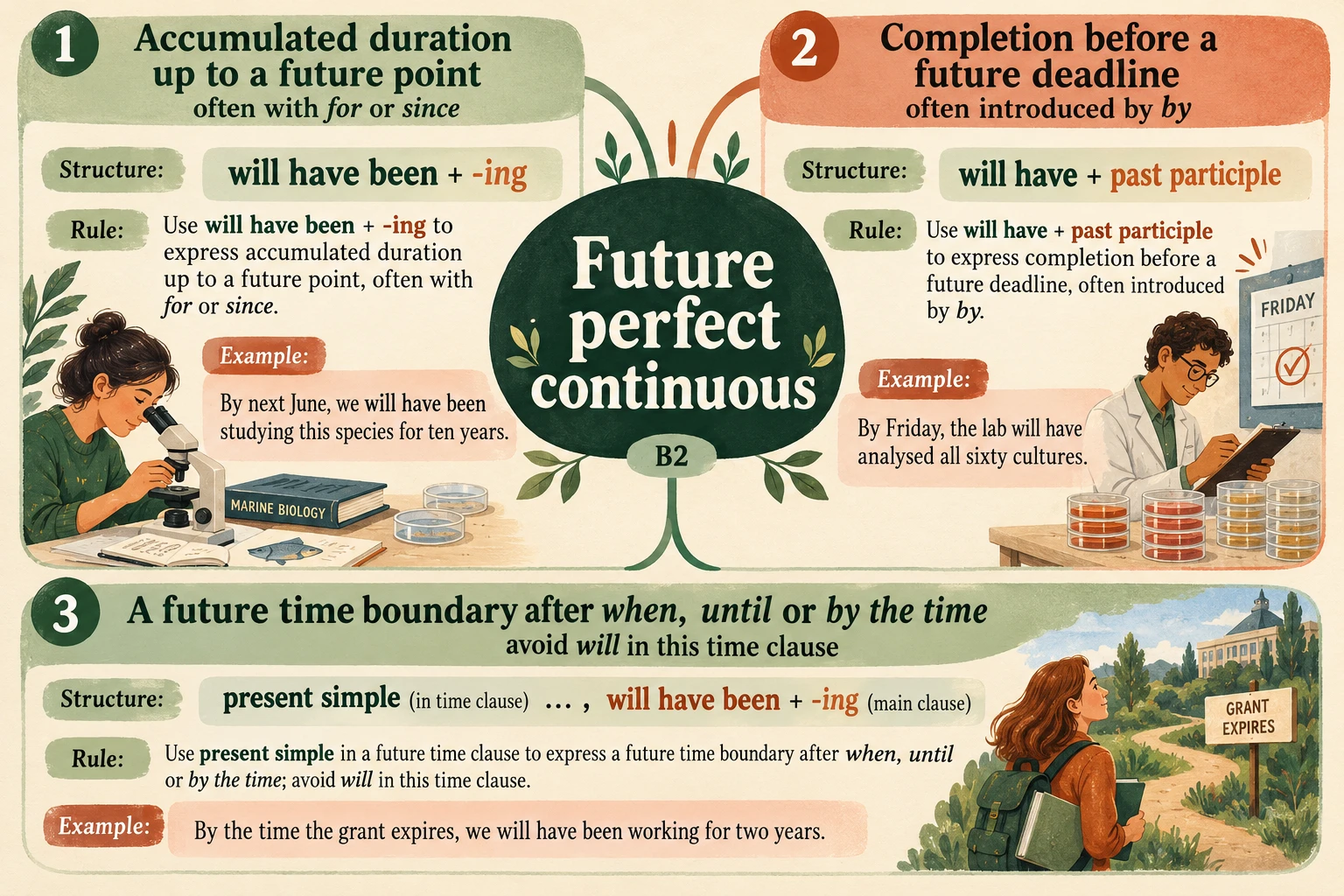
01a duração acumulada até um ponto futuro, muitas vezes com for ou since

Use will have been + -ing para expressar a duração acumulada até um ponto futuro, muitas vezes com for ou since.

By next June, we will have been studying this species for ten years.
02a conclusão antes de um prazo futuro, muitas vezes com by

Use will have + past participle para expressar a conclusão antes de um prazo futuro, muitas vezes com by.

By Friday, the lab will have analysed all sixty cultures.

03um limite futuro após when, until ou by the time, sem will nessa oração

Use present simple in a future time clause para expressar um limite futuro após when, until ou by the time, sem will nessa oração.

By the time the grant expires, we will have been working for two years.

Guia ilustrado

0/12
Questões
01 / 12D01Salve para encontrar em Minha coleção.

The research will continue; stress accumulated duration at next June.

By next June, we ___ this species for ten years.

Sua resposta
1 / 12

Seu caminho de aprendizagem

01
Etapa 1 · Aquecimento

Aquecimento

0/3
02
Etapa 2 · Praticar a habilidade

a duração acumulada até um ponto futuro, muitas vezes com for ou since

0/2

Use will have been + -ing para expressar a duração acumulada até um ponto futuro, muitas vezes com for ou since.

By next June, we will have been studying this species for ten years.
03
Etapa 3 · Praticar a habilidade

a conclusão antes de um prazo futuro, muitas vezes com by

0/1

Use will have + past participle para expressar a conclusão antes de um prazo futuro, muitas vezes com by.

By Friday, the lab will have analysed all sixty cultures.
04
Etapa 4 · Praticar a habilidade

um limite futuro após when, until ou by the time, sem will nessa oração

0/1

Use present simple in a future time clause para expressar um limite futuro após when, until ou by the time, sem will nessa oração.

By the time the grant expires, we will have been working for two years.
05
Etapa 5 · Novos contextos

Novos contextos

0/3
06
Etapa 6 · Um novo desafio

Um novo desafio

0/2
Revisões desta unidade

Transforme erros em aprendizado.

Guarde a primeira tentativa, entenda a mudança e confira em outra situação.

0

Ainda não há revisões. Faça um aquecimento curto.

Mapa da aula

Futuro perfeito contínuo

B2
Future perfect continuous

Pontos da aula

01

a duração acumulada até um ponto futuro, muitas vezes com for ou since

Use will have been + -ing para expressar a duração acumulada até um ponto futuro, muitas vezes com for ou since.

By next June, we will have been studying this species for ten years.
02

a conclusão antes de um prazo futuro, muitas vezes com by

Use will have + past participle para expressar a conclusão antes de um prazo futuro, muitas vezes com by.

By Friday, the lab will have analysed all sixty cultures.
03

um limite futuro após when, until ou by the time, sem will nessa oração

Use present simple in a future time clause para expressar um limite futuro após when, until ou by the time, sem will nessa oração.

By the time the grant expires, we will have been working for two years.

Perguntas e respostas

Abrir uma resposta registra ajuda para essa questão.

D01 · Aquecimento

The research will continue; stress accumulated duration at next June.

By next June, we ___ this species for ten years.

  1. had been studying
  2. were studying
  3. will have been studying
  4. have been studying
Resposta e explicação
will have been studying

A pista decisiva é “The research will continue; stress accumulated duration at next June.”. Use will have been + -ing para expressar a duração acumulada até um ponto futuro, muitas vezes com for ou since. Nesta tarefa, a frase completa é “By next June, we will have been studying this species for ten years.”.

D02 · Aquecimento

Focus on an exact completed total before the future deadline.

By Friday, the lab ___ all sixty cultures.

  1. has been analysing
  2. will have analysed
  3. had analysed
  4. will have been analysing
Resposta e explicação
will have analysed

A pista decisiva é “Focus on an exact completed total before the future deadline.”. Use will have + past participle para expressar a conclusão antes de um prazo futuro, muitas vezes com by. Nesta tarefa, a frase completa é “By Friday, the lab will have analysed all sixty cultures.”.

D03 · Aquecimento

Future time boundary follows by the time.

By the time the grant ___, we will have been working for two years.

  1. expires
  2. will expire
  3. would expire
  4. will have expired
Resposta e explicação
expires

A pista decisiva é “Future time boundary follows by the time.”. Use present simple in a future time clause para expressar um limite futuro após when, until ou by the time, sem will nessa oração. Nesta tarefa, a frase completa é “By the time the grant expires, we will have been working for two years.”.

P01 · Praticar a habilidade

The occupation will still be continuing; emphasise duration at a future anniversary.

In August, she ___ at the station for twenty years.

  1. will have been working
  2. was working
  3. had been working
  4. has been working
Resposta e explicação
will have been working

A pista decisiva é “The occupation will still be continuing; emphasise duration at a future anniversary.”. Use will have been + -ing para expressar a duração acumulada até um ponto futuro, muitas vezes com for ou since. Nesta tarefa, a frase completa é “In August, she will have been working at the station for twenty years.”.

P02 · Praticar a habilidade

Use the future perfect simple of publish for the completed total.

By the end of next year, the team ___ three volumes.

Resposta e explicação
will have published

Frase completa: “By the end of next year, the team will have published three volumes.” Use will have + past participle para expressar a conclusão antes de um prazo futuro, muitas vezes com by. O sujeito, o tempo e o sentido da tarefa determinam esta forma. Só as respostas revisadas são comparadas automaticamente; outras formulações não estão automaticamente erradas.

P03 · Praticar a habilidade

The main clause is future; this subordinate clause sets its time boundary.

When you ___ next week, I will have been teaching here for a month.

  1. will have arrived
  2. would arrive
  3. arrive
  4. will arrive
Resposta e explicação
arrive

A pista decisiva é “The main clause is future; this subordinate clause sets its time boundary.”. Use present simple in a future time clause para expressar um limite futuro após when, until ou by the time, sem will nessa oração. Nesta tarefa, a frase completa é “When you arrive next week, I will have been teaching here for a month.”.

P04 · Praticar a habilidade

Use the future perfect continuous of travel to stress duration up to next Monday.

By next Monday, they ___ for six consecutive weeks.

Resposta e explicação
will have been travelling

Frase completa: “By next Monday, they will have been travelling for six consecutive weeks.” Use will have been + -ing para expressar a duração acumulada até um ponto futuro, muitas vezes com for ou since. O sujeito, o tempo e o sentido da tarefa determinam esta forma. Só as respostas revisadas são comparadas automaticamente; outras formulações não estão automaticamente erradas.

Outras respostas aceitas
  • will have been traveling
R01 · Novos contextos

The strike will be ongoing; count its duration at next Friday.

By next Friday, the workers ___ for a fortnight.

  1. have been striking
  2. had been striking
  3. will have been striking
  4. were striking
Resposta e explicação
will have been striking

A pista decisiva é “The strike will be ongoing; count its duration at next Friday.”. Use will have been + -ing para expressar a duração acumulada até um ponto futuro, muitas vezes com for ou since. Nesta tarefa, a frase completa é “By next Friday, the workers will have been striking for a fortnight.”.

R02 · Novos contextos

Use the future perfect simple of complete for all ten trials finished before the meeting.

By the review meeting, we ___ all ten trials.

Resposta e explicação
will have completed

Frase completa: “By the review meeting, we will have completed all ten trials.” Use will have + past participle para expressar a conclusão antes de um prazo futuro, muitas vezes com by. O sujeito, o tempo e o sentido da tarefa determinam esta forma. Só as respostas revisadas são comparadas automaticamente; outras formulações não estão automaticamente erradas.

Outras respostas aceitas
  • shall have completed
R03 · Novos contextos

In a future time clause, use the present simple for the event boundary.

We will have been walking for five hours when we ___ the refuge.

  1. reach
  2. will reach
  3. will have reached
  4. would reach
Resposta e explicação
reach

A pista decisiva é “In a future time clause, use the present simple for the event boundary.”. Use present simple in a future time clause para expressar um limite futuro após when, until ou by the time, sem will nessa oração. Nesta tarefa, a frase completa é “We will have been walking for five hours when we reach the refuge.”.

X01 · Um novo desafio

Count completed deliveries, rather than the duration of delivery activity.

By this evening, the courier ___ eighty parcels.

  1. will have been delivering
  2. will have delivered
  3. has been delivering
  4. had delivered
Resposta e explicação
will have delivered

A pista decisiva é “Count completed deliveries, rather than the duration of delivery activity.”. Use will have + past participle para expressar a conclusão antes de um prazo futuro, muitas vezes com by. Nesta tarefa, a frase completa é “By this evening, the courier will have delivered eighty parcels.”.

X02 · Um novo desafio

Use the present simple of finish in the time clause.

By the time the course ___, she will have been studying for nine months.

Resposta e explicação
finishes

Frase completa: “By the time the course finishes, she will have been studying for nine months.” Use present simple in a future time clause para expressar um limite futuro após when, until ou by the time, sem will nessa oração. O sujeito, o tempo e o sentido da tarefa determinam esta forma. Só as respostas revisadas são comparadas automaticamente; outras formulações não estão automaticamente erradas.