01끝난 과거 시간
yesterday·last week·in 2019처럼 끝난 과거 시간이 있으면 과거시제를 씁니다.
I called her yesterday.
현재완료와 과거시제 · A2. yesterday·last week·in 2019처럼 끝난 과거 시간이 있으면 과거시제를 씁니다.
짧은 상황에서 ‘현재완료와 과거시제’을 연습합니다. 단서를 읽고 형태를 고르거나 쓴 뒤 이유를 확인하세요. 수준은 편집상 안내입니다.
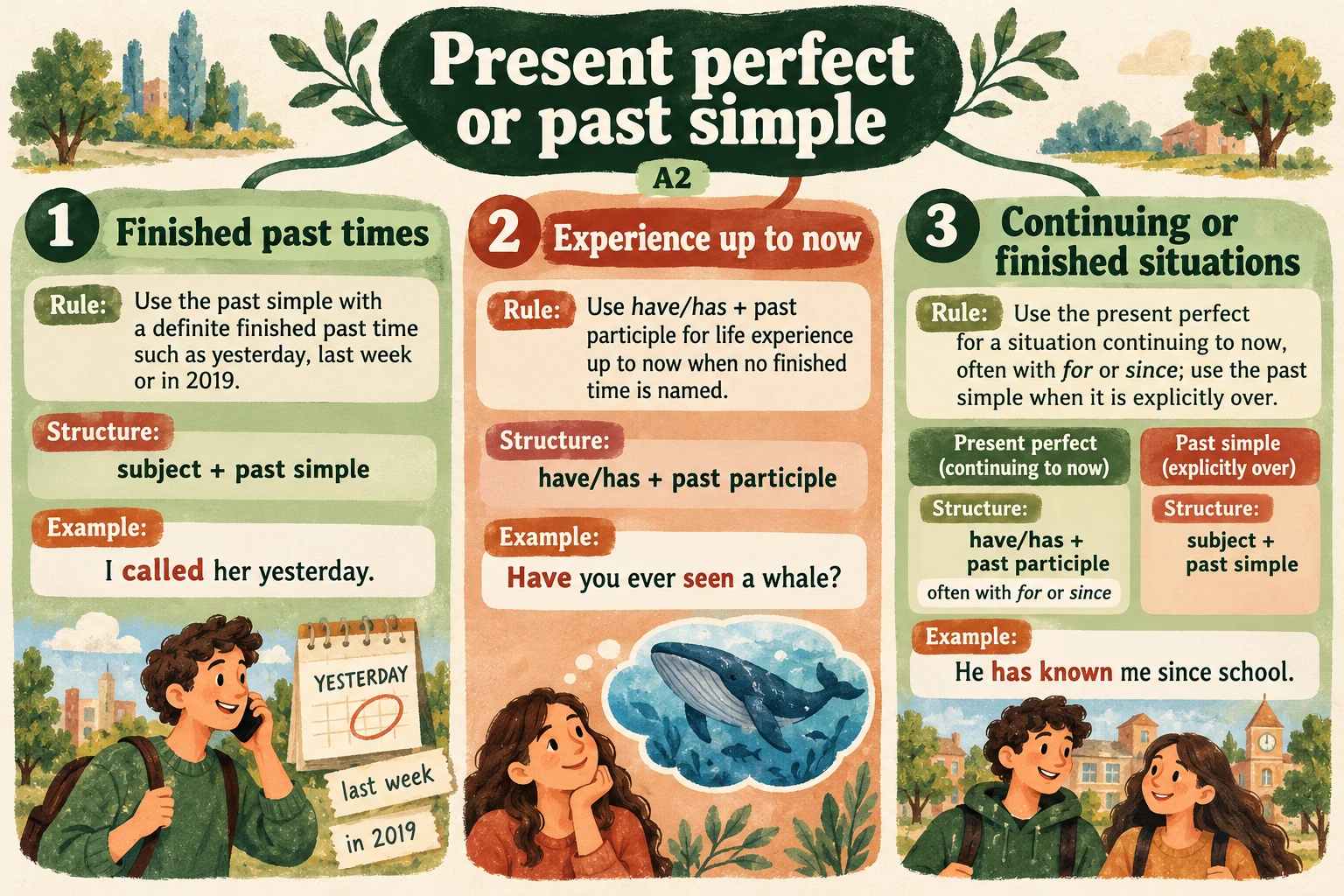
yesterday·last week·in 2019처럼 끝난 과거 시간이 있으면 과거시제를 씁니다.
I called her yesterday.끝난 시점을 말하지 않고 지금까지의 경험을 나타내면 have/has+과거분사를 씁니다.
Have you ever seen a whale?지금도 계속되는 상태는 for/since와 현재완료를 쓰며 명시적으로 끝난 상태는 과거시제를 씁니다.
He has known me since school.
I ___ that film last Saturday. (see)
yesterday·last week·in 2019처럼 끝난 과거 시간이 있으면 과거시제를 씁니다.
I called her yesterday.끝난 시점을 말하지 않고 지금까지의 경험을 나타내면 have/has+과거분사를 씁니다.
Have you ever seen a whale?지금도 계속되는 상태는 for/since와 현재완료를 쓰며 명시적으로 끝난 상태는 과거시제를 씁니다.
He has known me since school.첫 시도를 남기고 변화의 이유를 이해한 뒤 새로운 상황에서 확인해 보세요.
아직 복습 노트가 없어요. 짧은 워밍업부터 해보세요.
yesterday·last week·in 2019처럼 끝난 과거 시간이 있으면 과거시제를 씁니다.
I called her yesterday.끝난 시점을 말하지 않고 지금까지의 경험을 나타내면 have/has+과거분사를 씁니다.
Have you ever seen a whale?지금도 계속되는 상태는 for/since와 현재완료를 쓰며 명시적으로 끝난 상태는 과거시제를 씁니다.
He has known me since school.정답을 열면 해당 문제에 도움 사용이 기록돼요.
I ___ that film last Saturday. (see)
“I ___ that film last Saturday. (see)”를 보세요. yesterday·last week·in 2019처럼 끝난 과거 시간이 있으면 과거시제를 씁니다. 완성 문장: “I saw that film last Saturday. (see)”.
In her life up to now, Lea ___ three novels. (write)
“In her life up to now, Lea ___ three novels. (write)”를 보세요. 끝난 시점을 말하지 않고 지금까지의 경험을 나타내면 have/has+과거분사를 씁니다. 완성 문장: “In her life up to now, Lea has written three novels. (write)”.
We moved here in 2020 and still live here. We ___ here since 2020. (live)
“We moved here in 2020 and still live here. We ___ here since 2020. (live)”를 보세요. 지금도 계속되는 상태는 for/since와 현재완료를 쓰며 명시적으로 끝난 상태는 과거시제를 씁니다. 완성 문장: “We moved here in 2020 and still live here. We have lived here since 2020. (live)”.
They ___ the museum yesterday. (visit)
완성 예문: “They visited the museum yesterday. (visit)”. yesterday·last week·in 2019처럼 끝난 과거 시간이 있으면 과거시제를 씁니다.
I ___ sushi before in my life. (never eat)
“I ___ sushi before in my life. (never eat)”를 보세요. 끝난 시점을 말하지 않고 지금까지의 경험을 나타내면 have/has+과거분사를 씁니다. 완성 문장: “I have never eaten sushi before in my life. (never eat)”.
She worked at the café from 2018 to 2020, then left. She ___ there for two years. (work)
“She worked at the café from 2018 to 2020, then left. She ___ there for two years. (work)”를 보세요. 지금도 계속되는 상태는 for/since와 현재완료를 쓰며 명시적으로 끝난 상태는 과거시제를 씁니다. 완성 문장: “She worked at the café from 2018 to 2020, then left. She worked there for two years. (work)”.
Ben ___ his driving test in 2022. (pass)
완성 예문: “Ben passed his driving test in 2022. (pass)”. yesterday·last week·in 2019처럼 끝난 과거 시간이 있으면 과거시제를 씁니다.
Our train ___ an hour ago. (arrive)
“Our train ___ an hour ago. (arrive)”를 보세요. yesterday·last week·in 2019처럼 끝난 과거 시간이 있으면 과거시제를 씁니다. 완성 문장: “Our train arrived an hour ago. (arrive)”.
Up to now, we ___ to Iceland. (never be)
“Up to now, we ___ to Iceland. (never be)”를 보세요. 끝난 시점을 말하지 않고 지금까지의 경험을 나타내면 have/has+과거분사를 씁니다. 완성 문장: “Up to now, we have never been to Iceland. (never be)”.
I still own this bike. I ___ it for five years. (have)
완성 예문: “I still own this bike. I have had it for five years. (have)”. 지금도 계속되는 상태는 for/since와 현재완료를 쓰며 명시적으로 끝난 상태는 과거시제를 씁니다. 이 문제에서는 다음 표현도 확인된 답으로 인정합니다: 've had. 가능한 모든 영어 표현의 목록은 아닙니다.
Has he ever ___ a mountain? (climb)
“Has he ever ___ a mountain? (climb)”를 보세요. 끝난 시점을 말하지 않고 지금까지의 경험을 나타내면 have/has+과거분사를 씁니다. 완성 문장: “Has he ever climbed a mountain? (climb)”.
They left Paris in 2021 after a three-year stay. They ___ there for three years. (live)
완성 예문: “They left Paris in 2021 after a three-year stay. They lived there for three years. (live)”. 지금도 계속되는 상태는 for/since와 현재완료를 쓰며 명시적으로 끝난 상태는 과거시제를 씁니다.