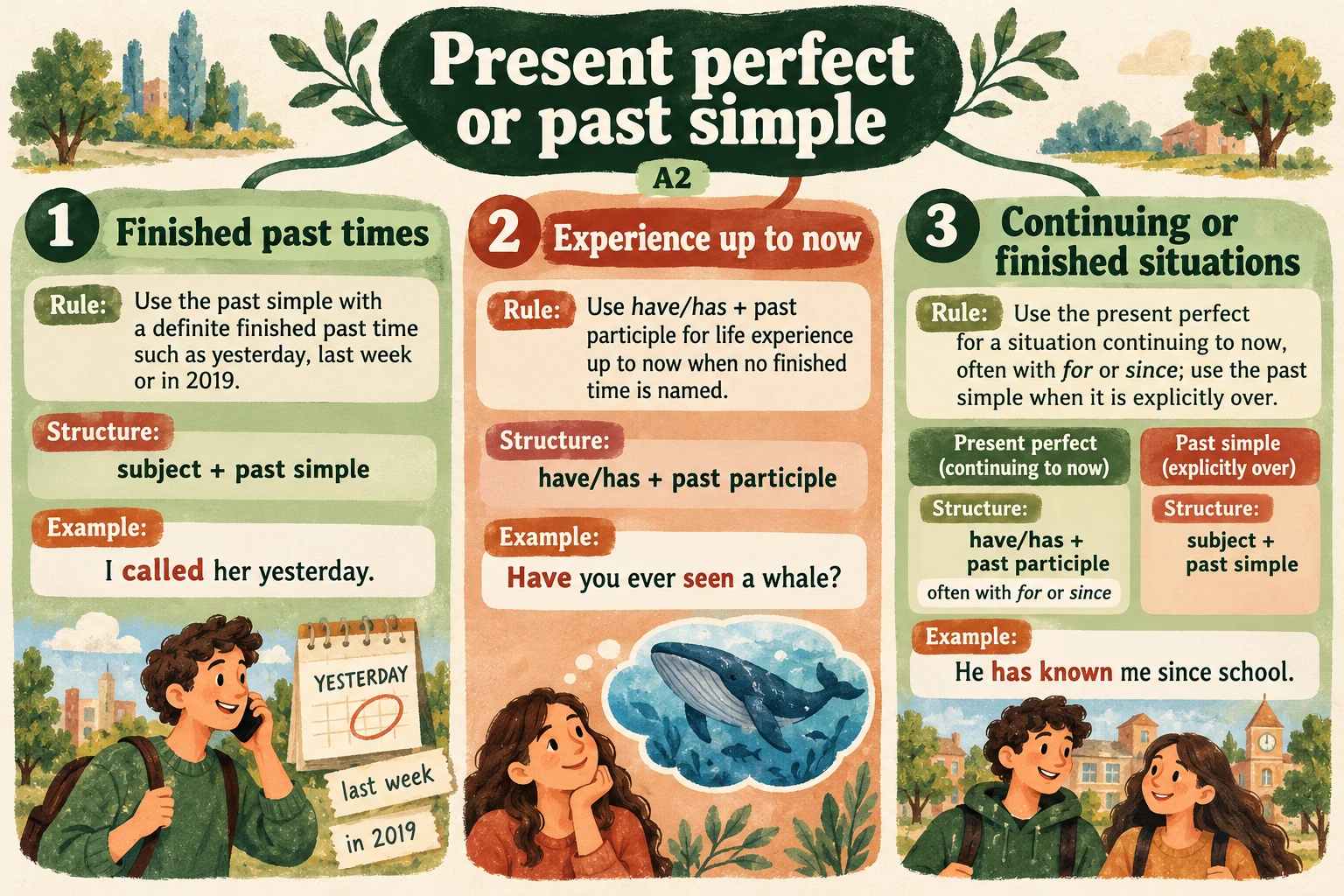
01Finished past times
Use the past simple with a definite finished past time such as yesterday, last week or in 2019.
I called her yesterday.
Present perfect or past simple · A2. Use the past simple with a definite finished past time such as yesterday, last week or in 2019.
Practise Present perfect or past simple in short situations. Read the clue, choose or write a form, then check the reason. The level is an editorial guide.
Use the past simple with a definite finished past time such as yesterday, last week or in 2019.
I called her yesterday.Use have/has + past participle for life experience up to now when no finished time is named.
Have you ever seen a whale?Use the present perfect for a situation continuing to now, often with for or since; use the past simple when it is explicitly over.
He has known me since school.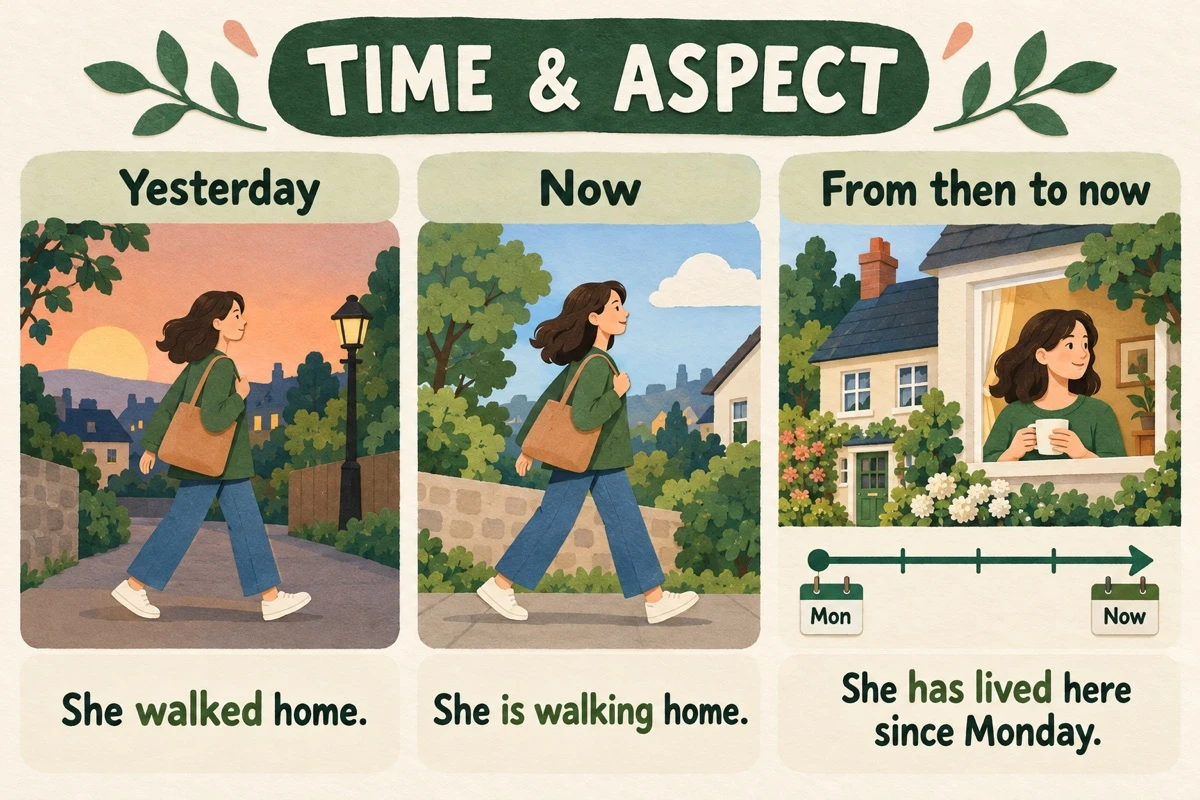
I ___ that film last Saturday. (see)
Use the past simple with a definite finished past time such as yesterday, last week or in 2019.
I called her yesterday.Use have/has + past participle for life experience up to now when no finished time is named.
Have you ever seen a whale?Use the present perfect for a situation continuing to now, often with for or since; use the past simple when it is explicitly over.
He has known me since school.Keep the first try. Understand the change. Check it in a fresh situation.
No practice notes yet. Try a short warm-up.
Use the past simple with a definite finished past time such as yesterday, last week or in 2019.
I called her yesterday.Use have/has + past participle for life experience up to now when no finished time is named.
Have you ever seen a whale?Use the present perfect for a situation continuing to now, often with for or since; use the past simple when it is explicitly over.
He has known me since school.Opening an answer records help for that question.
I ___ that film last Saturday. (see)
Look at “I ___ that film last Saturday. (see)”. Use the past simple with a definite finished past time such as yesterday, last week or in 2019. Complete sentence: “I saw that film last Saturday. (see)”.
In her life up to now, Lea ___ three novels. (write)
Look at “In her life up to now, Lea ___ three novels. (write)”. Use have/has + past participle for life experience up to now when no finished time is named. Complete sentence: “In her life up to now, Lea has written three novels. (write)”.
We moved here in 2020 and still live here. We ___ here since 2020. (live)
Look at “We moved here in 2020 and still live here. We ___ here since 2020. (live)”. Use the present perfect for a situation continuing to now, often with for or since; use the past simple when it is explicitly over. Complete sentence: “We moved here in 2020 and still live here. We have lived here since 2020. (live)”.
They ___ the museum yesterday. (visit)
Reference completion: “They visited the museum yesterday. (visit)”. Use the past simple with a definite finished past time such as yesterday, last week or in 2019.
I ___ sushi before in my life. (never eat)
Look at “I ___ sushi before in my life. (never eat)”. Use have/has + past participle for life experience up to now when no finished time is named. Complete sentence: “I have never eaten sushi before in my life. (never eat)”.
She worked at the café from 2018 to 2020, then left. She ___ there for two years. (work)
Look at “She worked at the café from 2018 to 2020, then left. She ___ there for two years. (work)”. Use the present perfect for a situation continuing to now, often with for or since; use the past simple when it is explicitly over. Complete sentence: “She worked at the café from 2018 to 2020, then left. She worked there for two years. (work)”.
Ben ___ his driving test in 2022. (pass)
Reference completion: “Ben passed his driving test in 2022. (pass)”. Use the past simple with a definite finished past time such as yesterday, last week or in 2019.
Our train ___ an hour ago. (arrive)
Look at “Our train ___ an hour ago. (arrive)”. Use the past simple with a definite finished past time such as yesterday, last week or in 2019. Complete sentence: “Our train arrived an hour ago. (arrive)”.
Up to now, we ___ to Iceland. (never be)
Look at “Up to now, we ___ to Iceland. (never be)”. Use have/has + past participle for life experience up to now when no finished time is named. Complete sentence: “Up to now, we have never been to Iceland. (never be)”.
I still own this bike. I ___ it for five years. (have)
Reference completion: “I still own this bike. I have had it for five years. (have)”. Use the present perfect for a situation continuing to now, often with for or since; use the past simple when it is explicitly over. Also accepted in this task: 've had. These are reviewed alternatives, not an exhaustive list of all possible English.
Has he ever ___ a mountain? (climb)
Look at “Has he ever ___ a mountain? (climb)”. Use have/has + past participle for life experience up to now when no finished time is named. Complete sentence: “Has he ever climbed a mountain? (climb)”.
They left Paris in 2021 after a three-year stay. They ___ there for three years. (live)
Reference completion: “They left Paris in 2021 after a three-year stay. They lived there for three years. (live)”. Use the present perfect for a situation continuing to now, often with for or since; use the past simple when it is explicitly over.