01Some in positive statements
Use some in an ordinary positive statement with plural or uncountable nouns when the exact amount is unstated.
There are some cherries.
Some and any · A1. Use some in an ordinary positive statement with plural or uncountable nouns when the exact amount is unstated.
Practise Some and any in short situations. Read the clue, choose or write a form, then check the reason. The level is an editorial guide.
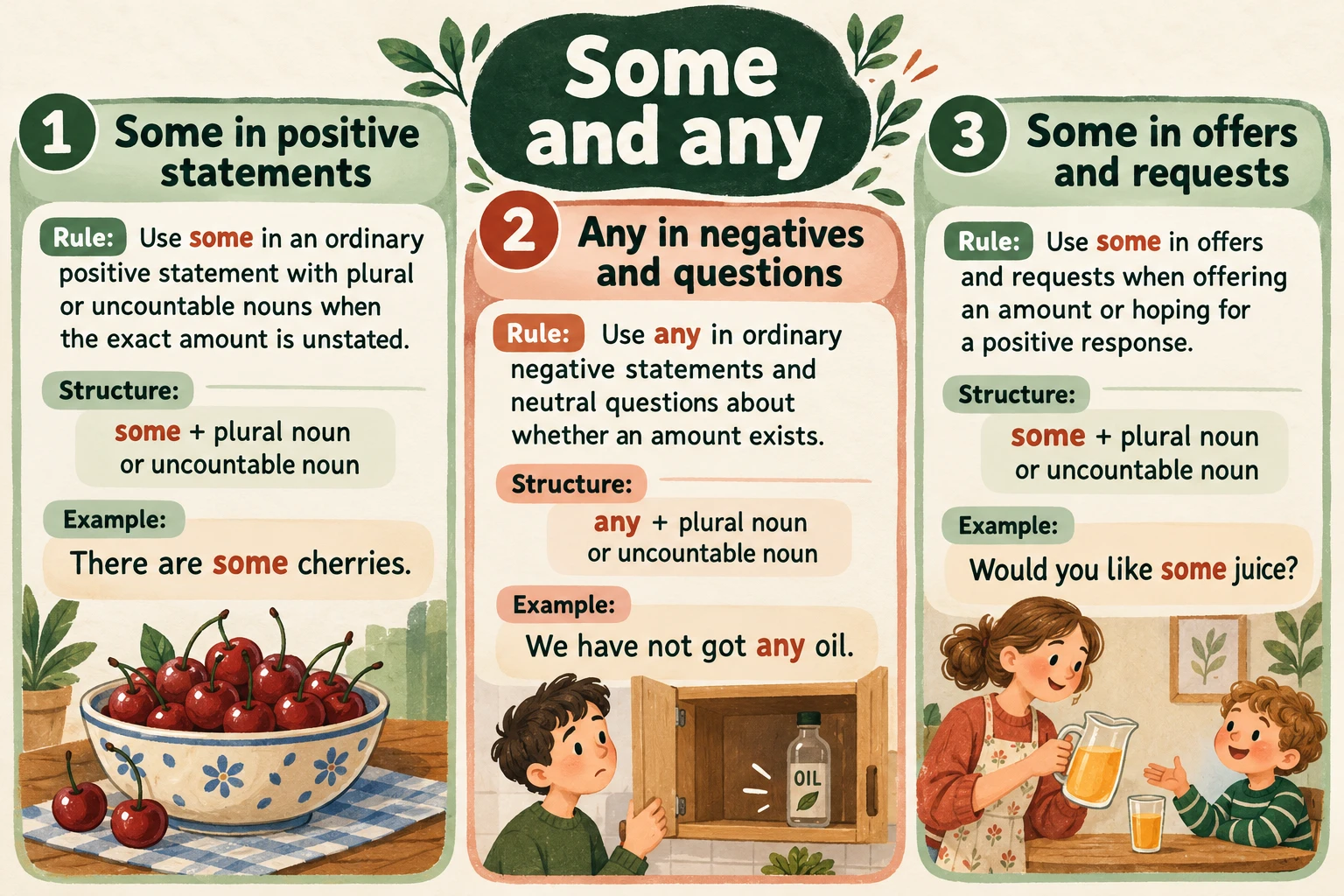
Use some in an ordinary positive statement with plural or uncountable nouns when the exact amount is unstated.
There are some cherries.Use any in ordinary negative statements and neutral questions about whether an amount exists.
We have not got any oil.Use some in offers and requests when offering an amount or hoping for a positive response.
Would you like some juice?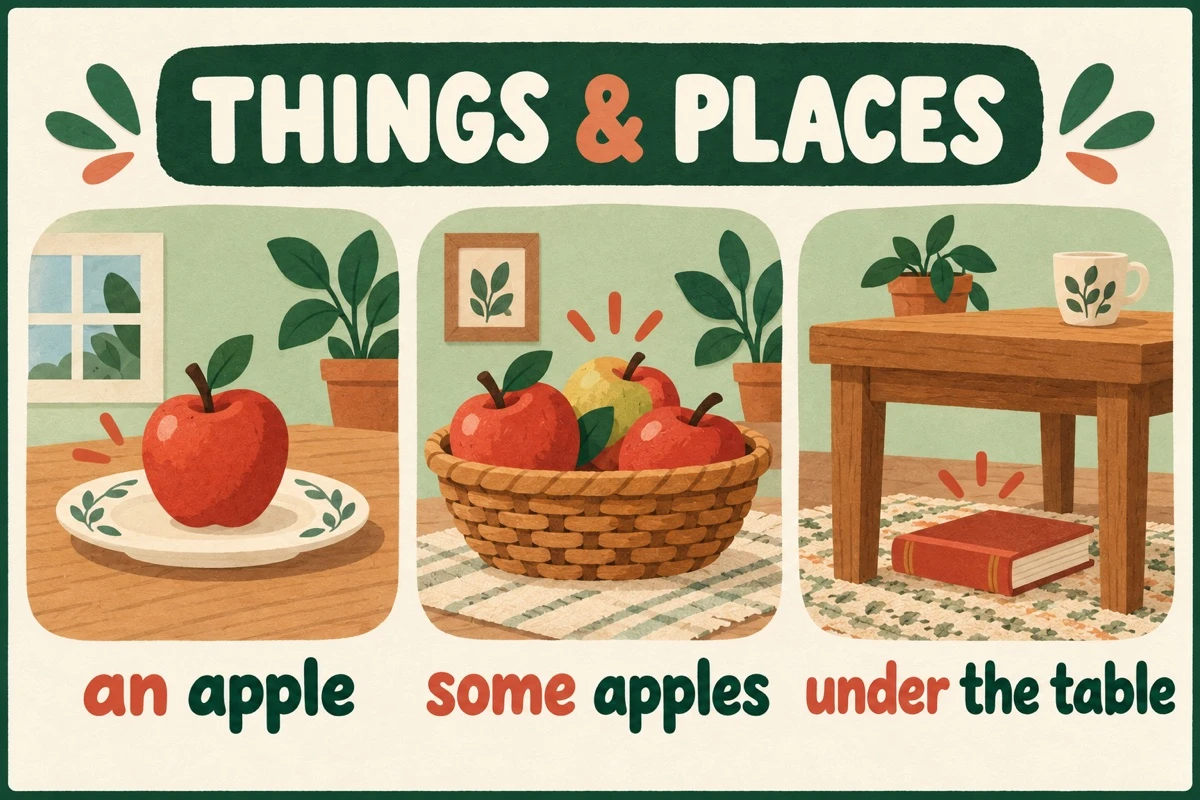
I bought ___ apples and put them in the bowl.
Use some in an ordinary positive statement with plural or uncountable nouns when the exact amount is unstated.
There are some cherries.Use any in ordinary negative statements and neutral questions about whether an amount exists.
We have not got any oil.Use some in offers and requests when offering an amount or hoping for a positive response.
Would you like some juice?Keep the first try. Understand the change. Check it in a fresh situation.
No practice notes yet. Try a short warm-up.
Use some in an ordinary positive statement with plural or uncountable nouns when the exact amount is unstated.
There are some cherries.Use any in ordinary negative statements and neutral questions about whether an amount exists.
We have not got any oil.Use some in offers and requests when offering an amount or hoping for a positive response.
Would you like some juice?Opening an answer records help for that question.
I bought ___ apples and put them in the bowl.
Look at “I bought ___ apples and put them in the bowl.”. Use some in an ordinary positive statement with plural or uncountable nouns when the exact amount is unstated. Complete sentence: “I bought some apples and put them in the bowl.”.
I cannot make tea. There is not ___ water.
Look at “I cannot make tea. There is not ___ water.”. Use any in ordinary negative statements and neutral questions about whether an amount exists. Complete sentence: “I cannot make tea. There is not any water.”.
The host is offering a portion of one sliced cake: Would you like ___ cake?
Look at “The host is offering a portion of one sliced cake: Would you like ___ cake?”. Use some in offers and requests when offering an amount or hoping for a positive response. Complete sentence: “The host is offering a portion of one sliced cake: Would you like some cake?”.
We have ___ fresh bread for lunch.
Reference completion: “We have some fresh bread for lunch.”. Use some in an ordinary positive statement with plural or uncountable nouns when the exact amount is unstated. Also accepted in this task: a small amount of / a lot of / plenty of / enough. These are reviewed alternatives, not an exhaustive list of all possible English.
Is there ___ sugar left in this bag? I have no idea whether any remains.
Look at “Is there ___ sugar left in this bag? I have no idea whether any remains.”. Use any in ordinary negative statements and neutral questions about whether an amount exists. Complete sentence: “Is there any sugar left in this bag? I have no idea whether any remains.”.
I am politely asking for an amount of water, not a serving in a café: Could I have ___ water, please?
Look at “I am politely asking for an amount of water, not a serving in a café: Could I have ___ water, please?”. Use some in offers and requests when offering an amount or hoping for a positive response. Complete sentence: “I am politely asking for an amount of water, not a serving in a café: Could I have some water, please?”.
There are ___ clean towels in the cupboard.
Reference completion: “There are some clean towels in the cupboard.”. Use some in an ordinary positive statement with plural or uncountable nouns when the exact amount is unstated. Also accepted in this task: a few / several / many / a lot of / plenty of / enough. These are reviewed alternatives, not an exhaustive list of all possible English.
The gardener planted ___ flowers beside the gate.
Look at “The gardener planted ___ flowers beside the gate.”. Use some in an ordinary positive statement with plural or uncountable nouns when the exact amount is unstated. Complete sentence: “The gardener planted some flowers beside the gate.”.
We did not see ___ birds on the lake.
Look at “We did not see ___ birds on the lake.”. Use any in ordinary negative statements and neutral questions about whether an amount exists. Complete sentence: “We did not see any birds on the lake.”.
I am offering to share: Would you like ___ grapes?
Reference completion: “I am offering to share: Would you like some grapes?”. Use some in offers and requests when offering an amount or hoping for a positive response. Also accepted in this task: a couple of. These are reviewed alternatives, not an exhaustive list of all possible English.
Do you have ___ spare batteries? I do not know if you do.
Look at “Do you have ___ spare batteries? I do not know if you do.”. Use any in ordinary negative statements and neutral questions about whether an amount exists. Complete sentence: “Do you have any spare batteries? I do not know if you do.”.
Complete with the some- word used in a polite request for an amount: May I have ___ soup, please?
Reference completion: “Complete with the some- word used in a polite request for an amount: May I have some soup, please?”. Use some in offers and requests when offering an amount or hoping for a positive response.