01statement word order inside an embedded question; omit question do-support
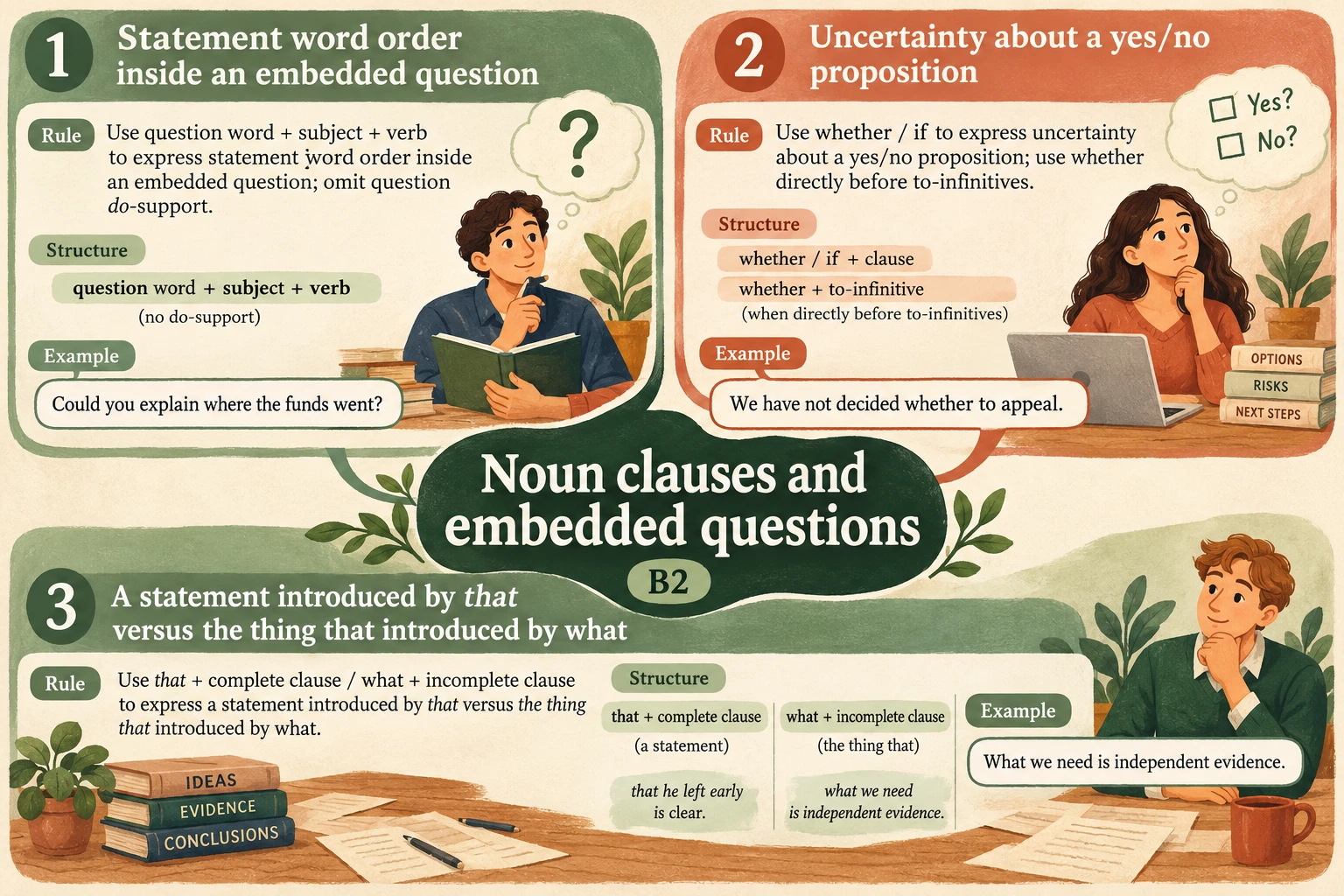
Use question word + subject + verb to express statement word order inside an embedded question; omit question do-support.
Could you explain where the funds went?
Noun clauses and embedded questions · B2. Use question word + subject + verb to express statement word order inside an embedded question; omit question do-support.
Complete 12 original tasks. Use the situation to choose the intended meaning, practise the form, then apply it in a fresh context.
Use question word + subject + verb to express statement word order inside an embedded question; omit question do-support.
Could you explain where the funds went?Use whether / if to express uncertainty about a yes/no proposition; use whether directly before to-infinitives.
We have not decided whether to appeal.Use that + complete clause / what + incomplete clause to express a statement introduced by that versus the thing that introduced by what.
What we need is independent evidence.
This is an embedded question, not a direct question.
Use question word + subject + verb to express statement word order inside an embedded question; omit question do-support.
Could you explain where the funds went?Use whether / if to express uncertainty about a yes/no proposition; use whether directly before to-infinitives.
We have not decided whether to appeal.Use that + complete clause / what + incomplete clause to express a statement introduced by that versus the thing that introduced by what.
What we need is independent evidence.Keep the first try. Understand the change. Check it in a fresh situation.
No practice notes yet. Try a short warm-up.
Use question word + subject + verb to express statement word order inside an embedded question; omit question do-support.
Could you explain where the funds went?Use whether / if to express uncertainty about a yes/no proposition; use whether directly before to-infinitives.
We have not decided whether to appeal.Use that + complete clause / what + incomplete clause to express a statement introduced by that versus the thing that introduced by what.
What we need is independent evidence.Opening an answer records help for that question.
This is an embedded question, not a direct question.
The deciding clue is “This is an embedded question, not a direct question.”. Use question word + subject + verb to express statement word order inside an embedded question; omit question do-support. In this task, the completed sentence is “Could you explain where the funds went?”.
Before a to-infinitive, select the appropriate yes/no linker.
The deciding clue is “Before a to-infinitive, select the appropriate yes/no linker.”. Use whether / if to express uncertainty about a yes/no proposition; use whether directly before to-infinitives. In this task, the completed sentence is “We have not decided whether to appeal.”.
The clause after the gap lacks the object of need.
The deciding clue is “The clause after the gap lacks the object of need.”. Use that + complete clause / what + incomplete clause to express a statement introduced by that versus the thing that introduced by what. In this task, the completed sentence is “What we need is independent evidence.”.
Keep statement order in an embedded question.
The deciding clue is “Keep statement order in an embedded question.”. Use question word + subject + verb to express statement word order inside an embedded question; omit question do-support. In this task, the completed sentence is “I wonder why the train left early.”.
Supply a yes/no-decision word directly before the to-infinitive.
Complete sentence: “She is considering whether to accept the offer.” Use whether / if to express uncertainty about a yes/no proposition; use whether directly before to-infinitives. The subject, time and meaning in the task determine this form. Only reviewed responses are matched automatically; other wording is not automatically wrong.
The clause is complete; it is a reported fact.
The deciding clue is “The clause is complete; it is a reported fact.”. Use that + complete clause / what + incomplete clause to express a statement introduced by that versus the thing that introduced by what. In this task, the completed sentence is “We know that the samples were contaminated.”.
Complete the embedded question using the subject the device and the present simple of work.
Complete sentence: “Please explain how the device works.” Use question word + subject + verb to express statement word order inside an embedded question; omit question do-support. The subject, time and meaning in the task determine this form. Only reviewed responses are matched automatically; other wording is not automatically wrong.
An embedded question keeps statement order.
The deciding clue is “An embedded question keeps statement order.”. Use question word + subject + verb to express statement word order inside an embedded question; omit question do-support. In this task, the completed sentence is “Nobody knows when the office will reopen.”.
Supply a yes/no-decision word directly before the to-infinitive.
Complete sentence: “I am unsure whether to disclose the result now.” Use whether / if to express uncertainty about a yes/no proposition; use whether directly before to-infinitives. The subject, time and meaning in the task determine this form. Only reviewed responses are matched automatically; other wording is not automatically wrong.
The gap means the thing that and supplies the object of said.
The deciding clue is “The gap means the thing that and supplies the object of said.”. Use that + complete clause / what + incomplete clause to express a statement introduced by that versus the thing that introduced by what. In this task, the completed sentence is “I disagree with what he said, not with his right to say it.”.
Choose the linker permitted immediately before to proceed.
The deciding clue is “Choose the linker permitted immediately before to proceed.”. Use whether / if to express uncertainty about a yes/no proposition; use whether directly before to-infinitives. In this task, the completed sentence is “The board must decide whether to proceed.”.
Supply the linker introducing the content of a fact before a complete clause.
Complete sentence: “The fact that nobody objected does not prove consent.” Use that + complete clause / what + incomplete clause to express a statement introduced by that versus the thing that introduced by what. The subject, time and meaning in the task determine this form. Only reviewed responses are matched automatically; other wording is not automatically wrong.