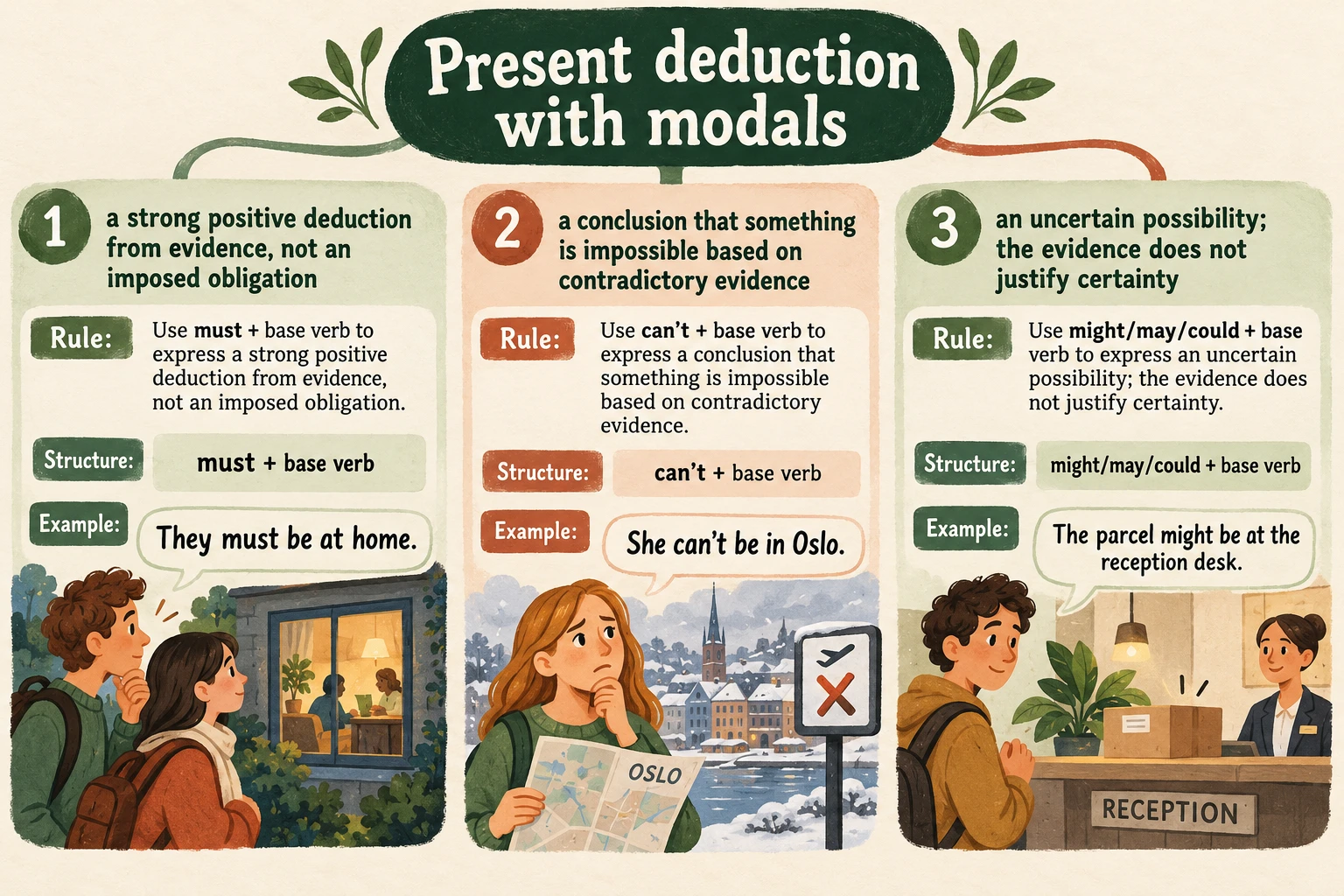
01a strong positive deduction from evidence, not an imposed obligation
Use must + base verb to express a strong positive deduction from evidence, not an imposed obligation.
They must be at home.
Present deduction with modals · B1. Use must + base verb to express a strong positive deduction from evidence, not an imposed obligation.
Complete 12 original tasks. Use the situation to choose the intended meaning, practise the form, then apply it in a fresh context.
Use must + base verb to express a strong positive deduction from evidence, not an imposed obligation.
They must be at home.Use can't + base verb to express a conclusion that something is impossible based on contradictory evidence.
She can’t be in Oslo.Use might/may/could + base verb to express an uncertain possibility; the evidence does not justify certainty.
The parcel might be at the reception desk.
All the lights are on and music is playing; make a strong positive deduction.
Use must + base verb to express a strong positive deduction from evidence, not an imposed obligation.
They must be at home.Use can't + base verb to express a conclusion that something is impossible based on contradictory evidence.
She can’t be in Oslo.Use might/may/could + base verb to express an uncertain possibility; the evidence does not justify certainty.
The parcel might be at the reception desk.Keep the first try. Understand the change. Check it in a fresh situation.
No practice notes yet. Try a short warm-up.
Use must + base verb to express a strong positive deduction from evidence, not an imposed obligation.
They must be at home.Use can't + base verb to express a conclusion that something is impossible based on contradictory evidence.
She can’t be in Oslo.Use might/may/could + base verb to express an uncertain possibility; the evidence does not justify certainty.
The parcel might be at the reception desk.Opening an answer records help for that question.
All the lights are on and music is playing; make a strong positive deduction.
Look at “They ___ be at home.”. Use must + base verb to express a strong positive deduction from evidence, not an imposed obligation. Complete sentence: “They must be at home.”.
I am speaking to her in Lisbon right now, so being in Oslo is impossible.
Look at “She ___ be in Oslo.”. Use can't + base verb to express a conclusion that something is impossible based on contradictory evidence. Complete sentence: “She can’t be in Oslo.”.
There is a possible explanation, but we have no confirmation.
Look at “The parcel ___ be at the reception desk.”. Use might/may/could + base verb to express an uncertain possibility; the evidence does not justify certainty. Complete sentence: “The parcel might be at the reception desk.”.
Fresh footprints lead from the only door; make a strong positive deduction.
Look at “Someone ___ be inside.”. Use must + base verb to express a strong positive deduction from evidence, not an imposed obligation. Complete sentence: “Someone must be inside.”.
The car is in the locked garage and I have the only key. Express a strong deduction that the car outside is not mine.
Complete sentence: “That car outside cannot be mine.” Use can't + base verb to express a conclusion that something is impossible based on contradictory evidence. The subject, time and meaning in the task determine this form. Only reviewed responses are matched automatically; other wording is not automatically wrong.
Express uncertain possibility; there is no decisive evidence.
Look at “The noise ___ be a loose window.”. Use might/may/could + base verb to express an uncertain possibility; the evidence does not justify certainty. Complete sentence: “The noise could be a loose window.”.
Express a strong positive deduction, not an order.
Complete sentence: “You ran twenty kilometres; you must be exhausted.” Use must + base verb to express a strong positive deduction from evidence, not an imposed obligation. The subject, time and meaning in the task determine this form. Only reviewed responses are matched automatically; other wording is not automatically wrong.
The label and sealed transparent packaging show that this is the correct part.
Look at “This ___ be the replacement we ordered.”. Use must + base verb to express a strong positive deduction from evidence, not an imposed obligation. Complete sentence: “This must be the replacement we ordered.”.
Express impossibility: this machine has no power supply.
Complete sentence: “It cannot be running now.” Use can't + base verb to express a conclusion that something is impossible based on contradictory evidence. The subject, time and meaning in the task determine this form. Only reviewed responses are matched automatically; other wording is not automatically wrong.
The office could be closed, but we do not know. Choose an uncertain modal.
Look at “The staff ___ be on a lunch break.”. Use might/may/could + base verb to express an uncertain possibility; the evidence does not justify certainty. Complete sentence: “The staff may be on a lunch break.”.
The witness is with us now, so being at the airport is impossible.
Look at “He ___ be at the airport.”. Use can't + base verb to express a conclusion that something is impossible based on contradictory evidence. Complete sentence: “He can’t be at the airport.”.
Keep the deduction uncertain rather than presenting it as established fact.
Complete sentence: “The unfamiliar caller might be a new client.” Use might/may/could + base verb to express an uncertain possibility; the evidence does not justify certainty. The subject, time and meaning in the task determine this form. Only reviewed responses are matched automatically; other wording is not automatically wrong.