01義務ではなく、根拠に基づく強い肯定の推量
must + base verb を用います。表す内容:義務ではなく、根拠に基づく強い肯定の推量。
They must be at home.
現在についての推量 · B1. must + base verb を用います。表す内容:義務ではなく、根拠に基づく強い肯定の推量。
12問のオリジナル問題です。状況から意味を読み取り、形を練習して、新しい場面で応用します。
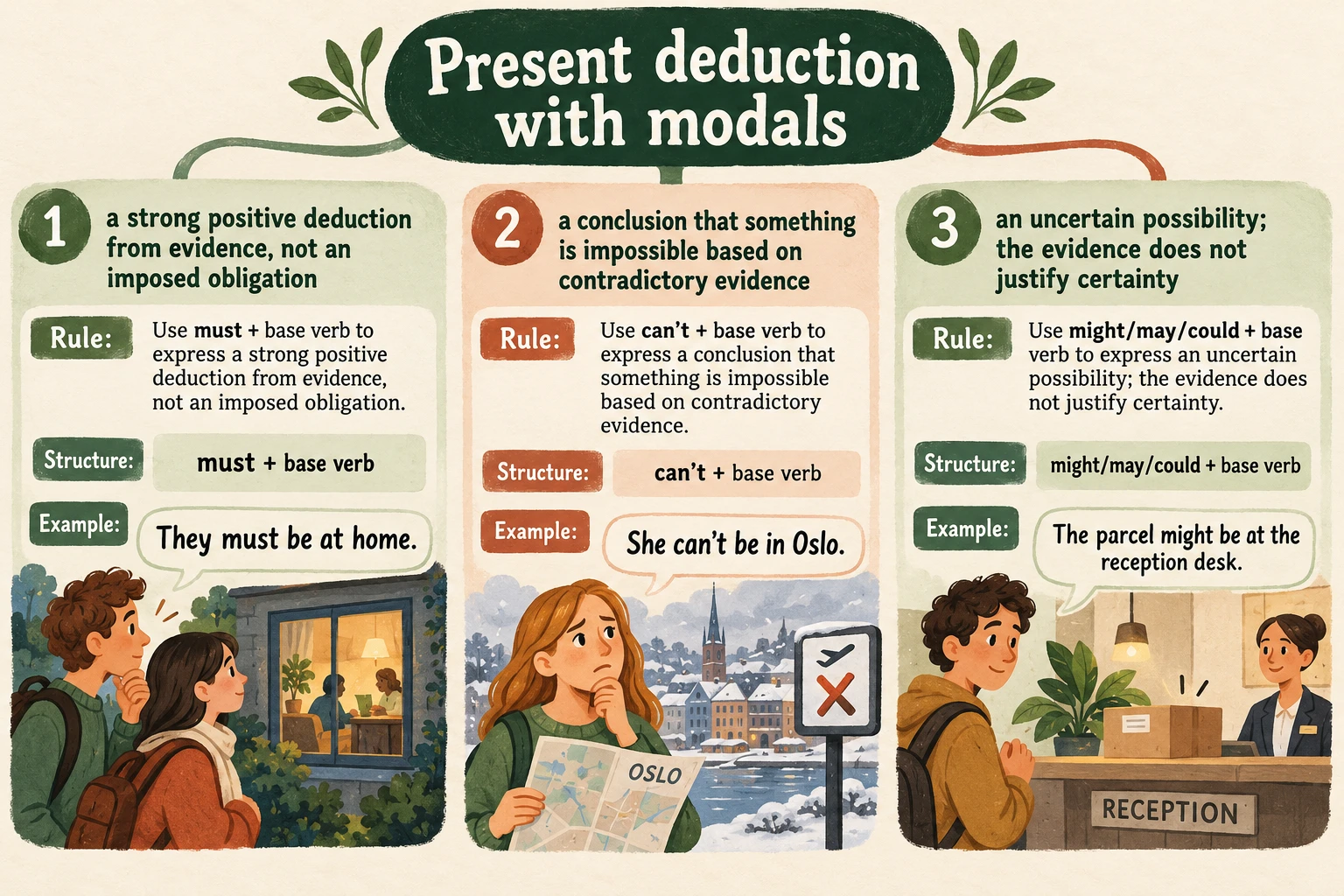
must + base verb を用います。表す内容:義務ではなく、根拠に基づく強い肯定の推量。
They must be at home.can't + base verb を用います。表す内容:矛盾する証拠から導く不可能という推量。
She can’t be in Oslo.might/may/could + base verb を用います。表す内容:確実だとは言えない証拠に基づく可能性。
The parcel might be at the reception desk.
All the lights are on and music is playing; make a strong positive deduction.
must + base verb を用います。表す内容:義務ではなく、根拠に基づく強い肯定の推量。
They must be at home.can't + base verb を用います。表す内容:矛盾する証拠から導く不可能という推量。
She can’t be in Oslo.might/may/could + base verb を用います。表す内容:確実だとは言えない証拠に基づく可能性。
The parcel might be at the reception desk.初回答を残し、変化の理由を理解して、別の場面で確かめます。
まだ復習ノートはありません。まずは短いウォームアップを。
must + base verb を用います。表す内容:義務ではなく、根拠に基づく強い肯定の推量。
They must be at home.can't + base verb を用います。表す内容:矛盾する証拠から導く不可能という推量。
She can’t be in Oslo.might/may/could + base verb を用います。表す内容:確実だとは言えない証拠に基づく可能性。
The parcel might be at the reception desk.解答を開くと、その問題にヒント利用が記録されます。
All the lights are on and music is playing; make a strong positive deduction.
「They ___ be at home.」に注目しましょう。must + base verb を用います。表す内容:義務ではなく、根拠に基づく強い肯定の推量。 完成文:「They must be at home.」。
I am speaking to her in Lisbon right now, so being in Oslo is impossible.
「She ___ be in Oslo.」に注目しましょう。can't + base verb を用います。表す内容:矛盾する証拠から導く不可能という推量。 完成文:「She can’t be in Oslo.」。
There is a possible explanation, but we have no confirmation.
「The parcel ___ be at the reception desk.」に注目しましょう。might/may/could + base verb を用います。表す内容:確実だとは言えない証拠に基づく可能性。 完成文:「The parcel might be at the reception desk.」。
Fresh footprints lead from the only door; make a strong positive deduction.
「Someone ___ be inside.」に注目しましょう。must + base verb を用います。表す内容:義務ではなく、根拠に基づく強い肯定の推量。 完成文:「Someone must be inside.」。
The car is in the locked garage and I have the only key. Express a strong deduction that the car outside is not mine.
完成文:「That car outside cannot be mine.」 can't + base verb を用います。表す内容:矛盾する証拠から導く不可能という推量。 問題の主語・時間・意味に合わせた形です。確認済みの解答だけを自動照合します。別の表現を自動的に誤りとはしません。
Express uncertain possibility; there is no decisive evidence.
「The noise ___ be a loose window.」に注目しましょう。might/may/could + base verb を用います。表す内容:確実だとは言えない証拠に基づく可能性。 完成文:「The noise could be a loose window.」。
Express a strong positive deduction, not an order.
完成文:「You ran twenty kilometres; you must be exhausted.」 must + base verb を用います。表す内容:義務ではなく、根拠に基づく強い肯定の推量。 問題の主語・時間・意味に合わせた形です。確認済みの解答だけを自動照合します。別の表現を自動的に誤りとはしません。
The label and sealed transparent packaging show that this is the correct part.
「This ___ be the replacement we ordered.」に注目しましょう。must + base verb を用います。表す内容:義務ではなく、根拠に基づく強い肯定の推量。 完成文:「This must be the replacement we ordered.」。
Express impossibility: this machine has no power supply.
完成文:「It cannot be running now.」 can't + base verb を用います。表す内容:矛盾する証拠から導く不可能という推量。 問題の主語・時間・意味に合わせた形です。確認済みの解答だけを自動照合します。別の表現を自動的に誤りとはしません。
The office could be closed, but we do not know. Choose an uncertain modal.
「The staff ___ be on a lunch break.」に注目しましょう。might/may/could + base verb を用います。表す内容:確実だとは言えない証拠に基づく可能性。 完成文:「The staff may be on a lunch break.」。
The witness is with us now, so being at the airport is impossible.
「He ___ be at the airport.」に注目しましょう。can't + base verb を用います。表す内容:矛盾する証拠から導く不可能という推量。 完成文:「He can’t be at the airport.」。
Keep the deduction uncertain rather than presenting it as established fact.
完成文:「The unfamiliar caller might be a new client.」 might/may/could + base verb を用います。表す内容:確実だとは言えない証拠に基づく可能性。 問題の主語・時間・意味に合わせた形です。確認済みの解答だけを自動照合します。別の表現を自動的に誤りとはしません。