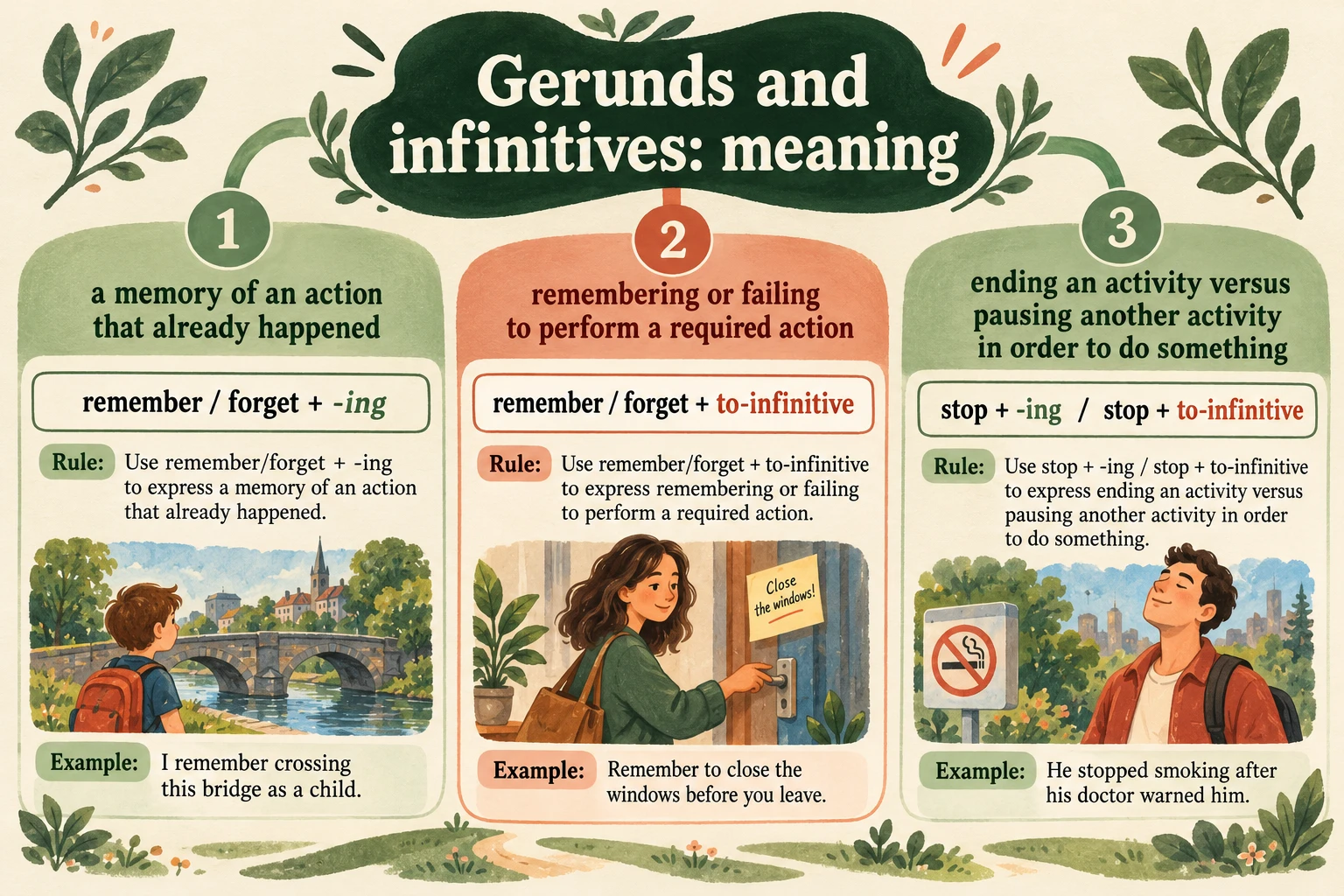
01a memory of an action that already happened
Use remember/forget + -ing to express a memory of an action that already happened.
I remember crossing this bridge as a child.
Gerunds and infinitives: meaning · B1. Use remember/forget + -ing to express a memory of an action that already happened.
Complete 12 original tasks. Use the situation to choose the intended meaning, practise the form, then apply it in a fresh context.
Use remember/forget + -ing to express a memory of an action that already happened.
I remember crossing this bridge as a child.Use remember/forget + to-infinitive to express remembering or failing to perform a required action.
Remember to close the windows before you leave.Use stop + -ing / stop + to-infinitive to express ending an activity versus pausing another activity in order to do something.
He stopped smoking after his doctor warned him.
I have a clear memory of an event that happened.
Use remember/forget + -ing to express a memory of an action that already happened.
I remember crossing this bridge as a child.Use remember/forget + to-infinitive to express remembering or failing to perform a required action.
Remember to close the windows before you leave.Use stop + -ing / stop + to-infinitive to express ending an activity versus pausing another activity in order to do something.
He stopped smoking after his doctor warned him.Keep the first try. Understand the change. Check it in a fresh situation.
No practice notes yet. Try a short warm-up.
Use remember/forget + -ing to express a memory of an action that already happened.
I remember crossing this bridge as a child.Use remember/forget + to-infinitive to express remembering or failing to perform a required action.
Remember to close the windows before you leave.Use stop + -ing / stop + to-infinitive to express ending an activity versus pausing another activity in order to do something.
He stopped smoking after his doctor warned him.Opening an answer records help for that question.
I have a clear memory of an event that happened.
Look at “I remember ___ this bridge as a child.”. Use remember/forget + -ing to express a memory of an action that already happened. Complete sentence: “I remember crossing this bridge as a child.”.
Do not fail to perform the duty before leaving.
Look at “Remember ___ the windows before you leave.”. Use remember/forget + to-infinitive to express remembering or failing to perform a required action. Complete sentence: “Remember to close the windows before you leave.”.
He ended the activity completely.
Look at “He stopped ___ after his doctor warned him.”. Use stop + -ing / stop + to-infinitive to express ending an activity versus pausing another activity in order to do something. Complete sentence: “He stopped smoking after his doctor warned him.”.
The concert is a remembered past experience.
Look at “I will never forget ___ that singer live.”. Use remember/forget + -ing to express a memory of an action that already happened. Complete sentence: “I will never forget hearing that singer live.”.
Complete with the correct form of send: the reminder concerns a task still to be done.
Complete sentence: “Please remember to send the confirmation tonight.” Use remember/forget + to-infinitive to express remembering or failing to perform a required action. The subject, time and meaning in the task determine this form. Only reviewed responses are matched automatically; other wording is not automatically wrong.
She paused her walk in order to consult the map.
Look at “She stopped ___ the map.”. Use stop + -ing / stop + to-infinitive to express ending an activity versus pausing another activity in order to do something. Complete sentence: “She stopped to check the map.”.
Complete with the correct form of meet to describe a memory of an earlier encounter.
Complete sentence: “I remember meeting her at a conference in 2019.” Use remember/forget + -ing to express a memory of an action that already happened. The subject, time and meaning in the task determine this form. Only reviewed responses are matched automatically; other wording is not automatically wrong.
The speaker recalls the actual experience of signing.
Look at “I remember ___ the agreement; the pen leaked.”. Use remember/forget + -ing to express a memory of an action that already happened. Complete sentence: “I remember signing the agreement; the pen leaked.”.
Complete with the correct form of lock for the duty he failed to perform.
Complete sentence: “He forgot to lock the cabinet, so it stayed open.” Use remember/forget + to-infinitive to express remembering or failing to perform a required action. The subject, time and meaning in the task determine this form. Only reviewed responses are matched automatically; other wording is not automatically wrong.
The machine ceased making the noise.
Look at “The machine stopped ___ when we replaced the fan.”. Use stop + -ing / stop + to-infinitive to express ending an activity versus pausing another activity in order to do something. Complete sentence: “The machine stopped rattling when we replaced the fan.”.
This is a reminder about a future action.
Look at “Do not forget ___ your passport tomorrow.”. Use remember/forget + to-infinitive to express remembering or failing to perform a required action. Complete sentence: “Do not forget to bring your passport tomorrow.”.
Complete with the correct form of answer: she paused her reading for the purpose of responding to the doorbell.
Complete sentence: “She stopped reading to answer the doorbell.” Use stop + -ing / stop + to-infinitive to express ending an activity versus pausing another activity in order to do something. The subject, time and meaning in the task determine this form. Only reviewed responses are matched automatically; other wording is not automatically wrong.